
ავიაკომპანიის პილოტის კარიერის ინფორმაცია


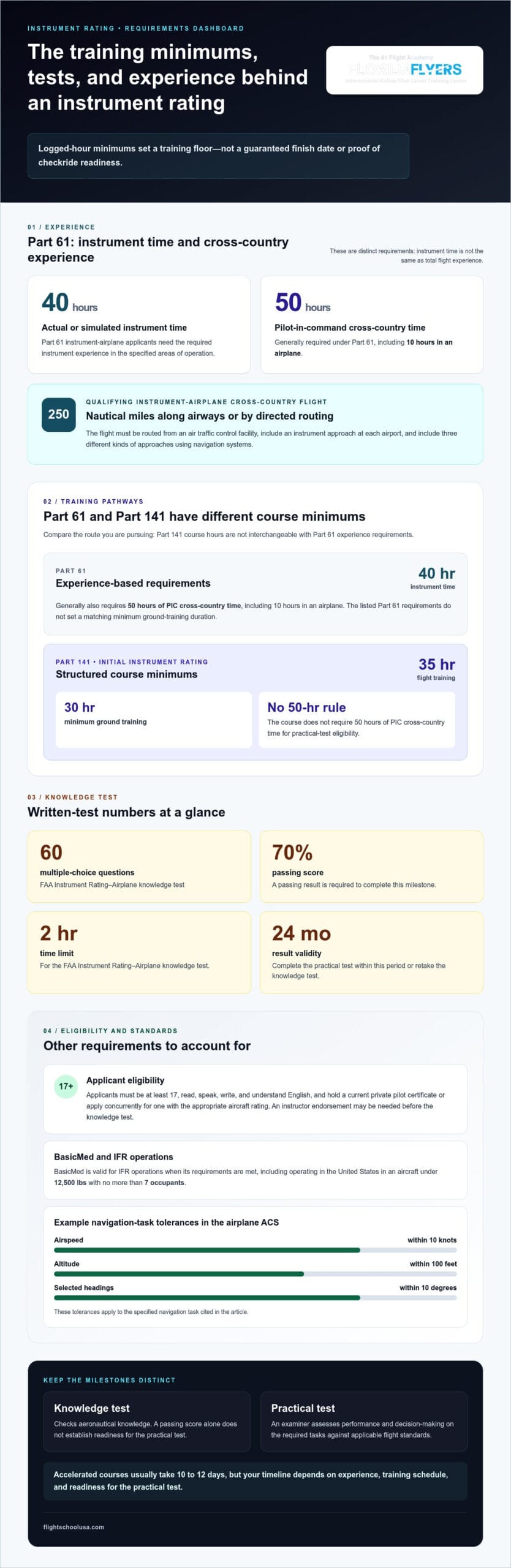
The instrument rating requirements set a training floor, not a guaranteed finish date: under Part 61, applicants need 40 hours of actual or simulated instrument time and generally 50 hours of pilot-in-command cross-country time. The Office of the Federal Register states the instrument-time requirement; Part 141 schools have a separate course minimum of 35 hours of flight training. Accelerated instrument-rating courses usually take 10 to 12 days, but the time you need depends on your experience, training schedule, and readiness for the practical test.
That distinction matters. Meeting the logged-hour minimum doesn’t automatically mean you’re prepared to fly to instrument standards or pass the checkride. This guide explains the FAA’s training, cross-country, instrument-time, knowledge-test, and currency rules, then shows what can speed up or extend the path. You’ll also see how Part 61 and Part 141 requirements differ, so you can estimate your next steps based on the route you’re pursuing and the experience you already have.
Aeronautical knowledge training prepares you to understand and apply instrument procedures before and during flight. In the United States, instrument rating requirements include structured ground study, a knowledge test, and preparation for the practical test.
In the United States, instrument-rating training costs depend on aircraft and instructor rates, the amount of flight and simulator training needed, and training frequency. The price depends on the case and is given after a quote request.
Ground training covers the knowledge needed to operate under instrument flight rules. It connects weather interpretation, regulations, navigation, flight planning, and instrument procedures with decisions made in the cockpit.
For an initial instrument rating through a Part 141 course, ground training requires at least 30 hours. Part 61 applicants also need to prepare for the knowledge test, but the listed requirements do not set a matching minimum ground-training duration for that route. In either pathway, study should connect procedures to practical situations, such as interpreting an instrument approach chart before flying the approach.
Build a structured study plan around the knowledge areas, then use practice questions to identify weak topics. For each missed question, review the underlying concept rather than memorizing only the correct option. A training device or simulator can reinforce how instrument procedures fit together, but it does not replace aeronautical knowledge study or required flight training.
Applicants should confirm whether an instructor endorsement is required before taking the written test. Treat that endorsement as a formal training step, not an administrative detail: it confirms preparation to take the test. An applicant must pass the required knowledge test, except a person who already holds an instrument rating does not need another knowledge test.
The instrument knowledge test evaluates whether you can apply aeronautical knowledge to instrument operations. The practical test assesses your performance and decision-making on the required tasks.
The FAA Instrument Rating-Airplane knowledge test contains 60 multiple-choice questions, requires a 70% passing score, and has a 2-hour time limit. A passing result remains valid for 24 months. Schedule the practical test within that validity period; otherwise, the knowledge test must be retaken before the rating can be completed.
Prepare for the test by reviewing regulations, weather, charts, navigation systems, and instrument procedures. Work through scenarios that require you to interpret information, select a procedure, and explain your decision. On test day, read each question carefully and distinguish similar terms, since a small difference in wording can change the correct answer.
The practical test is an examiner’s assessment of whether you meet the applicable flight standards. Passing the knowledge test alone does not establish readiness for the practical test. Review the required tasks with an instructor, including instrument procedures and the decisions that support safe flight. Treat the knowledge and practical tests as separate milestones, and plan for both.
Hour eligibility combines logged experience, aircraft-category prerequisites, and completed training. For an airplane rating, separate Part 61 experience requirements from Part 141 course minimums before planning the practical test.
Eligibility means meeting the certificate, age, language, knowledge-test, and instructor-endorsement conditions for an instrument rating. In the United States, applicants must be at least 17 years old, read, speak, write, and understand English, and hold a current private pilot certificate or apply concurrently for one with the appropriate aircraft rating. Applicants may need an instructor endorsement before taking the instrument knowledge test.
For medical eligibility, BasicMed is valid for IFR operations when pilots comply with its requirements, including operating in the United States in an aircraft under 12,500 lbs with no more than 7 occupants. Common checkride weaknesses include failing to maintain task standards, manage an approach, or make sound instrument-flight decisions. For example, the FAA Instrument Rating-Airplane ACS calls for airspeed within 10 knots, altitude within 100 feet, and selected headings within 10 degrees during its specified navigation task.
Part 61 and Part 141 are different regulatory training pathways, with distinct experience and course requirements. For a U.S. instrument-airplane rating, an applicant generally must log 50 hours of cross-country time as pilot in command, including 10 hours in an airplane, according to the Office of the Federal Register. The Part 141 course does not require 50 hours of cross-country pilot-in-command time for practical-test eligibility.
Under Part 61, applicants must also meet the instrument experience requirements in the specified areas of operation. The qualifying instrument-airplane cross-country training flight must cover 250 nautical miles along airways or by directed routing from an air traffic control facility, according to the Office of the Federal Register. It must include an instrument approach at each airport and three different kinds of approaches using navigation systems.
A Part 141 school must provide at least 35 hours of flight training for an initial instrument rating, according to the Office of the Federal Register. That course minimum is not interchangeable with Part 61’s experience criteria. Compare the pathway’s course structure with the flight time and cross-country experience already logged, then identify which requirements remain outstanding.
For planning, separate total experience from training specific to the instrument rating. Record each flight’s purpose, aircraft category, pilot-in-command status, and instrument conditions accurately; those distinctions determine whether time applies to a requirement. A structured flight training plan can help organize that review before practical-test preparation.
Instrument currency is the recent experience required to act as pilot in command under instrument flight rules. Part 61 sets a rolling approach requirement, while an instrument proficiency check provides a separate route for regaining currency when needed.
To remain instrument-current, a pilot must complete 6 instrument approaches within the preceding 6 calendar months of the flight. The approaches must fall within that look-back period. An instrument rating on a pilot certificate does not, by itself, satisfy this recent-experience requirement.
Use your logbook to track each approach and its date, so you can determine whether the required six fall within the relevant six-calendar-month period. If an earlier approach moves outside that period before a planned IFR flight, recount the remaining qualifying approaches. Check currency before each flight, not only when the rating is issued.
Currency and proficiency are related, but they answer different questions. Currency concerns the required recent approaches; proficiency concerns whether you can safely manage the flight’s demands. Even after logging the required approaches, you may need focused practice with procedures, aircraft control, or workload management before flying in actual instrument conditions.
An instrument proficiency check, or IPC, is an evaluation used to regain instrument currency when the recent-approach requirement is no longer met. The check must consist of at least 3 instrument approaches. A pilot who has been instrument-uncurrent for more than six months may need an IPC with a Certificated Instrument Flight Instructor to regain currency.
An IPC is not another knowledge test. It assesses practical instrument flying rather than written aeronautical knowledge. First identify weak areas, then use instruction and flight practice to address them before the evaluation. Approach setup, navigation, aircraft control, and decision-making all affect how well you manage an instrument flight.
Keep records that clearly distinguish instrument approaches from other flight activity. When reviewing your logbook, identify the approach dates, the relevant six-calendar-month period, and whether you have completed an IPC. This helps establish your current status before accepting an IFR assignment or planning a cross-country flight under instrument flight rules.
Build proficiency beyond the minimum currency threshold. A focused practice session can target a demanding procedure, while an instructor can assess how consistently you manage the aircraft and workload. Use actual instrument conditions only when appropriate for the flight and pilot; simulated practice can also help develop proficiency. The required six approaches establish currency, but sound preparation remains essential for safe instrument operations.
An instrument-powered-lift rating applies instrument-flight qualifications to the powered-lift aircraft category. Its cross-country experience requirement is distinct from airplane experience, so review logbook entries for each category separately.
For a U.S. instrument-powered-lift rating, an applicant generally must log 50 hours of cross-country time as pilot in command, including 10 hours in a powered-lift. The 10-hour component is part of the 50-hour total, not an additional amount. Track the total and category-specific time separately when reviewing eligibility.
Cross-country time describes flights between locations, while pilot-in-command status records the capacity in which you acted. For each logbook entry, note the aircraft category, route, and PIC role. An airplane flight may count toward a different experience record, but it does not replace the required powered-lift experience.
Build an experience audit before planning the remaining training. First, total cross-country entries flown as PIC. Next, identify how much of that total was in powered-lift aircraft. Then compare both figures with the 50-hour overall requirement and its 10-hour powered-lift portion. This method exposes a shortfall that a single undifferentiated “hours of cross-country” total could conceal.
The aircraft category matters even when two flights share a similar route. For example, a pilot with 50 cross-country PIC hours, but fewer than 10 in powered-lift, has not met the stated category-specific experience threshold. Conversely, reaching 10 powered-lift hours does not by itself satisfy the total if overall cross-country PIC time remains below 50 hours.
Keep powered-lift logbook entries legible and consistent. Record departure and destination airports, aircraft identification, flight duration, and PIC status as part of your usual logging process. When reviewing your records, reconcile the entries against category totals instead of relying on memory or rounded estimates. Clear records make it easier to identify the experience you still need.
Don’t treat airplane, helicopter, and powered-lift experience as interchangeable. The supplied powered-lift requirement specifies powered-lift time, while the instrument-airplane requirements use airplane time. A separate rule for an instrument-helicopter cross-country training flight calls for 100 nautical miles along airways or by directed routing from an air traffic control facility. That helicopter-specific distance should not be mistaken for the powered-lift PIC-hour requirement.
Ground planning can prevent avoidable gaps: review the logbook, sort entries by aircraft category, and calculate cross-country PIC totals before scheduling further flights. Then use the remaining gap in each category to guide the experience-building plan. For an applicant pursuing powered-lift privileges, the decisive check is both totals: 50 cross-country PIC hours overall and 10 powered-lift hours within them.
Instrument time is logged practice under actual or simulated instrument conditions in specified areas of operation. Under 14 CFR 61.65, an instrument rating applicant must log 40 hours of actual or simulated instrument time in the specified areas of operation, according to the Office of the Federal Register.
Actual instrument time is experience gained while operating by reference to instruments in actual instrument conditions. Simulated instrument time involves practice in simulated conditions, such as using a view-limiting device with an instructor or operating an approved training device. Both may count toward the experience requirement when logged properly and within applicable credit limits.
Instructor qualifications matter. Of the instrument time for a U.S. instrument-airplane rating, at least 15 hours must be received from an authorized instructor who holds an instrument-airplane rating, according to the Office of the Federal Register. Record the instructor’s credentials and the training received, rather than relying only on a total-hours figure.
Aviation training devices can supplement aircraft instruction, but their credits have limits. A U.S. applicant may credit a maximum of 10 hours of instrument time received in a basic aviation training device toward the instrument time requirements, according to the Office of the Federal Register. Under Part 61, up to 20 hours in an Advanced Aviation Training Device may count toward the experience requirements.
Device allowances also depend on how training is conducted. Except for the Part 142 simulator allowance, no more than 20 total hours may be credited across simulators, flight training devices, aviation training devices, or a combination. For instrument time completed under Part 142, up to 30 hours in a full flight simulator or flight training device may count. Keep device type and training basis distinct in the logbook.
Cross-country experience is separate from the 40-hour instrument-time total. For an instrument-airplane rating, the required IFR cross-country training flight must cover 250 nautical miles along airways or by directed routing from an air traffic control facility, according to the Office of the Federal Register. The flight must include an instrument approach at each airport and three different kinds of approaches using navigation systems.
Organize records by aircraft flight, simulator session, training device, instructor, and completed procedure. This makes it easier to identify which time applies and whether each approach or task is documented. A private pilot certificate and aeronautical knowledge preparation address separate eligibility areas; neither replaces logged instrument experience. English-language ability is also an applicant requirement, not a credit toward instrument hours.
For structured practice that aligns aircraft and device sessions with instrument procedures, plan instrument flight training around the experience still needed.
Flight School USA offers a Fixed-Price Career Program for aspiring pilots pursuing a professional aviation career. Once you have reviewed the instrument experience, knowledge, and proficiency standards, consider how the rating fits your broader training goals. Map the remaining requirements against the certificates and training you plan to pursue, rather than treating the instrument rating as an isolated milestone.
Flight School USA also offers a CFI Fast Track Program, GI Bill Flight Training, M1 Visa Admission Services, and an Airline Ready Program. These options address different career stages and student circumstances. If you’re ready to discuss your flight-training goals and possible next steps, contact Flight School USA.
Connect the instrument rating requirements to the pilot career you’re building. Decide where the rating fits in your training sequence, then identify the experience and preparation you still need. A clear plan ties each training decision to your intended progression, rather than treating each certificate as a separate destination.
Flight School USA offers a Fixed-Price Career Program for career-focused training, a CFI Fast Track Program, and GI Bill Flight Training. These programs address different goals and circumstances, so consider which best aligns with your next stage. Contact Flight School USA to discuss how your training objectives fit these programs.
დაუკავშირდით აშშ-ის ფრენის სკოლას to discuss your aviation goals and next steps. Continue with discipline, and make each flight count toward the pilot you intend to become.
An accelerated instrument-rating course usually takes 10 to 12 days, but your actual timeline depends on training frequency, weather, aircraft access, and readiness for the practical test. A concentrated schedule can reduce gaps between lessons, while interrupted training may require extra review and practice. Your starting experience and ability to meet each flight standard also affect the pace. Plan around demonstrated proficiency, not just a target calendar date.
Part 61 offers a training pathway built around meeting applicable experience and endorsement requirements; Part 141 follows an approved, structured course. Compare how each route treats your logged experience, course progression, and remaining flight training. For example, a pilot with substantial cross-country PIC time may weigh that differently than someone starting within a school’s course structure. The best fit depends on your records, training preferences, and career plan.
The practical test evaluates whether you can perform the required instrument tasks to FAA standards, not simply recall procedures. The FAA Instrument Rating-Airplane ACS includes navigation, emergency-operation, and instrument-approach tasks. For example, one navigation task specifies airspeed within 10 knots, altitude within 100 feet, and selected headings within 10 degrees. The approach tasks also assess guidance tracking and adherence to applicable minimums.
For an airplane instrument rating, applicants need the appropriate pilot certificate, required aeronautical knowledge and endorsements, qualifying flight experience, and a passing practical test. Applicants must be at least 17 years old and able to read, speak, write, and understand English. Before scheduling the checkride, organize your logbook by aircraft category, cross-country PIC time, instructor training, and actual or simulated instrument experience to identify any remaining eligibility gaps.
Under 14 CFR 61.65, applicants must log 40 hours of actual or simulated instrument time in specified areas of operation. For an instrument-airplane rating, the general cross-country requirement is 50 hours as pilot in command, including 10 hours in an airplane. These are separate experience categories, so don’t treat cross-country PIC time as a substitute for instrument time. Review each logbook entry for its applicable category and purpose.
The FAA Instrument Rating-Airplane knowledge test has 60 multiple-choice questions, a 70% passing score, and a 2-hour time limit. Under Part 61, applicants need an instructor endorsement before taking the test. A passing result is valid for 24 months, so align test preparation with practical-test planning. After practice exams, review each missed topic and explain the underlying rule or instrument procedure in your own words.
The practical test checks performance against the FAA Instrument Rating-Airplane ACS, including required instrument tasks and decision-making. For a specified approach task, vertical and lateral guidance must remain within ¾-scale on the final approach segment. A specified nonprecision approach task calls for altitude, if applicable, to remain above MDA +100/-0 feet to the visual descent point or missed approach. Prepare by practicing each ACS task and reviewing its tolerances.
Part 141 requires at least 35 hours of flight training for an initial instrument rating, while Part 61 uses experience requirements that include 40 hours of actual or simulated instrument time. Part 141 practical-test eligibility does not require the 50 hours of cross-country PIC time applicable under Part 61. Compare your existing logbook against the chosen pathway before training, especially if you have accumulated experience outside a structured course.