A flight school’s authority to issue your I-20 is a critical starting point for M-1 visa flight training. The program must be an eligible FAA Part 141 or Part 142 program listed on the Student and Exchange Visitor Program’s Form I-17; a school’s training quality alone doesn’t establish that eligibility.
Choosing a school is only the first step. You’ll also need to prepare the required documents, complete the student visa application, and plan around your program start date and consular interview. Missing a requirement or leaving too little time for processing can disrupt your training plans.
This guide explains how to assess a school’s M-1 eligibility, what to prepare for your I-20 and visa application, and how the interview and timing fit into the process. You’ll come away with a clear sequence for organizing your application and understanding the decisions that matter before you travel to the United States.
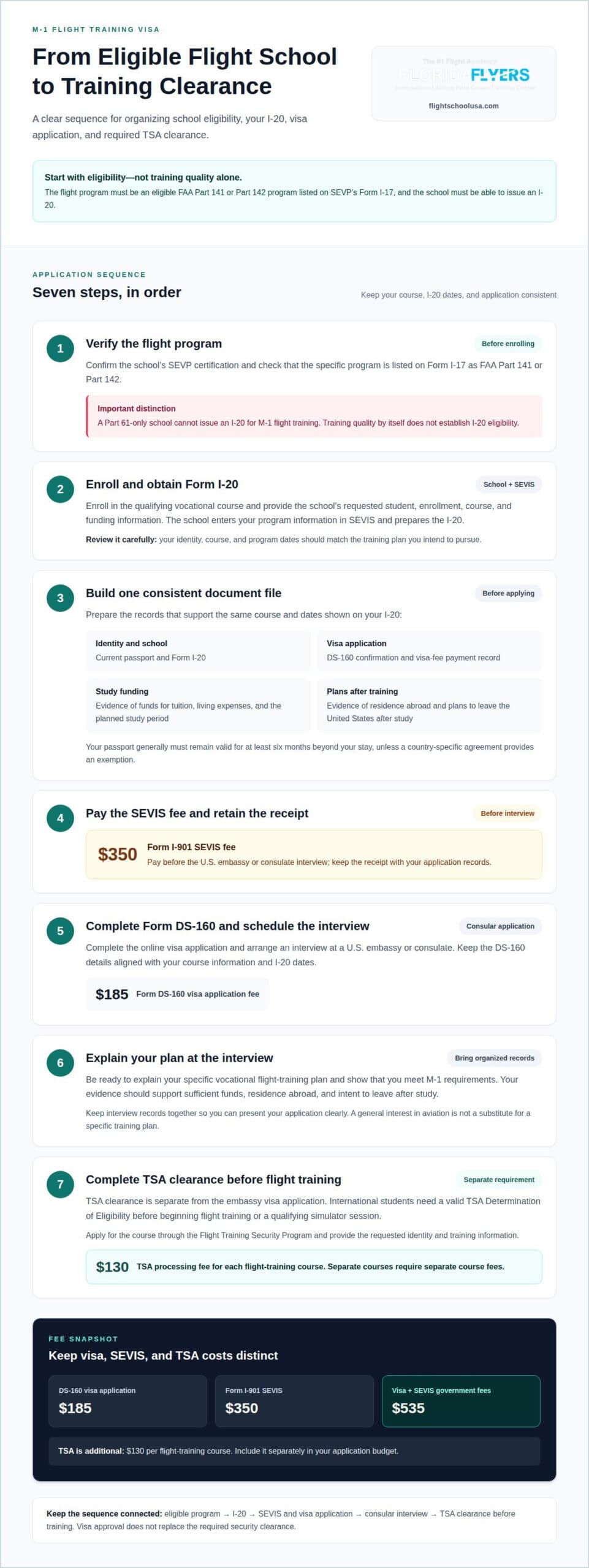
The M-1 process links flight-school enrollment, the I-20, TSA clearance, and a consular visa application. Keep those steps in sequence: a visa approval alone does not replace required security clearance before flight training.
Start by enrolling in an eligible vocational flight-training program and obtaining Form I-20. Next, pay the SEVIS I-901 fee, complete Form DS-160, and schedule an interview at a U.S. embassy or consulate. At the interview, explain your training plan and show that you meet M-1 requirements, including sufficient funds and intent to leave after study.
F-1 and M-1 applicants both follow a student-visa application process, but the appropriate classification depends on the program. An M-1 applicant should keep the course details, I-20 dates, and visa application consistent.
Prepare a current passport, Form I-20, DS-160 confirmation, and records showing payment of the visa and SEVIS fees. Bring evidence of sufficient funds for tuition, living expenses, and the planned period of study. These documents should support the same course and dates shown on your I-20.
Also organize evidence of your residence abroad and plans to leave the United States after training. Your passport generally must remain valid for at least six months beyond your stay, unless a country-specific agreement provides an exemption. Keep your interview records together so you can present your application materials clearly.
TSA clearance is separate from the embassy visa application. International students must receive a valid TSA Determination of Eligibility before beginning flight training or a qualifying simulator session. Apply for your course through the Flight Training Security Program and provide the requested identity and training information.
The TSA processing fee is $130 for each flight-training course. For example, a student applying for separate courses should account for each course’s processing fee, rather than treating TSA clearance as one general visa charge.
The Form DS-160 visa application fee is $185, and the Form I-901 SEVIS fee is $350. Together, the mandatory U.S. government fees for the visa application and SEVIS are $535. The TSA processing fee is separate, so include it independently in your application budget.
Pay the SEVIS fee before the embassy interview and retain the receipt with your DS-160 confirmation. At the interview, be ready to explain how your funds cover the program and how your residence abroad, study purpose, and post-training plans satisfy M-1 requirements. A complete, consistent file helps officers assess the application efficiently.
For M-1 flight training, the program must be an FAA Part 141 or Part 142 program listed on SEVP’s Form I-17. Your application should also demonstrate a vocational study purpose, sufficient funds, residence abroad, and plans to leave after training.
Check the school’s SEVP certification and the program’s listing on Form I-17 before enrolling. Eligible flight training must fall under an FAA Part 141 or Part 142 program; a Part 61-only school cannot issue an I-20 for M-1 flight training. After enrollment, the school enters the student’s program information in SEVIS as part of preparing the I-20.
M-1 students may transfer schools only within the first 6 months after arrival, with USCIS approval. Transfers and extensions may require additional steps, and M-1 students have limited options for changing status while in the United States.
An I-20 comes from the eligible school after enrollment in a qualifying course. To obtain one, submit the school’s enrollment materials and information needed to document your identity, course selection, and ability to fund the training. Review the I-20 carefully: its program and dates should match the flight course you intend to pursue.
Keep the I-20 with your visa application records. The document connects your school’s SEVIS record to your requested M-1 classification, so inconsistencies in your name, course, or study dates can complicate the application. A commercial pilot career goal should be supported by a specific vocational flight-training plan, not a general interest in aviation.
What flight training programs qualify for an M-1 student visa? FAA Part 141 or Part 142 flight-training programs listed on SEVP’s Form I-17 may qualify. The school must be SEVP-certified and able to issue an I-20 for the enrolled course.
How do you get an I-20 from an FAA-approved flight school? Enroll in an eligible program and provide the school with its requested enrollment and student information. The school uses the course details to issue the I-20 through its SEVIS process.
What are common reasons M-1 flight training visa applications are denied? Applications may be weakened when students cannot show sufficient funds, a residence abroad they do not intend to abandon, or an intention to leave after study. Inconsistent course details between the I-20 and visa application can also make the study plan harder to assess.
Can M-1 students change schools, extend their stay, or change visa status? A school transfer is limited to the first 6 months after arrival and requires USCIS approval through Form I-539. Extensions also require USCIS approval, and students cannot change from M-1 to F-1 status inside the United States.
Iji M-1 admission support to organize school eligibility and the I-20 process around your flight-training plan.
Plan the embassy interview around your I-20 program dates, not just your intended travel date. Visa issuance and permission to enter the United States follow separate timing rules.
Complete Form DS-160, pay the required fees, then arrange an interview with a U.S. embassy or consulate. Appointment timing depends on the post handling your application, so build the interview into your preparation sequence instead of leaving it until travel is near. Bring paperwork that supports the same course, school, and dates shown on your I-20.
Applicants are instructed to pay the $350 Form I-901 fee before their U.S. embassy interview, according to U.S. Immigration and Customs Enforcement. Keep the payment record with your interview documents. A receipt helps connect the SEVIS payment to your student visa application and gives you a clear record to present if requested.
Use the interview to explain your vocational study plan and answer questions consistently with your submitted forms. Your course, funding evidence, and intended stay should align across the DS-160 and I-20. If an interview is rescheduled, update your travel planning around the new appointment rather than assuming the original date still governs your application.
Before attending, organize the passport, DS-160 confirmation, I-20, fee records, and supporting evidence in one folder. Review names and program dates across each document. A mismatch can create questions during the interview or delay the next step, so resolve clerical errors before presenting the paperwork.
New F-1 and M-1 student visas for U.S. flight training may be issued up to 365 days before the program start date. That issuance window lets students seek a visa well ahead of training, but it does not authorize early arrival for any date they choose. Keep the visa validity and I-20 start date distinct in your travel plan.
F-1 and M-1 students cannot enter the United States more than 30 days before the start date on Form I-20, according to U.S. Customs and Border Protection. For example, if your program begins on the date printed on your I-20, calculate your earliest permitted arrival from that date, not from the interview or visa issuance date.
After the embassy issues the student visa, compare its validity with the I-20 dates before booking travel. A visa allows you to seek admission at a U.S. port of entry; it does not replace the program document or remove the 30-day entry limit. Carry your passport and I-20 for inspection when you travel.
Keep flight reservations flexible until the visa is issued and the entry window fits your arrival plan. If the consular appointment moves, reassess the travel date against the I-20 start date and the 30-day rule. This separates the timing of the visa decision from the timing of lawful arrival for study.
Prepare a consistent file for your U.S. consulate interview, including your identity, course details, finances, and plans after study. The interview assesses whether your documents support the same vocational training purpose.
How much does flight training in the U.S. cost for international students? The cost depends on the course, training plan, aircraft, and required flight time, and is provided after a quote request. Build your financial evidence around the full program and related living expenses, not tuition alone.
Arrange these core records before your embassy appointment:
Keep the documents aligned. For example, the flight course described in your interview answers should match the program on Form I-20 and the study purpose in your DS-160. If a family member or other sponsor will fund your aviation training, organize records that show the source and availability of that support. Explain any differences between the sponsor’s documents and your own financial records clearly.
Your financial documents should show how you can pay for the program throughout the stated study period. Consider tuition, flight-training expenses, and living costs together. A bank record that shows funds without explaining their source may prompt questions, so include relevant supporting documents when available. Demonstrate sufficient resources for the course without relying on unauthorized U.S. employment.
At the consulate, answer directly and consistently. Be prepared to explain why you selected the course, how it supports your pilot career objective, and what you intend to do after completing the training. Your academic history can help explain a change in direction, while a clear account of the vocational course connects that history to your current plan. Keep your answers factual and consistent with your paperwork.
Before the interview, review names, dates, and school details across the passport, I-20, and DS-160. Place the originals and supporting copies in an orderly folder, then rehearse a concise explanation of your course and funding. This preparation helps you present a coherent application rather than searching through documents while answering the consular officer.
An M-1 flight program must meet both immigration-school and aviation-training requirements. Confirm the program’s SEVP listing and FAA status before treating enrollment as a route to an I-20.
For M-1 flight training, an eligible program must be FAA Part 141 or Part 142 and listed on the Student and Exchange Visitor Program’s Form I-17. A flight school with only FAA Part 61 status cannot issue an I-20 for an M-1 flight-training program under the SEVP guidance described here. FAA approval alone is not enough; the program must also meet the SEVP requirement.
Form I-20 connects your enrollment to the school’s SEVIS record. Confirm that the document identifies the vocational flight program you intend to take and that its program dates match your enrollment plans. Keep your passport information consistent with your school and immigration paperwork, including your legal name and identifying details.
Training authorization is a separate requirement. International flight students must receive TSA Flight Training Security Program approval before their first training flight or qualifying simulator session. TSA clearance is also required before training toward a type rating, instrument rating, or multi-engine rating. Do not treat an issued I-20 or student visa as a substitute for TSA approval.
TSA clearance applies to the training course, so keep the course information accurate throughout the application. If your planned course includes instrument training, for example, make sure your TSA application reflects the applicable training. A change to the planned course can affect the clearance process, so align the school’s course details with your TSA submission.
M-1 status is designed for vocational study, including eligible flight-training programs. The M-1 visa is typically valid for the duration of the vocational training program, up to 12 months, and may be extended to a maximum of 3 years in some cases. An M-1 student seeking an extension of the fixed admission period needs USCIS approval. Build your program plan around the I-20 dates and required training, rather than assuming extra time is automatic.
English proficiency also matters in aviation training. Foreign pilots seeking FAA license conversion should meet the ICAO Level 4 English proficiency standard referenced in FAA guidance. This is an international operational standard, distinct from SEVP school eligibility and TSA security clearance.
Before enrollment, compare the school’s official SEVP listing, FAA program status, I-20 course details, and TSA requirements. For help organizing the admission steps around an eligible flight program, use M-1 flight training admission support.
Flight School USA offers M1 Visa Admission Services for international students planning U.S. flight training. Turn to this support when you’re matching a vocational program with the admissions and visa steps, including the school enrollment and I-20 process.
For students pursuing a professional pilot career, Flight School USA offers the Fixed-Price Career Program, CFI Fast Track Program, GI Bill Flight Training, and Airline Ready Program. Choose your next step based on your training goals and eligibility, and keep your visa plan aligned with the program you intend to pursue.
Contact Flight School USA or visit flightschoolusa.com to discuss your training and admission plans.
Your next move is to connect your aviation goal to a training pathway and an admissions plan. A disciplined M-1 visa flight training plan starts with a defined course objective, then keeps enrollment, documentation, and preparation aligned with that objective.
Flight School USA offers the Fixed-Price Career Program, CFI Fast Track Program, and GI Bill Flight Training for students pursuing different pilot pathways. Consider which direction fits your career aims, then address the M-1 admission process as part of your training preparation. A focused plan helps you approach each decision with purpose rather than treating paperwork as a last-minute task.
For guidance on the next step, kpọtụrụ Ụlọ Akwụkwọ Ụgbọelu USA to discuss your training and admission plans. Bring your intended course and goals into that conversation, and move forward with a clear direction for your aviation future.
Choose a school with an eligible flight program and the authority to issue Form I-20. For M-1 visa flight training, the program must be FAA Part 141 or Part 142 and listed on SEVP’s Form I-17. Compare the program’s course sequence with your pilot career objective, then confirm that the school’s enrollment documents describe the same training plan you intend to present in your visa application.
Apply in a sequence that keeps school enrollment and visa paperwork aligned. First, enroll in an eligible vocational flight program and obtain Form I-20. Then pay the SEVIS I-901 fee, complete Form DS-160, and schedule a consular interview. Prepare evidence of funds, residence abroad, and your intention to leave after study. Separately, complete the TSA Flight Training Security Program process before beginning covered flight or simulator training.
Personal travel must fit your school’s program schedule and cannot extend your authorized M-1 stay. Plan any break with your school so it does not disrupt required training or your SEVIS record. If your plans affect the program dates or require more time in the United States, an extension of the fixed admission period requires USCIS approval. A vacation itself does not change your immigration status or program end date.
Qualifying spouses and dependents may join an M-1 student in the United States in M-2 status. Eligible dependents include a spouse and unmarried children under 21. Plan their applications alongside your student paperwork, using consistent identity and relationship records. Their presence does not change the M-1 student’s course requirements or extend the student’s program dates, so coordinate family travel with the I-20 schedule.
Yes, eligible vocational flight training can support an M-1 student visa application in the United States. The training program must meet the applicable school and SEVP requirements, and the applicant must establish a genuine study purpose. For example, an enrolled student pursuing a defined pilot-training course should ensure the I-20, course details, and visa application describe a consistent plan.
You need enrollment in an eligible vocational program, an I-20 from the school, and a completed student visa application. Applicants must show a residence abroad they do not immediately intend to abandon, plans to leave the United States after study, and sufficient funds. Prepare to explain how the specific flight course supports your training objective, rather than relying only on a broad interest in aviation.
Prepare your passport, Form I-20, DS-160 confirmation, SEVIS payment record, and evidence supporting your funding and study plans. The Form DS-160 fee is $185, and the Form I-901 SEVIS fee is $350; U.S. Immigration and Customs Enforcement instructs applicants to pay the I-901 fee before the embassy interview. TSA processing is separate and costs $130 for each flight-training course.
The M-1 visa is typically valid for the vocational program’s duration, up to 12 months, and may be extended to a maximum of 3 years in some cases. The authorized stay follows the fixed admission period, so use the I-20 program dates to plan training and departure. An extension requires USCIS approval; do not assume unfinished training automatically extends your stay.


