

In 2026, your career velocity is determined less by natural talent and more by the structural integrity of your training institution. Selecting a flight academy is a strategic capital investment where training standards and financial transparency dictate your professional future. You likely feel the weight of this decision; the fear of hidden costs and the confusion between Part 61 and Part 141 regulations are valid concerns for any serious candidate. Understanding how to choose a flight academy is the first high-stakes maneuver of your aviation career.
You deserve a clear roadmap to your commercial pilot license that eliminates the anxiety of job placement and training delays. This guide provides the master criteria for selecting an elite academy that aligns with your objectives and maximizes your return on investment. We will analyze the regulatory frameworks governing modern flight training, establish a path toward seamless airline employment, and demonstrate how fixed-price transparency secures your financial standing. By the end of this analysis, you’ll possess the precise knowledge required to navigate the transition from student to professional aviator with absolute certainty.
Determining your end-state is the first critical decision in the process of how to choose a flight academy. If your objective is commercial aviation, treating your training as a casual hobby is a significant liability. There’s a fundamental divide between recreational flight and the rigors of a professional career track. While private ownership might allow for the flexibility of FAA Part 61 regulations, an airline career demands the structured environment of a Part 141 institution. This distinction isn’t merely administrative; it’s a matter of career velocity and professional standards. The hobbyist approach fails because it lacks the accountability and standardized metrics required by Part 121 air carriers.
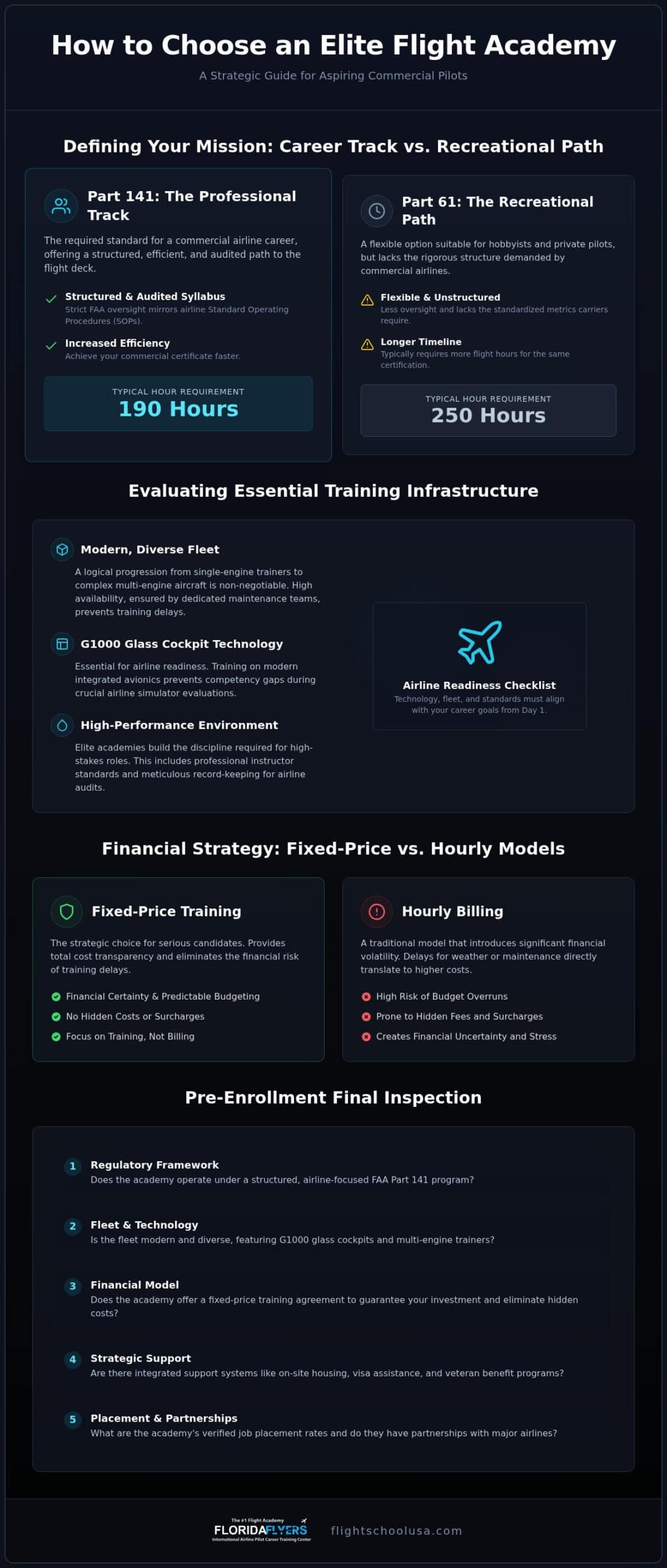
Part 141 academies operate under strict FAA oversight, requiring a meticulously structured syllabus that ensures every hour in the cockpit serves a specific training objective. This environment mirrors the Standard Operating Procedures (SOPs) found in major airline flight decks. For those seeking a comprehensive guide to flight training, the most significant advantage is the efficiency of the curriculum. Under Part 141, the hour requirements for a commercial certificate are often reduced to 190 hours compared to the 250 hours required under Part 61. This allows you to reach the flight deck sooner while adhering to a more rigorous, audited training schedule that prestige institutions demand.
Success in this industry requires an airline pilot career training mindset from day one. Elite academies don’t just teach you to fly; they build the discipline required for high-stakes environments. When evaluating how to choose a flight academy, look for institutions that prioritize airline partnership potential and professional immersion. Consider these critical mission-alignment factors:
The “Zero to Hero” roadmap isn’t a shortcut. It’s a high-performance pathway that demands unwavering adherence to regulatory codes and institutional standards. Choosing a school that offers an Airline Ready Program ensures you’re not just getting a license, but preparing for the transition to a turbine flight deck. Professional-grade discipline is the only way to safeguard your investment and ensure your progression through the ranks of commercial aviation.
Infrastructure serves as a non-negotiable metric when determining how to choose a flight academy. You cannot achieve airline readiness in outdated airframes that lack the technical sophistication of modern transport-category aircraft. A premier institution must provide a diverse fleet that facilitates a logical progression from initial single-engine trainers to complex multi-engine command. The inclusion of G1000 Glass Cockpit technology is essential. Modern airlines operate with integrated avionics; training exclusively on analog instruments creates a dangerous competency gap that will hinder your performance during airline simulator evaluations. High-performance aircraft availability depends on strict maintenance standards. Elite schools employ dedicated maintenance teams to ensure that safety compliance exceeds minimum FAA requirements, minimizing training cancellations and maximizing your time in the air. An academy’s commitment to fleet modernization signals its financial stability and its dedication to student success. When aircraft are grounded for unscheduled maintenance, your training timeline suffers. A high-performing school maintains a surplus of airworthy trainers to ensure that your progress toward the 1,500-hour requirement remains on schedule. This redundancy is a hallmark of elite professional institutions.
The quality of your instruction dictates your technical proficiency. When researching how to choose a flight academy, examine the Chief Flight Instructor’s experience and the instructor-to-student ratio. High ratios lead to training delays. A significant risk in the current market is the transition of instructors to major airlines. Leading institutions mitigate this by utilizing a CFI Fast Track program. This strategic pipeline ensures a consistent supply of standardized educators, preventing the costly delays associated with instructor turnover.
Mastering complex airline procedures requires advanced Flight Training Devices (FTDs) that replicate emergency scenarios. This equipment allows for the rigorous repetition of critical maneuvers without live flight costs. According to AOPA’s guide to selecting a flight school, technical evaluation is a primary step in assessing quality. Training in high-performance aircraft is non-negotiable for turbine transitions. Proactive inspections and safety culture ensure maximum aircraft availability.
Ultimately, your choice of infrastructure defines your competitive edge in the hiring market. Airlines don’t just look for hours; they look for candidates who have been forged in high-stakes, technologically advanced environments. A school that invests in its fleet and its people is a school that invests in your future. If you’re seeking an environment that prioritizes technical excellence and operational reliability, consider the professional tracks at Flight School USA to launch your career.
Capital allocation is the most overlooked phase of professional pilot development. Most candidates fail to realize that a pay-as-you-go model is a high-risk financial strategy in a volatile economic environment. When you’re determining how to choose a flight academy, you must look beyond the advertised hourly rate. Inflation and fluctuating fuel prices can inflate your training costs mid-program, leading to stalled progress or total mission failure. Hourly billing creates a conflict of interest; the slower you learn, the more the institution profits. This financial friction is the primary reason many students never reach the flight deck. A fixed-price flight training program provides the structural stability required for career velocity. This architecture locks in your investment, protecting you from the hidden training tax often found in hourly billing. These hidden costs frequently include:
A professional fixed-price contract functions as a risk-mitigation tool. It shifts the financial burden of training delays from the student to the academy, incentivizing the school to maintain high aircraft availability and instructor consistency. By removing financial friction from the cockpit, students can focus entirely on technical mastery. A comprehensive professional package typically includes all ground school, flight hours, simulator sessions, and pre-flight briefings required to meet certification standards. This transparency ensures that your training ROI is maximized by reaching the 1,500-hour milestone without unexpected capital calls.
The cheapest hourly rate often leads to the most expensive total bill. When calculating the total cost of ownership for a commercial pilot certificate, you must account for the time-value of money. Every month spent in a slow, hourly program is a month of lost airline seniority and salary. How to choose a flight academy requires analyzing financing options for high-performance career tracks that prioritize speed and quality. Securing a fixed-price agreement allows for precise long-term budgeting, ensuring you have the liquid capital necessary to complete the transition to a turbine flight deck without interruption.
Professional flight training isn’t a part-time endeavor. It’s a full-immersion commitment. When evaluating how to choose a flight academy, you must prioritize institutional support systems that extend beyond the flight line. Student housing is a tactical requirement for full-time candidates. It facilitates a 24/7 training environment where ground school study and simulator practice aren’t interrupted by long commutes. This immersion ensures you maintain the mental discipline required for an elite aviation career. Administrative support is equally vital. An academy’s ability to manage complex regulatory filings determines your legal standing and training continuity. If a school lacks a dedicated support staff, you risk administrative delays that can ground your progress for weeks.
Navigating the SEVIS process is a high-stakes administrative task that leaves no room for error. If you’re searching for a flight school for international students, you need a dedicated admissions team that understands the nuances of M1 Visa compliance. Errors in documentation can lead to visa denials or deportation, terminating your career before it begins. An elite academy ensures your US-based training meets global licensing standards, allowing for a seamless transition to your home country’s civil aviation authority. This global perspective is what separates a local flight school from a premier international training powerhouse.
For those transitioning from military service, deploying veteran assets requires precision. Leveraging the GI Bill for professional flight training involves navigating specific reimbursement caps. For the 2026 to 2027 academic year, vocational flight training reimbursement is available up to the full cost of training or $17,661.89 for the academic year, whichever is less. Veterans excel in high-discipline Part 141 environments because these programs mirror the structured, high-stakes training of the armed forces. Using these benefits for commercial and instructor ratings is the most efficient way to secure a professional aviation career path. How to choose a flight academy as a veteran means finding a school that is not only FAA-certified but also VA-approved, ensuring your hard-earned benefits are utilized effectively.
Your success depends on an environment that removes logistical friction. If you’re ready to deploy your benefits or need specialized visa support, explore the strategic programs at Flight School USA today to launch your commercial career.
The final phase of your selection process must be as rigorous as a pre-flight inspection. Surface-level inquiries regarding the number of aircraft in a fleet are insufficient when your career velocity is at stake. When determining how to choose a flight academy, you must verify the institution’s ability to facilitate a direct transition to airline employment. This requires auditing verified job placement rates and the strength of established airline hiring partnerships. A school that merely meets FAA minimums is not preparing you for a turbine flight deck. You need an Airline Ready Program that integrates transport-category procedures from the first day of training, ensuring you’re prepared for the 1,500-hour milestone required for an unrestricted ATP certificate.
Conducting a physical site visit is a non-negotiable component of your due diligence. You cannot assess institutional integrity or maintenance standards through a digital brochure. Use this tactical checklist to evaluate your options:
nghọta how to choose a flight academy means looking for red flags in the training record. If an institution cannot provide clear data on student completion rates or checkride pass percentages, it lacks the professional accountability required for your career advancement.
Our institution functions as a high-performance gateway for those who demand excellence. The Airline Ready Program exceeds standard industry requirements by focusing on the specific competencies that major carriers prioritize during the hiring process. By utilizing our dedicated student housing, you maintain the full-immersion environment necessary to master complex systems and reach your professional objectives without distraction. This disciplined approach ensures you aren’t just a pilot, but a highly qualified candidate ready for the rigors of a commercial cockpit. Decision-making in aviation involves meticulous risk management. Scheduling a strategic admissions consultation is the final step in securing your professional trajectory and maximizing your training ROI.
Your transition to the airline flight deck requires more than just flight hours; it demands a strategic alignment with an institution that prioritizes professional excellence. Mastering how to choose a flight academy is the final pre-flight check before you commit your capital and time to this high-stakes industry. Success in 2026 relies on the structural integrity of a Part 141 environment and the financial security of a fixed-price model. By selecting an academy that offers full-immersion housing and dedicated administrative support, you eliminate the logistical friction that grounds less-prepared candidates.
The path to 1,500 hours is a marathon that requires unwavering discipline and elite resources. Don’t leave your career velocity to chance or variable hourly rates that threaten your mission completion. As an FAA Part 141 Certified Academy, we provide the transparency and technical sophistication required for modern commercial aviation. Secure your professional trajectory by choosing a partner that guarantees fixed-price transparency and provides dedicated international M1 Visa support.
Tinye akwụkwọ maka Mmemme Ọrụ A Na-akwụghị Ụgwọ na Flight School USA. Your future in the cockpit starts with a single, decisive action.
Part 141 flight academies operate under a strictly regulated, FAA-approved syllabus that requires high levels of institutional oversight. This structured environment is designed for career-track pilots who prioritize efficiency and professional standards. In contrast, Part 61 programs offer more flexibility but lack the audited training milestones that major airlines value. Choosing a Part 141 school can reduce the total flight hour requirement for a commercial certificate from 250 to 190 hours.
A comprehensive zero-to-commercial program typically requires 10 to 12 months of full-time immersion to complete initial ratings. However, reaching the 1,500-hour requirement for an unrestricted ATP certificate generally necessitates an additional 12 to 18 months of flight instruction or time-building. Understanding these timelines is essential for those learning how to choose a flight academy that aligns with their specific career velocity and professional objectives.
GI Bill benefits are primarily applicable to vocational flight training beyond the Private Pilot License. Veterans must typically hold a PPL and a valid medical certificate before utilizing these assets. For the 2026 to 2027 academic year, the reimbursement cap for vocational flight training is $17,661.89. It’s critical to verify that your chosen academy is VA-approved to ensure your benefits are deployed effectively toward advanced ratings and commercial certification.
Premier academies provide dedicated M1 Visa Admission Services to facilitate the entry of international candidates into the United States. This support includes navigating the SEVIS process and ensuring all documentation complies with federal regulations. Without professional administrative assistance, international students risk visa denials or training interruptions. Elite institutions treat visa compliance as a critical component of their instructional mission, ensuring a seamless transition for global candidates.
A fixed-price career program provides financial transparency and protects students from the volatility of fuel surcharges and hourly rate increases. In a high-inflation environment, pay-as-you-go models often lead to unexpected capital calls that stall training progress. By locking in costs, the academy assumes the financial risk of training delays, which incentivizes the school to maintain high aircraft availability and instructor consistency throughout your professional development.
Student housing is vital for maintaining a full-immersion training environment. Professional pilot development demands total focus; eliminating long commutes and external distractions allows students to maximize their time in simulators and ground school. On-site accommodation fosters a high-discipline culture where candidates can collaborate with peers and instructors, mirroring the immersive nature of airline training centers and accelerating the mastery of complex aviation systems.
You should demand transparency regarding maintenance logs, fleet age, and safety culture audits. A reputable academy maintains a dedicated maintenance team and a surplus of airworthy trainers to ensure that safety compliance exceeds minimum FAA standards. Assessing the safety record involves reviewing institutional accident history and the frequency of unscheduled maintenance events. A school that prioritizes technical integrity over cost-cutting is essential for your professional security.
An Airline Ready academy utilizes a curriculum that integrates transport-category Standard Operating Procedures (SOPs) and advanced glass cockpit technology from day one. You’ll know a school is truly airline-oriented if they offer multi-engine command experience and maintain active hiring partnerships with regional carriers. When researching how to choose a flight academy, prioritize institutions that focus on the specific competencies required for turbine transitions rather than just meeting FAA minimums.


