
Ավիաընկերության օդաչուի կարիերայի մասին տեղեկատվություն


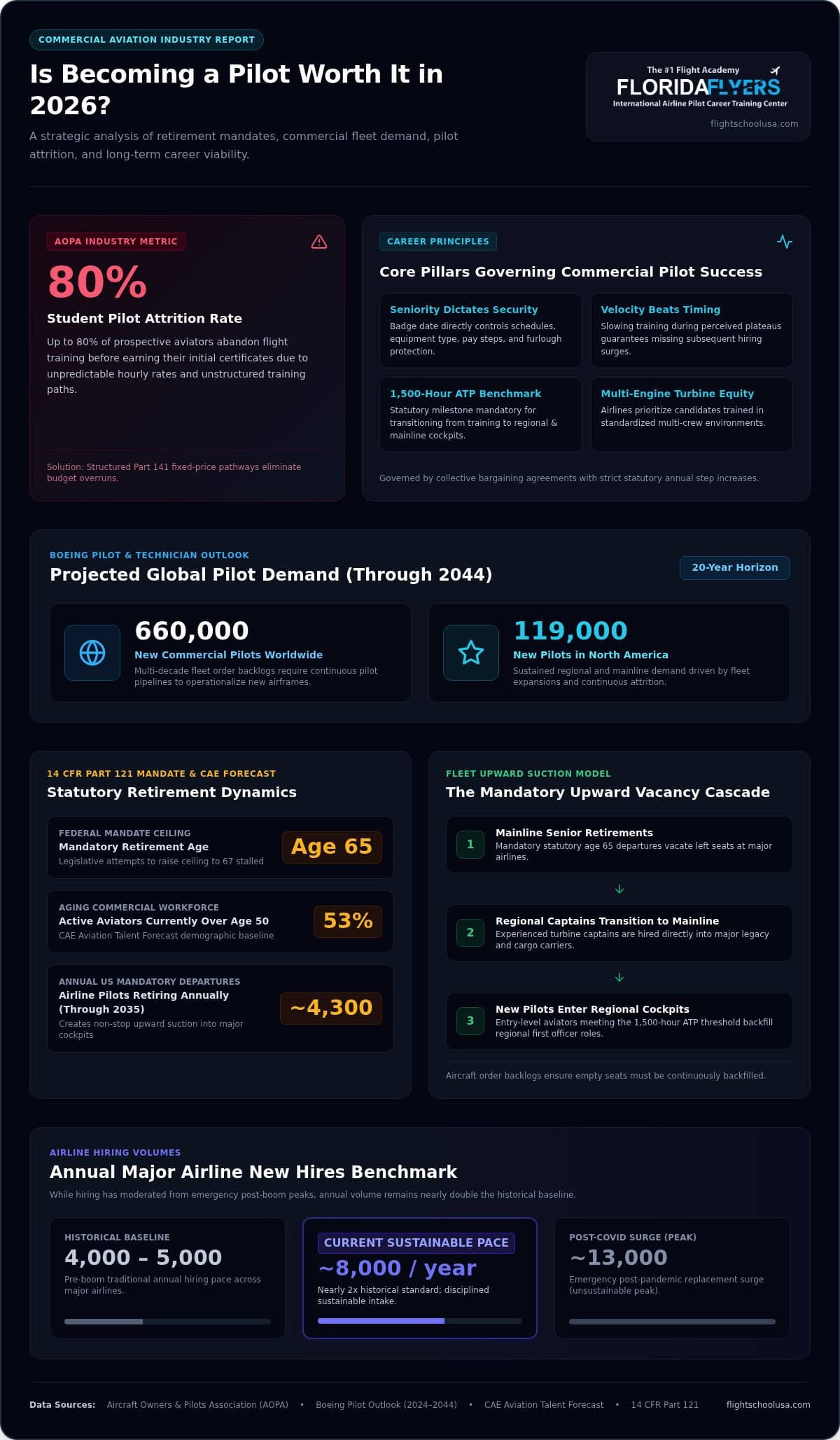
According to data from the Aircraft Owners and Pilots Association, up to 80% of prospective aviators abandon flight training before earning their initial certificates. In a shifting market defined by post-boom airline hiring normalizations, aspiring flight candidates are forced to confront an urgent question: is becoming a pilot worth it 2026?
You’re entirely justified in questioning the commitment. High capital demands, unpredictable hourly aircraft rates, and strict FAA regulatory standards present tangible risks if you enter the cockpit without a disciplined plan. Career success no longer belongs to casual hour-builders; it demands strategic capital protection and focused progression. This analysis provides an authoritative evaluation of commercial aviation viability, multi-decade earning potential, mandatory airline retirement metrics, and structured qualification benchmarks.
Below, we examine the definitive career return on investment, operational frameworks to eliminate training budget overruns, and the accelerated institutional pathways that bridge the critical gap to the airline flight deck.
Commercial aviation viability is not dictated by short-term news cycles. It is governed strictly by three structural forces: statutory retirements, aircraft delivery backlogs, and workforce attrition. Prospective candidates weighing whether is becoming a pilot worth it 2026 must separate temporary hiring normalizations from generational labor replacement. The post-COVID hiring frenzy has evolved into a disciplined baseline. Regional carriers, cargo operations, and mainline carriers now hire at sustainable rates rather than emergency volumes.
Temporary onboarding pauses often stem from aircraft delivery delays rather than declining passenger demand. While an applicant waiting on a class date might perceive a stalled market, multi-decade fleet growth paints an entirely different picture. Boeing’s Pilot and Technician Outlook projects a global demand for 660,000 new commercial pilots through 2044, including 119,000 in North America alone. Career success belongs to candidates who build qualification equity during these operational plateaus instead of waiting for the next acute shortage.
The primary driver of ongoing airline recruitment remains the federal statutory retirement age. Under 14 CFR Part 121, airline pilots face mandatory retirement at age 65. Legislative attempts to lift this ceiling to 67 stalled due to international harmonization standards and rigorous opposition. According to the CAE Aviation Talent Forecast, approximately 4,300 U.S. airline pilots reach mandatory retirement annually through 2035, while 53% of active commercial aviators are currently over age 50. This creates an unyielding upward suction from regional flight decks into major cockpits.
Simultaneously, major global airlines hold multi-year order backlogs for modern narrowbody and widebody airframes. These airframes cannot generate revenue while parked on ramps. Every statutory departure forces a cascade: regional captains move to mainline fleets, regional first officers upgrade to the left seat, and entry-level aviators step into regional cockpits.
Aviation forums frequently confuse class-date backlogs with a permanent collapse in pilot demand. In truth, major airlines project roughly 8,000 new hires this year. While down from emergency peaks of 13,000, this figure nearly doubles the historical baseline of 4,000 to 5,000 annual hires. Mainline carriers have simply raised their standards, heavily prioritizing applicants who possess extensive turbine time and complete their foundational Airline Transport Pilot Licence requirements without procedural lapses.
Որոշում կայացնելը, եթե is becoming a pilot worth it 2026 requires treating flight training as a high-stakes, time-sensitive qualification race. The flight deck rewards operational velocity, disciplined timeline execution, and rigorous institutional training.
Professional aviation represents a high-capital, high-yield investment model governed entirely by seniority. Evaluating whether is becoming a pilot worth it 2026 requires looking beyond initial training debt and measuring total lifetime compensation. Unlike conventional careers where earnings scale through periodic merit negotiations, an airline pilot’s income trajectory is locked into collective bargaining agreements with strict annual step increases.
The financial payoff outpaces most traditional four-year professional degrees. According to the U.S. Bureau of Labor Statistics pilot career outlook, median annual wages for airline pilots, copilots, and flight engineers reached $226,600. When calculating actual total yield, base hourly rates tell only half the story. Top-tier airline contracts routinely provide 16% to 18% direct, non-elective 401(k) company contributions, international override premiums, and profit-sharing distributions that add tens of thousands of dollars to annual earnings. Review our strategic breakdown of airline pilot salary benchmarks across regional and legacy carriers to model these numbers accurately.
A pilot’s date of hire dictates everything: seat upgrades, airframe category, monthly route pairings, and hourly pay brackets. The financial climb accelerates rapidly after initial hour-building milestones:
Because every step relies on your standing on the master seniority list, entering the airline stream even twelve months earlier compounds hundreds of thousands of dollars in lifetime earnings.
Unstructured, hourly flight training remains the single greatest financial hazard for student pilots. Hourly pay-as-you-go structures invite hidden flight line surcharges, fluctuating fuel fees, and sporadic scheduling that stretches timelines and inflates the final bill. When timelines drag, interest accumulates on training debt while delaying high-yield airline class dates.
Protecting your investment demands complete financial certainty. Enrolling in a structured fixed price flight training program caps capital exposure, locks in operational resources, and establishes an accelerated timeline. When you evaluate if is becoming a pilot worth it 2026, mitigating tuition volatility through fixed-cost commitments is the most decisive move you can make. Prospective aviators seeking structured momentum can review available enrollment paths through Flight School USA to align their career investment with verified airline hiring timetables.
Aviation training is an unforgiving regulatory environment where mistakes exact heavy financial tolls. When evaluating whether is becoming a pilot worth it 2026, candidates must recognize that attrition is rarely caused by a lack of stick-and-rudder talent. AOPA research confirms that 70% to 80% of student aviators drop out before completing their initial certifications. They fail because of capital exhaustion, erratic lesson pacing, and preventable checkride disapprovals that stay on their permanent FAA records.
Securing a position on an airline flight deck requires treating flight training as a disciplined industrial process. Long-term forecasts like the Boeing-ի օդաչուի և տեխնիկի հեռանկարը validate strong multi-decade career demand, but that demand only benefits students who reach commercial qualification. Overcoming systemic training obstacles requires a protective operational strategy.
The primary driver of student failure is training friction. Casual, pay-as-you-go scheduling forces gaps between flights, eroding muscle memory and requiring students to pay double for repetitive review flights. Unstructured ground study creates severe knowledge deficiencies during practical checkride oral exams, where examiners fail candidates for poor regulatory comprehension.
Never commit training capital before holding an unrestricted FAA First-Class Medical Certificate. Commercial aviation requires meeting rigorous physiological standards under 14 CFR Part 67. Disqualifying conditions or complex deferrals regarding distant visual acuity, cardiovascular issues, or childhood medical histories can halt an aviation career before the first takeoff.
Navigating the aeromedical system requires strategic compliance. The FAA’s recent updates to mental health protocols, such as the fast-track clearance for documented histories of ADHD, allow qualifying applicants who have been medication-free and stable for four consecutive years to obtain clearance without expensive neuropsychological testing. Applicants who don’t meet fast-track criteria must prepare for comprehensive evaluations that take several months to clear.
Որոշում կայացնելը, եթե is becoming a pilot worth it 2026 depends heavily on your medical eligibility. Schedule an exam with an experienced Aviation Medical Examiner to obtain full legal clearance before buying flight gear or signing training agreements.
Transitioning from an aspiring student to an airline first officer is a five-stage progression governed by strict federal qualification thresholds. Understanding whether is becoming a pilot worth it 2026 requires looking past romantic ideas of flying and mapping the precise operational benchmarks leading to the airline flight deck. The statutory 1,500-hour Airline Transport Pilot requirement, codified under Public Law 111-216 following the Colgan Air safety reforms, established a firm regulatory barrier that every mainline applicant must clear. Structured execution through validated airline pilot career training ensures candidates advance through each phase without costly scheduling interruptions.
A professional trajectory begins with core certificates completed under FAA Airman Certification Standards (ACS), progressing through distinct operational capabilities:
Completing your commercial multi-engine rating delivers roughly 250 flight hours, leaving a mandatory 1,250-hour gap before entering a Part 121 regional airline cockpit.
How an aviator covers those remaining 1,250 flight hours dictates total career velocity. While specialized flying roles like pipeline inspection, aerial surveying, or Part 135 cargo operations exist, flight instruction remains the gold standard for regional airline recruitment boards. Instructing builds deep command presence, procedural discipline, and continuous instrument currency from the right seat.
Enrolling in a standardized cfi fast track program transforms newly minted commercial aviators into active flight instructors in weeks. This allows candidates to log 70 to 100 flight hours monthly while earning an instructional wage. For candidates evaluating if is becoming a pilot worth it 2026, accelerated flight instruction contracts the time-building window to roughly 12 to 18 months.
Take decisive control of your aviation career by submitting your enrollment profile to Flight School USA to lock in your flight training schedule today.
Choosing where to train shapes your entire career trajectory. While casual aviation forums often advocate decentralized Part 61 flying clubs for their perceived upfront flexibility, this approach regularly derails professional timelines. Flying clubs operate with aging airframes, independent mechanics, and part-time instructors who leave unexpectedly. When an aircraft enters unscheduled maintenance at a flying club, your training stalls for weeks. In contrast, an FAA Part 141 institutional flight school operates under rigid regulatory oversight, maintaining dedicated backup aircraft and uniform training syllabi designed for rapid professional advancement.
Airlines recruit candidates trained in standardized, procedurally disciplined environments. Part 141 academies mirror Part 121 air carrier operations from day one. You fly standardized profiles, execute formal callouts, and integrate Crew Resource Management (CRM) principles before ever stepping into an airline simulator.
Institutional flight academies eliminate the operational friction that inflates training duration. Dedicated on-site maintenance teams conduct phased inspections and swift line repairs, keeping aircraft flight-ready and protecting student schedules. Standardized cockpits ensure that swapping tail numbers doesn’t disrupt an instrument scan or flight workflow.
Environmental immersion accelerates learning velocity. Programs offering dedicated student housing place aviators in continuous, full-time study environments. Living alongside fellow flight candidates fosters collaborative ground preparation, constant technical briefing, and intense procedural focus. This immersive structure prevents the real-world distractions that cause casual students to lose momentum.
Այնպես որ, is becoming a pilot worth it 2026? The answer is an emphatic yes, but solely for candidates committed to accelerated, highly structured training. Commercial aviation remains one of the few high-yield professions where multi-million-dollar career earnings don’t demand a graduate degree. However, attempting to navigate this pipeline casually or with inadequate capital guarantees failure. Attrition ruthlessly punishes half-measures.
If you possess the physical qualifications, mental focus, and dedication to train full-time, the financial upside and schedule autonomy of an airline command seat justify the work. Stop speculating on market cycles. Take control of your career by choosing an uncompromising, fixed-cost professional flight academy built to get you hired.
Aviation rewards candidates who replace speculation with disciplined execution. Navigating statutory airline retirements, contractual seniority escalation, and rigorous certification standards demands total operational focus. Determining whether is becoming a pilot worth it 2026 isn’t a matter of guessing hiring cycles; it’s about executing a proven, high-velocity training plan.
Protect your capital and career velocity by training within an institutional environment engineered for airline placement. Flight School USA delivers FAA Part 141 curricular rigor, a transparent Fixed-Price Career Program that eliminates billing surprises, and accelerated CFI Fast Track and Airline Ready Program pathways to bridge the 1,500-hour mark. With dedicated on-site student housing, your training remains an immersive, full-time pursuit.
Airlines need disciplined aviators ready to step into command. Apply for Professional Flight Academy Career Programs today, claim your seniority number, and turn your commitment into cockpit authority.
Yes, commercial aviation remains a premier return on investment for candidates who finish training on schedule. Determining whether is becoming a pilot worth it 2026 requires measuring upfront capital against lifetime seniority earnings. Airline compensation packages feature elevated regional starting pay, contractual step increases, and substantial non-elective retirement contributions. Choosing a fixed-price training model eliminates cost uncertainty, ensuring you reach airline cockpits before statutory retirements slow down.
A full-time, accelerated pipeline takes roughly two to two and a half years from zero flight time to a regional airline seat. Students complete foundational ratings through Commercial Multi-Engine in nine to twelve months. Accumulating the remaining flight time to meet the statutory 1,500-hour Airline Transport Pilot requirement typically takes an additional 12 to 18 months of professional flight instruction.
An FAA practical test disapproval is recorded in the FAA airman database, requiring retraining and an instructor endorsement before retesting. While a single checkride disapproval will not disqualify you from airline hiring, multiple failures signal procedural or preparation deficiencies to airline review boards. Professional flight academies enforce rigorous stage checks and standardized mock evaluations to protect student records from preventable checkride disapprovals.
Yes, major and regional airlines no longer require a four-year degree for flight deck positions. While degree-granting programs were once common screening tools, carriers now prioritize total flight hours, multi-engine turbine operational experience, and a spotless FAA checkride record. Completing an accelerated institutional program allows you to build seniority years ahead of peers enrolled in traditional academic programs.
Most commercial pilots bridge the gap by working as certified flight instructors. Enrolling in a CFI Fast Track Program qualifies aviators to train initial students while logging 70 to 100 hours each month. Secondary hour-building roles include Part 135 on-demand cargo charters, pipeline inspection, and aerial survey operations. However, flight instruction remains the preferred route because it builds critical command judgment.
Commercial operations require an FAA First-Class Medical Certificate. Disqualifying conditions listed under 14 CFR Part 67 include uncontrolled diabetes, severe cardiovascular disease, active psychosis, bipolar disorder, and substance dependence. Other conditions, like managed hypertension or a documented history of ADHD, may qualify for clearance or special issuance waivers. Every aspiring pilot must secure this unrestricted medical certificate before committing any flight training capital.
Up to 80% of student aviators drop out due to capital depletion and poor training momentum rather than flying difficulty. Casual, pay-as-you-go training invites variable hourly billing, fuel surcharges, and scheduling interruptions that require costly repeated lessons. Aspiring pilots wondering if is becoming a pilot worth it 2026 can avoid attrition by enrolling in an immersive, fixed-price academy with on-site housing and dedicated maintenance support.


