
The M1 visa interview is not an administrative hurdle; it’s your first professional check-ride where you must demonstrate command, intent, and precision. We recognize the high stakes of this encounter, where the fear of visa denial due to immigrant intent suspicion often outweighs the excitement of starting your training. You’ve likely searched for M1 visa interview questions for flight school only to find vague advice that doesn’t account for the rigorous scrutiny applied to prospective professional pilots. It’s natural to feel uncertain when explaining why a premier U.S. institution is necessary for your goals or how you’ll maintain financial self-sufficiency throughout your program.
This 2026 guide promises to help you master the interview by providing a strategic framework for answering consular questions with professional pilot readiness. We’ll deliver a comprehensive list of likely questions alongside a tactical strategy for proving non-immigrant intent through concrete ties to your home country. You’ll also find a detailed checklist of required documentation to ensure every administrative component of your application is beyond reproach. This methodical approach transforms a stressful requirement into a structured path toward your professional aviation career.
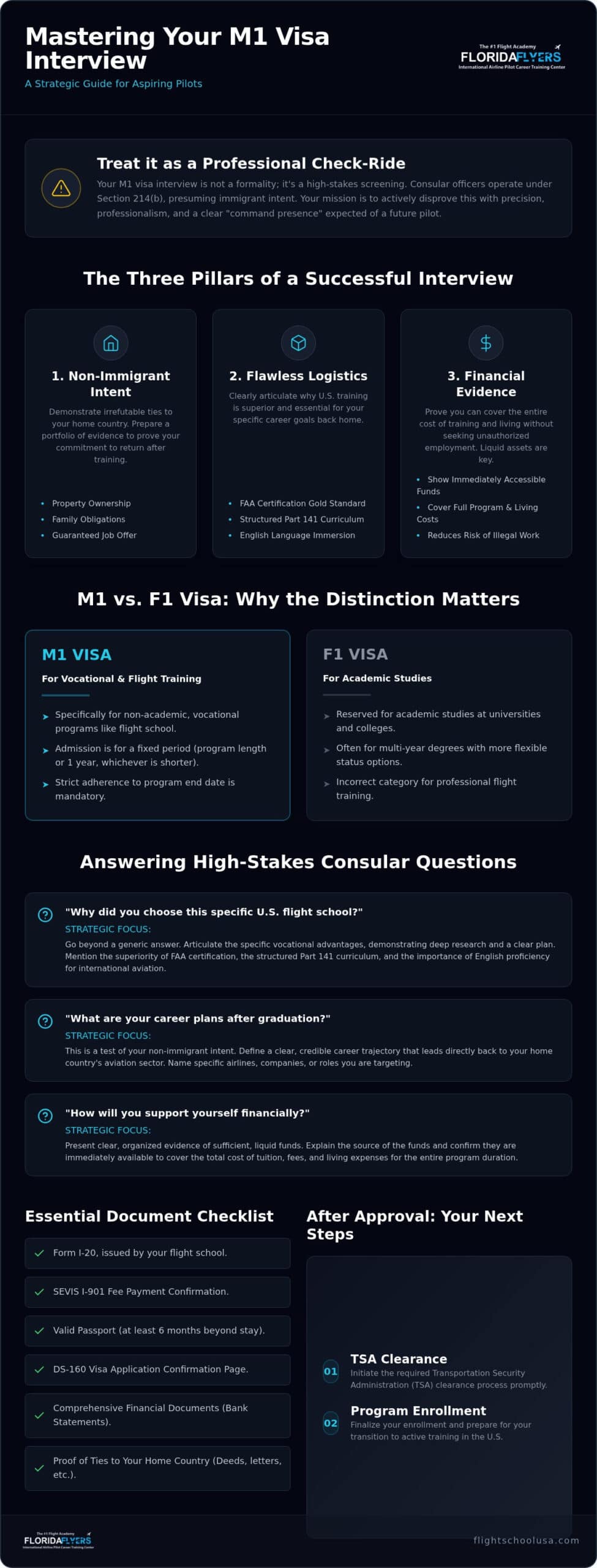
The M1 visa interview is your first professional check-ride. Consular officers don’t view this as a bureaucratic formality; they see it as a high-stakes screening process to ensure you meet the rigorous standards of a vocational student. Preparing for M1 visa interview questions for flight school requires you to understand that you’re being evaluated on your ability to follow complex regulations and your commitment to returning home. Consular officers operate under Section 214(b) of the Immigration and Nationality Act, which mandates a presumption of immigrant intent. You must actively disprove this suspicion through every answer you provide.
Flight training carries a unique weight. Unlike general vocational studies, aviation training involves significant security oversight and high financial requirements. Your professional demeanor, or “command presence,” acts as a critical non-verbal indicator of your readiness. If you cannot communicate with the precision and authority expected of a pilot during a ten-minute interview, an officer may doubt your ability to handle the rigors of an FAA-approved curriculum.
Navigating the differences between visa categories is essential for maintaining legal standing. This M-1 visa overview clarifies that the M-1 is specifically reserved for non-academic or vocational studies. While F-1 students often pursue multi-year degrees with flexible status, M-1 pilots are admitted for a fixed period. This duration is strictly limited to the length of your training program or one year, whichever is shorter. As of September 2026, the Department of Homeland Security has reinforced a trend toward fixed admission periods for nonimmigrant visas, making precise adherence to your program end date a mandatory compliance factor.
Success in the consular booth rests on three non-negotiable foundations. First, you must prove non-immigrant intent by demonstrating strong ties to your home country, such as property ownership, family obligations, or a guaranteed job offer. Second, your logistics must be flawless. You need to explain why you chose a U.S. school over local options and how the specific curriculum, like our Airline Ready Program, fits your career trajectory. Finally, your financial evidence must show immediate access to liquid assets. Consular officers require proof that you can cover the entire cost of the training and living expenses without seeking unauthorized employment. Any ambiguity in these areas will lead to an immediate denial.
Success depends on your ability to categorize the officer’s objectives. When facing M1 visa interview questions for flight school, you must respond with a narrative that aligns with U.S. regulatory expectations. Officers evaluate your vocational background to ensure your career trajectory is logical and that your training in the United States serves a specific professional end. According to the Department of Homeland Security on M-1 Visas, aviation students constitute nearly 70% of the M-1 population. Consular staff are trained to spot inconsistencies in flight training plans immediately. They prioritize candidates who demonstrate a high level of preparedness and a clear understanding of the vocational nature of their stay.
Financial solvency is the second pillar of your interview. Officers prioritize liquid assets over fixed property because they need to see that you can pay for your training without interruption. You must demonstrate that the funds for your entire program are immediately accessible. This clarity reduces the risk that you’ll seek illegal employment. Finally, your ties to your home country must be irrefutable. Whether it’s a specific family business, property ownership, or a letter of intent from a local carrier, this evidence is the only thing that overcomes the presumption of immigrant intent.
Ambiguity in your bank statements is a primary cause for denial. If you’re utilizing family funding, provide notarized affidavits that clearly state the sponsor’s commitment to your professional development. Utilizing a fixed price flight training program documentation provides the officer with a transparent, itemized cost structure. This level of detail removes the guesswork from your financial evaluation. It shows you have calculated your expenses with the precision of a pilot. If you require expert guidance on your application package, our M1 Visa Admission Services provide the strategic oversight necessary for success.
Consular officers use a specific set of M1 visa interview questions for flight school to identify candidates who lack a clear vocational objective. You must approach every inquiry with the precision of a pre-flight briefing. When asked, “Why did you choose this specific flight school?”, avoid subjective answers regarding weather or location. Instead, highlight the FAA Part 141 certification and the rigorous standards of our Fixed-Price Career Program. This demonstrates that your choice was based on technical superiority and financial transparency rather than a desire for U.S. residency.
One of the most critical “trap” questions involves your response to a hypothetical U.S. job offer. If asked, “What will you do if you are offered a job in the U.S. after training?”, any answer other than an immediate refusal is grounds for denial. You must state clearly that M-1 status prohibits U.S. employment and that your entire career strategy is built around returning to your home country to meet specific airline hiring needs. Precision in these answers signals that you’ve mastered the regulatory scope of your visa.
You must shift your narrative from a personal hobby to a strategic career execution. Consular officers aren’t interested in your love for aviation; they’re interested in your professional roadmap. Be prepared to list the specific milestones of your training: Private Pilot Certificate, Instrument Rating, and Commercial Multi-Engine Rating. Connect these ratings to current hiring trends in your home region. For instance, if local carriers are expanding their narrow-body fleets, explain how your U.S. training prepares you for those specific flight decks. This level of detail proves you’re a serious professional with a concrete plan.
Composure under fire is a non-verbal answer that proves your pilot readiness. If an officer questions your financial sponsors or previous visa denials, don’t become defensive. Provide direct, factual responses supported by your documentation. When discussing your airline pilot career training goals, always frame them within the context of your home country’s aviation sector. If you’ve faced a previous denial, address it with transparency, explaining how your current application has been corrected to meet all regulatory requirements. This honesty builds institutional credibility and demonstrates your commitment to compliance.
Precision in documentation is a non-negotiable standard for any professional pilot. When you face M1 visa interview questions for flight school, your ability to produce the correct document within seconds signals to the officer that you possess the organizational discipline required for the cockpit. A disorganized applicant is a high-risk applicant. You’ve got to perform a rigorous audit of your SEVIS record and Form I-20 before arriving at the consulate. Ensure your name, date of birth, and program dates match your passport exactly. Any discrepancy, however minor, can trigger an immediate administrative delay or denial.
Organize your “Evidence Portfolio” for rapid retrieval. We recommend a professional accordion folder with labeled tabs for financial records, academic transcripts, and identity documents. This methodical approach allows you to answer questions by presenting physical proof rather than relying on verbal claims. It’s about showing, not just telling. If an officer asks about your funding, you should be able to place the bank statement on the counter before they finish the sentence. This level of readiness commands respect and reinforces your status as an elite candidate.
Your mission to attend a flight school for international students depends on a flawless administrative package. As of September 2026, the SEVIS I-901 fee remains $350, and the DS-160 application fee is $185. You must bring printed receipts for both. Your documentation should include:
Your demeanor must project the image of a commercial pilot from the moment you enter the consulate. Officers evaluate your “command presence” through eye contact and posture. Speak with the same brevity and clarity you would use on an aviation radio. Follow the “30-Second Rule” by delivering concise, high-impact responses that answer the question directly without unnecessary elaboration. Avoid the “student” mindset; instead, speak as a future professional who is executing a pre-determined career plan. If you need assistance refining your presentation, our M1 Visa Admission Services provide the elite training necessary to navigate this high-stakes encounter.
Securing your visa is a decisive victory, but it’s merely the first milestone in a high-stakes professional journey. Once you’ve successfully navigated the M1 visa interview questions for flight school, you must pivot immediately to operational readiness. This phase requires meticulous coordination of TSA clearance and international travel logistics. Flight School USA functions as your strategic partner during this transition, ensuring that your arrival in the United States is seamless and that you’re prepared to begin the Airline Ready Pilot Program without administrative delay. Precision in your post-interview steps is just as critical as the interview itself.
Timing is a critical component of regulatory compliance. Under M-1 regulations, you’re permitted to enter the United States up to 30 days before your program start date. We recommend utilizing this window for maximum efficiency. Upon arrival, your immediate priorities include completing your TSA fingerprinting and securing your FAA First-Class Medical Certificate. These are not suggestions; they’re mandatory prerequisites for flight training. For those aiming for long-term career scaling, our CFI Fast Track Program offers a disciplined pathway to becoming a professional flight instructor, allowing you to build the experience required by global airlines.
We provide an immersive training environment that extends beyond the cockpit. Our on-site student housing eliminates the logistical friction of finding local accommodations, allowing you to focus entirely on your studies. This immersion is vital for mastering the rigors of an FAA Part 141 curriculum. By centralizing your living and training, we foster a culture of high-level discipline and professional camaraderie. Our dedicated M1 admission services remain active throughout your stay, providing the regulatory oversight necessary to maintain your legal standing.
The same fixed-price transparency that helped you answer M1 visa interview questions for flight school regarding your finances ensures that your training remains on budget and on schedule. We don’t just prepare you for the interview; we prepare you for the cockpit. We treat every administrative task as a critical component of your professional standing. Start your international pilot journey with Flight School USA today and join the ranks of elite aviators trained to the highest global standards.
掌握 M1 visa interview questions for flight school is the definitive first step in your professional aviation career. You’ve learned that success in the consular booth isn’t about luck; it’s about projecting command presence, proving financial solvency, and articulating a clear vocational roadmap back to your home country. By treating the interview as a professional check-ride, you demonstrate the high-level discipline required of an elite pilot. Precision in your documentation and a no-nonsense approach to regulatory compliance will separate you from the average applicant.
Flight School USA stands as your strategic partner, providing the specialized M1 Admission Support and FAA Part 141 professional environment necessary for your success. Our Fixed-Price Career Program ensures that your financial planning remains as accurate as your flight path. Don’t leave your international career to chance when you can train at a premier institution that demands excellence from every student.
Secure Your Future in Aviation: Apply for M1 Visa Admission Services
Your journey toward the flight deck begins with a single, decisive action. We’re ready to help you navigate the complexities of the US flight system and achieve your goal of becoming a professional pilot.
The primary cause for M1 visa denial is the failure to overcome the presumption of immigrant intent under Section 214(b). Consular officers must believe you’ll depart the United States immediately after your training concludes. Rejections also frequently stem from insufficient financial evidence or a lack of clarity regarding M1 visa interview questions for flight school. If you cannot demonstrate immediate access to liquid funds for the entire program, the officer will view you as a high-risk candidate.
You must present objective evidence of strong economic, social, and professional ties to your home country. This includes property titles, notarized family obligations, or a letter of intent from a local airline carrier. Your narrative should focus on how your FAA Part 141 training serves a specific vocational gap in your domestic market. Proving that you have a high-value career waiting for you at home is the most effective way to neutralize the suspicion of immigrant intent.
No, M-1 students are strictly prohibited from engaging in any form of employment during their flight training. This is a non-academic vocational visa with rigid compliance standards. Any unauthorized work will lead to the immediate termination of your SEVIS record and deportation. Practical training is only permitted after you complete your program and must be specifically authorized by the Department of Homeland Security. You must demonstrate total financial self-sufficiency during your interview to prove you won’t seek work.
You are required to demonstrate immediate access to liquid assets that cover the total cost of your flight training and all living expenses for the duration of your stay. While specific amounts vary by program, the officer expects to see certified bank statements that match the costs listed on your Form I-20. Relying on fixed property or non-liquid investments is insufficient. Using documentation from a Fixed-Price Career Program provides the necessary transparency to satisfy this high-stakes financial inquiry.
Dress in professional business attire that mirrors the discipline of a commercial pilot. Projecting a professional image through a suit or business casual clothing reinforces your command presence and signals that you take your vocational training seriously. Avoid casual wear like t-shirts or jeans, as these undermine the gravity of your application. Your appearance is a non-verbal answer to M1 visa interview questions for flight school, suggesting you are ready for the rigors of an elite aviation career.
The actual interview typically lasts between five and ten minutes. Because of this limited window, you must deliver concise, assertive responses. Consular officers process a high volume of applications and prioritize candidates who can communicate their intent with precision. Following the 30-second rule ensures you address the officer’s concerns without unnecessary elaboration. Every second in the booth is an opportunity to demonstrate the situational awareness and clarity expected of a professional pilot.
While an FAA medical certificate isn’t a legal prerequisite for the visa interview, obtaining one beforehand is a strategic advantage. It proves to the officer that you’ve already cleared the physical standards required to hold a pilot license, reducing the risk that you’ll be unable to complete your training. This proactive step demonstrates a high level of professional readiness. If you wait until arrival, a medical disqualification could jeopardize your entire investment and your legal standing in the United States.
If your visa is denied, the officer will provide a written explanation, most commonly citing Section 214(b) for lack of ties to your home country. You’re permitted to reapply, but you must demonstrate a significant change in circumstances or provide new, compelling evidence that addresses the original reason for refusal. Simply repeating the same interview strategy will likely result in a second denial. Our M1 Visa Admission Services specialize in auditing these cases to identify and correct regulatory deficiencies before your next attempt.


