
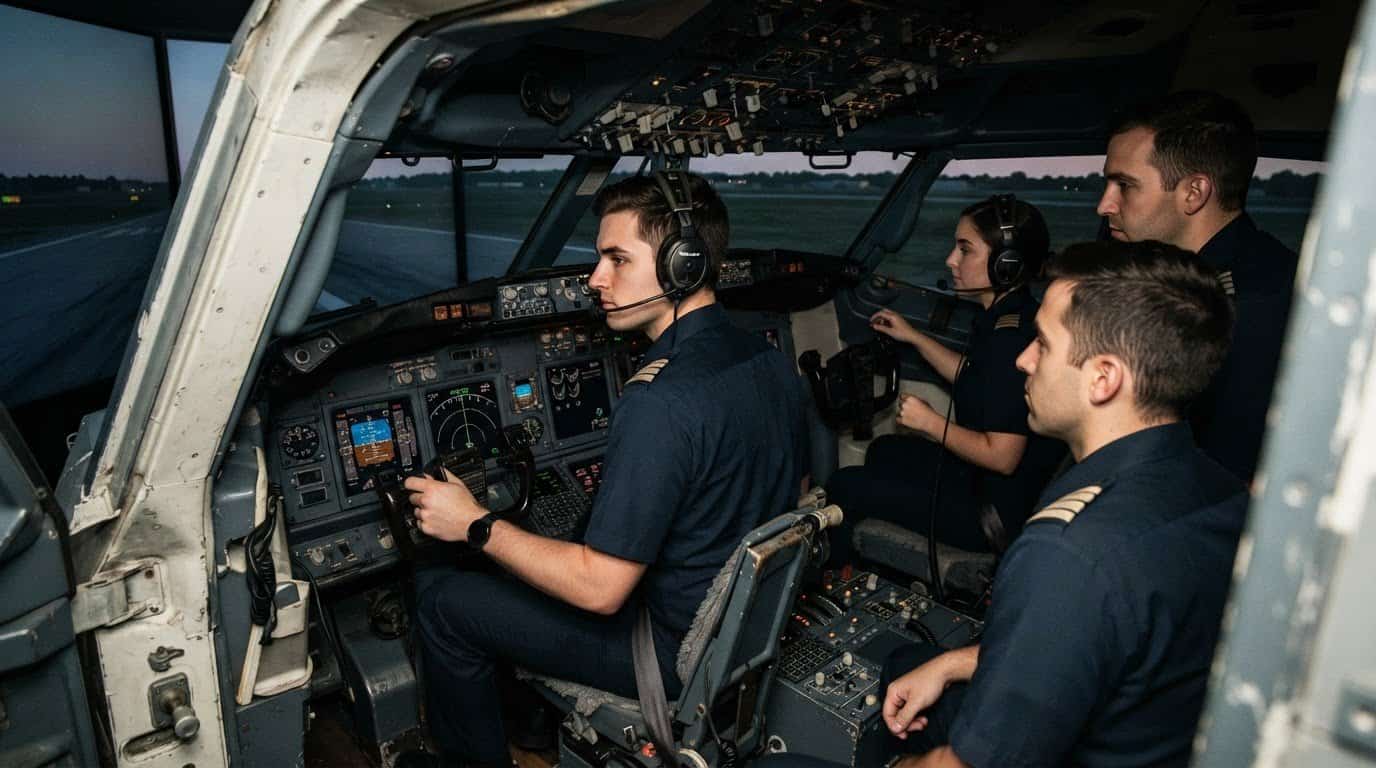
A simulator assessment isn’t won by flying alone. Airline assessments don’t follow one standard duration; the time depends on the assessment profile and whether briefing and debriefing are included. One Boeing 737 or Airbus A320 preparation session includes two hours of simulator time and a 30-minute debrief, but that isn’t a universal airline assessment schedule. These pilot simulator assessment tips start with the right focus: how you respond, learn and work with the other pilot matters alongside aircraft handling.
It’s understandable to focus first on how long you’ll spend in the simulator and which maneuvers you’ll be expected to fly. But preparation also means knowing how to absorb feedback, manage workload and communicate clearly under pressure.
This article explains what affects assessment timing and how to demonstrate trainability and sound judgment in the simulator. You’ll also learn how to approach competency-based evaluation, use crew resource management effectively and show consistent foundational flying skills without adding unnecessary complexity.
There’s no single duration for an airline pilot assessment. The profile, briefing, simulator slot and debrief all affect the time required. A listed Boeing 737 or Airbus A320 preparation session includes two hours of simulator time and a 30-minute debrief. Another listed preparation schedule includes a one-hour pre-flight briefing. These are examples of preparation sessions, not a standard duration for every airline’s selection assessment.
Plan for the full appointment, not only the time in the simulator. Confirm the assessment logistics 48 hours beforehand, then aim to arrive 30 minutes before the stated start time. This provides a practical buffer for check-in and briefing without assuming that every airline follows the same schedule. Keep travel plans flexible until the assessment’s own instructions establish the sequence and finish time.
Do airlines require prior simulator experience for pilot assessments? No. Prior simulator experience isn’t a universal prerequisite across airline selection processes. Focus instead on the aircraft and assessment profile, reliable procedures, instrument interpretation and clear communication.
What flight maneuvers and procedures are commonly tested? Profiles can include approaches, configuration and speed changes, steep turns, go-arounds, engine failures or other system abnormalities. A described low-drag ILS approach, for example, included configuration and speed changes between 3,000 feet and final flap at 1,500 feet; profiles vary by airline.
Build assessment preparation around the actual tasks. Study Jeppesen chart formats and rehearse instrument procedures rather than memorizing one assessment scenario. Psychometric tests need weeks of short daily practice sessions; cramming during the final 48 hours isn’t an effective substitute. Choose simulator preparation that matches the aircraft type and gives you time to brief, fly and review performance. A useful debrief connects each correction to a specific action for the next exercise.
Common gaps include arriving unfamiliar with the schedule, relying on aircraft handling alone or failing to apply feedback promptly. Use a simple preparation sequence: confirm logistics, review charts and procedures, then practise communicating decisions aloud. Leave room for unexpected events, since assessors may evaluate how you prioritize and respond, not just whether you complete a maneuver.
What happens if you fail a pilot simulator assessment? In airline recruitment, a failed assessment means performance fell short of that airline’s selection standard; the airline determines whether candidacy ends or another assessment follows. A hiring assessment is not the same as a regulatory flight test. For a partial flight test, Transport Canada states it must be completed within 30 days after the failed test.
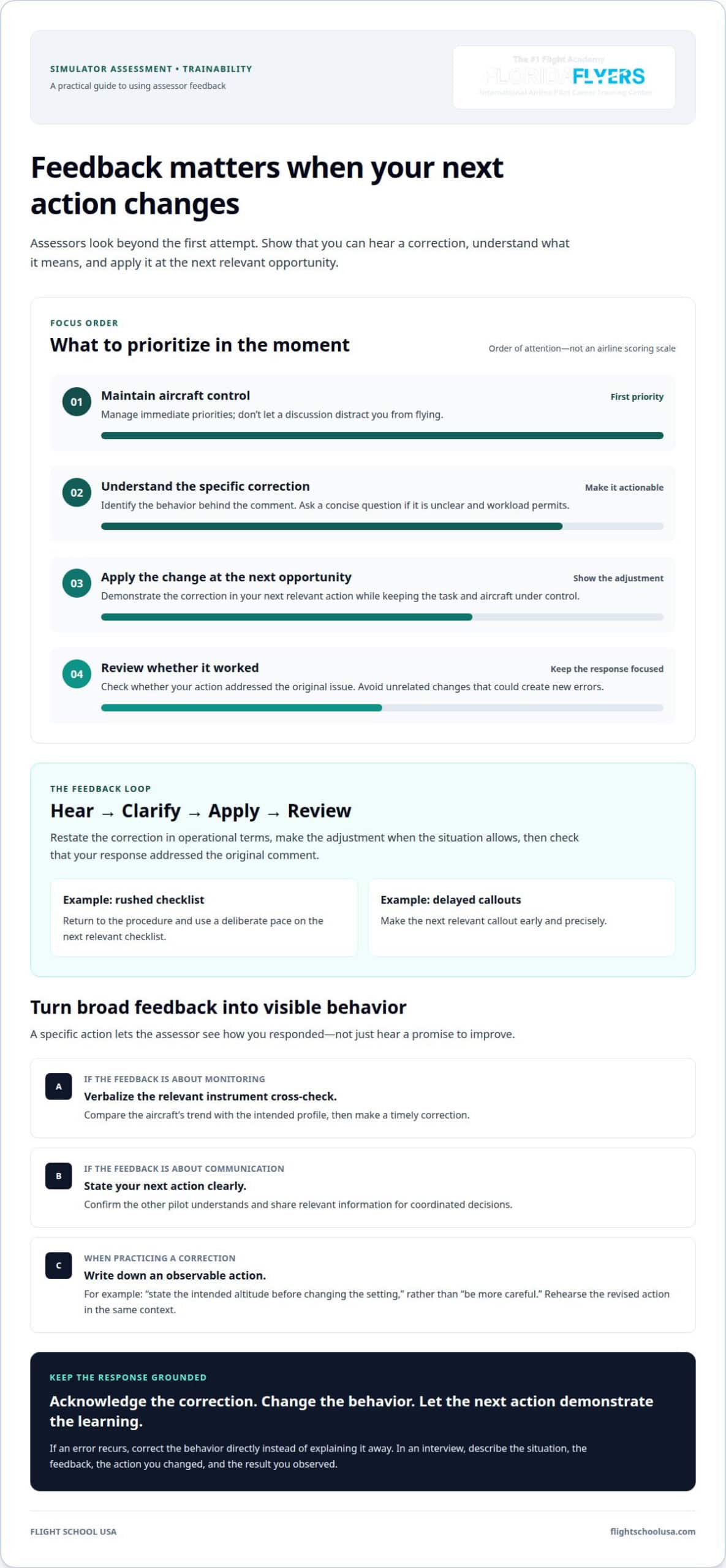
Assessors evaluate more than your first attempt. Trainability shows in how you receive a correction, understand its purpose and change your next action. One of the most useful pilot simulator assessment tips is to acknowledge feedback, then demonstrate the adjustment at the next relevant opportunity. If an assessor identifies a rushed checklist, return to the procedure and use a deliberate pace next time. Don’t defend the earlier choice. Show a clear adjustment while maintaining aircraft control.
Listen for the specific behavior behind each comment. “Improve your monitoring” calls for a practical response, not a general promise to do better. You might verbalize the relevant instrument cross-check, compare the aircraft’s trend with the intended profile, then make a timely correction. If feedback concerns communication, state your next action clearly and confirm the other pilot understands. The assessor can then observe the change.
Use a simple feedback loop during the session: hear, clarify, apply, then review. If a comment is unclear, ask a concise question when workload permits. Restate the correction in operational terms, such as, “I’ll stabilize the flight path before troubleshooting.” Apply it at the next suitable opportunity. Then consider whether your action addressed the original issue, rather than adding unrelated changes that could create new errors.
Feedback may arrive while tasks are still unfolding. Maintain aircraft control and manage immediate priorities; don’t let a discussion distract you from flying. When the situation allows, incorporate the assessor’s instruction into your next decision. For example, if the assessor flags delayed callouts, make the next relevant callout early and precisely. This shows responsiveness and judgment. If an error recurs, correct the behavior directly instead of explaining it away.
Make practice sessions more disciplined by recording each correction as an observable behavior: “state the intended altitude before changing the setting,” not “be more careful.” Then rehearse the revised action in the same context. Focus notes on decisions, procedures and communication, rather than treating every comment as a separate criticism. This also gives you specific examples for an interview about learning from feedback.
In an interview, describe the situation, the feedback you received, the action you changed and the result you observed. Use a real example, such as revising a briefing after a mentor identified unclear task allocation. These pilot simulator assessment tips are most useful when tied to a specific behavior you can practise and evaluate. Avoid claiming perfection; explain how you recognized the issue and applied the lesson. For pilots developing consistent habits through strukturerad flygträning, deliberate practice turns each correction into a repeatable skill.
Competency-based assessment examines how you operate, not just whether you can fly a maneuver. Airlines increasingly align recruitment assessments with competency-based training and recurrent checking. Many processes assess pilots against the IATA core pilot competencies. Manual flying is one part of performance, alongside decision-making, communication and workload management. A polished maneuver cannot make up for poor judgment during the rest of a session.
How are pilot simulator assessments scored and what are the pass criteria? The airline evaluates performance against the competencies and tasks in its assessment profile. Pass criteria depend on that airline’s standards; there is no single numerical pass score for every airline.
Prepare by identifying the behaviors behind each exercise. For a flight-path task, maintain control, monitor the aircraft’s response and make measured corrections. During an abnormal situation, stabilize the aircraft before diagnosing the problem. This keeps the immediate flying task under control while leaving attention for analysis and communication.
An unexpected event tests the quality of your process. Gather relevant information, identify the immediate priority and work through the problem methodically. For example, if a system indication changes, maintain a safe flight path, verify what the instruments show, then decide on the next action. Don’t rush into a diagnosis before understanding the aircraft’s condition.
Consistency matters, too. Predictable flying is stronger than adding complexity to impress an assessor. Hold a stable profile, make deliberate inputs and monitor the aircraft’s response. If a task becomes demanding, return to the basics: control the aircraft, understand the situation, then act. This disciplined sequence makes your reasoning easier to follow.
Use each simulator session to connect actions with competencies. After an exercise, identify the decision point, the information available and the action you chose. Consider whether another option would have reduced workload or improved coordination. This builds practical awareness without turning preparation into memorizing a fixed script that may not match the airline’s scenario.
During assessment, make your operational thinking clear through concise, relevant callouts. Explain a decision when it supports coordination, but don’t narrate every control movement. If the profile changes, reassess the situation instead of forcing your original plan. Competency-based preparation helps you adapt while maintaining sound aircraft control and a methodical approach.
Crew Resource Management (CRM) is visible in how you coordinate flight tasks, communicate risks and use the other pilot’s support. A simulator evaluation estimate assigns 60% to CRM, making teamwork a major part of performance. Treat the other pilot as an active crew member, not a background figure. Share relevant information, invite input and respond directly to their callouts.
Use clear, concise communication at decision points. State the situation, your intended action and any support needed. For example: “The approach is unstable. I’m initiating a go-around; confirm the missed-approach altitude.” This gives the other pilot a specific task and a chance to acknowledge it. Avoid vague calls such as “Take a look,” which don’t identify the concern or requested action.
CRM means offering help as well as requesting it. If the other pilot is managing a checklist, monitor the flight path and call out a developing deviation. If you’re occupied with aircraft control, ask them to locate the relevant procedure or handle a radio task. Make task ownership explicit, then confirm completion. This reduces duplicated effort and keeps both pilots aware of the aircraft’s status.
In an abnormal situation, use the familiar sequence “Aviate, Navigate, Communicate.” First maintain aircraft control, then establish where you are and what path is appropriate. Communicate the plan and delegate supporting tasks. For instance, one pilot can maintain the flight path while the other reviews a system indication. Reassess workload before accepting another task, especially during a changing approach.
Use available resources deliberately. Instruments, checklists, charts and the other pilot’s observations can all inform a decision. If an instrument reading conflicts with an expected indication, say what differs and request a cross-check. Don’t treat silence as agreement. Ask for confirmation when a task or clearance is unclear, then repeat critical information accurately so both pilots share the same understanding.
Assessors observe whether communication supports safe, coordinated action. A technically strong pilot may perform less effectively with poor CRM; strong teamwork helps a candidate share information and adapt. During practice, review whether each callout had a purpose, whether tasks were acknowledged and whether assistance arrived before workload became excessive. These concrete checks build communication skills that remain useful under pressure.
In an airline simulator assessment, communicate clearly, involve the other pilot and use available resources. Ask for help during maneuvers and offer help in return. Excellent teamwork can distinguish candidates from technically stronger pilots with poor CRM skills.
Airline assessments examine foundational aircraft handling alongside judgment, monitoring and professional conduct. Basic flying skills are estimated to account for 40% of a pilot simulator evaluation. That makes accuracy essential, but it doesn’t make other competencies secondary. Assessors also observe whether you manage workload, follow standard operating procedures and maintain a clear understanding of the flight.
Start with precise flight-path control. Maintain the assigned altitude and heading, manage power smoothly and monitor the aircraft’s response to each input. A stable approach shows you can control speed, configuration and descent without chasing deviations. If conditions require a correction, make it deliberately, then check whether the aircraft returns to a stable profile.
Some profiles include steep turns at a 45-degree bank angle. Others may test situational awareness by asking you to determine your position and altitude relative to the airport’s 25-mile MSA. A candidate has also described drawing a holding pattern and locating the aircraft in relation to it in under a minute. These examples reward chart interpretation and orientation, not just hands-on control.
Workload management is another observable skill. Use applicable standard operating procedures, prioritize immediate tasks and delegate when appropriate. For example, maintain aircraft control while assigning the other pilot a checklist or navigation task. Organize actions to create time to think, rather than starting several tasks without completing or monitoring them. Effective monitoring helps catch altitude, heading or approach deviations before they grow.
Assessors may introduce engine failures, go-arounds, windshear, unstable approaches, system failures or diversions. The profile varies, but your response should remain orderly: control the aircraft, identify the situation, use procedures and communicate the plan. Advanced procedures can be taught; candidates should demonstrate strong foundational skills and sound decisions when conditions change unexpectedly.
Airlines may also assess Professional Standards, including how you respond to colleagues and maintain disciplined conduct during a demanding session. Avoid trying to impress through unnecessary complexity. Consistent handling, accurate monitoring and timely decisions provide clearer evidence of competence. Use these pilot simulator assessment tips to connect each maneuver with the judgment and workload skills it tests. Strengthen those foundations through professionell flygutbildning, with deliberate attention to stable control and procedure use. Effective pilot simulator assessment tips focus on repeatable habits, not adding complexity to appear more capable.
Flight School USA helps aspiring pilots build a flight-training foundation and career direction for professional aviation. If simulator assessment preparation has highlighted gaps in aircraft handling, procedures or workload management, structured flight training can help strengthen those core skills. For pilots pursuing an airline career, the Airline Ready Program offers a relevant next step in career-focused preparation.
Choosing a training path depends on your experience, goals and circumstances. Flight School USA also offers the Fixed-Price Career Program, CFI Fast Track Program, GI Bill Flight Training and M1 Visa Admission Services. These options support different stages and needs, from career training to specific student circumstances.
To discuss your flight-training goals and next steps, contact Flight School USA.
Turn assessment preparation into a deliberate training plan. Identify the skills you want to strengthen, then connect each one to an observable cockpit action. For example, replace “improve decision-making” with a specific practice goal: state the priority, choose an action and communicate it clearly. Focused practice makes your development easier to assess and refine.
Use these pilot simulator assessment tips as a starting point, not a script. Airline profiles differ, and strong preparation means building adaptable judgment rather than memorizing one scenario. Flight School USA helps aspiring pilots pursue professional flight training through programs suited to different career goals and circumstances.
Kontakta Flygskola USA to discuss training and your next step. Bring your goals and the areas you’re working to strengthen. A disciplined plan can move you forward with confidence.
The length depends on the airline’s assessment profile and schedule. The appointment may include instructions, simulator tasks and a review afterward, so simulator time alone doesn’t reflect the full commitment. Use the airline’s stated schedule to plan transportation and other obligations. If the appointment combines several selection activities, allow time for transitions rather than assuming each stage starts immediately.
A pilot simulator assessment typically involves flight tasks observed and evaluated by an assessor. You may receive a profile, operate the aircraft, respond to changing conditions and discuss your performance afterward. The assessor considers how your decisions support the task, not just whether you complete it. For example, an exercise may require you to adapt your plan when new information changes the situation.
Start with the assessment instructions, then organize your preparation around the aircraft and tasks they identify. Review relevant operating procedures and system knowledge, and rehearse concise briefings for likely decisions. After each practice exercise, write down one behavior to maintain and one to improve. This creates a focused review plan and prevents preparation from becoming an unfocused attempt to study every possible scenario.
Avoid focusing on one instrument or maneuver while neglecting the wider flight picture. Another mistake is changing something without clearly communicating why to the other pilot. If an indication surprises you, assess the available information instead of guessing. Keep decisions proportionate to the situation, and don’t let the desire to appear decisive replace sound judgment.
Keep communication with the examiner concise, especially when aircraft control or another time-sensitive task needs attention. Acknowledge an instruction, clarify it if necessary, then act when the aircraft’s state permits. If a direction is unclear during a busy phase, for example, state what you understood and ask for clarification instead of guessing silently. This makes your response and priorities visible.
Bring the identification and documents specified in the airline’s assessment instructions; requirements differ between recruiting processes. Review the aircraft information and procedures named in the assessment materials, along with any provided profile or schedule. Keep materials organized so you can find relevant information efficiently. Avoid relying on notes that conflict with the airline’s instructions or the assigned aircraft configuration.


