
ايئر لائن پائلٽ ڪيريئر جي ڄاڻ

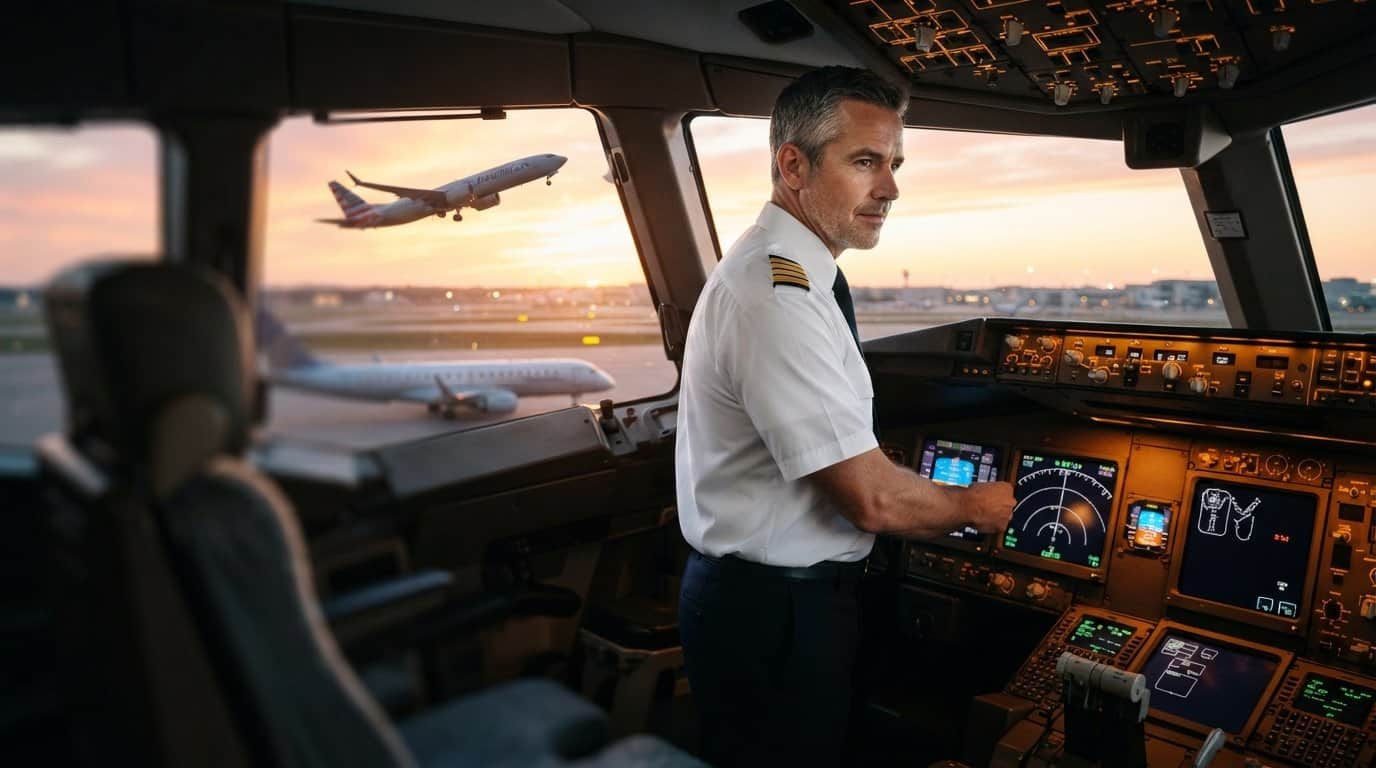
In 2026, the distance between a regional cockpit and a mainline flight deck isn’t measured in miles, but in the precision of your professional development. Many pilots assume that logging hours is enough to guarantee a seat at a legacy carrier, yet the reality of today’s competitive landscape proves otherwise. You’ve likely experienced the uncertainty of unreliable flow-through agreements or the frustration of missing out on recruitment cycles because you lack specific turbine command time. It’s a high-stakes environment where stagnation isn’t just a delay; it’s a significant career risk.
This strategic transition guide provides the authoritative roadmap you need to master the trajectory from regional flight decks to major airline command. By focusing on elite-level competency, you’ll learn how to secure your position at a major carrier with a clear, actionable timeline. We’ll examine the 1,500-hour rule’s current impact and demonstrate why advanced airline ready flight training is the critical differentiator for candidates who refuse to wait. You’re about to discover how to leverage the Airline Ready Program to bypass common bottlenecks and command the professional respect your career demands.
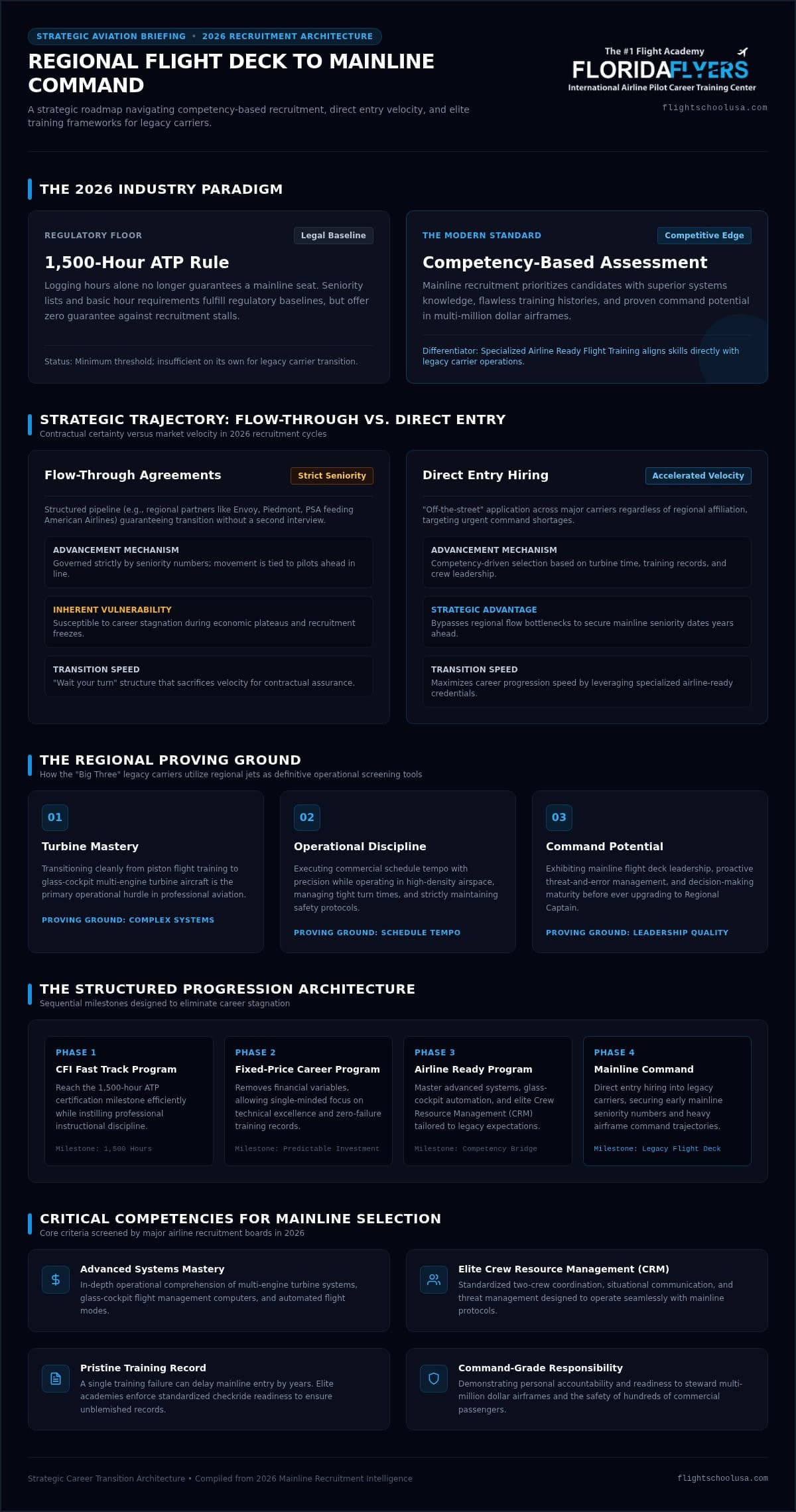
The 2026 aviation industry demands more than just basic flight hours. Major carriers are currently accelerating mainline recruitment to address a critical shortage of command-ready pilots. This acceleration has shifted the traditional hierarchy, where the transition from a Regional First Officer to a Mainline Captain now requires a more aggressive strategic approach. The “Big Three” legacy carriers utilize regional partners as essential screening tools, but they no longer rely solely on seniority. Success in this high-stakes environment depends on the quality of your initial preparation. Your training quality dictates your career velocity; a disorganized start often leads to a stagnant professional trajectory.
Regional airlines serve as the primary engine for the U.S. pilot supply chain. These carriers operate complex regional jets that function as the definitive proving ground for mainline heavy equipment. Building multi-engine turbine time isn’t just a regulatory requirement; it’s a competitive necessity. Pilots who treat their time at a regional carrier as a rigorous laboratory for professional discipline often reach the mainline environment years ahead of their peers. This phase is about demonstrating that you can handle the operational tempo of a commercial schedule while maintaining strict adherence to safety protocols.
Mainline recruitment in 2026 has evolved toward competency-based assessment. While the ايئر لائن ٽرانسپورٽ پائلٽ سرٽيفڪيٽ remains the legal baseline, major airlines prioritize candidates who demonstrate superior systems knowledge and a clean training history. This is where specialized airline ready flight training becomes indispensable. Legacy carriers look for graduates from structured, elite academies because these individuals possess the technical discipline required for mainline command.
A single training failure or a disorganized record can stall a career for years. By enrolling in the ايئر لائن تيار پروگرام, pilots ensure their skills align with the rigorous standards of the world’s most prestigious carriers. It’s not enough to simply have the hours; you must prove that you’re ready for the responsibility of a multi-million dollar airframe and the lives of hundreds of passengers. Choosing a مقرر ڪيل قيمت ڪيريئر پروگرام ensures that your focus remains on professional excellence rather than financial variables, allowing you to maintain the high-performance mindset required for the mainline leap.
Navigating the transition to a major carrier requires a calculated choice between contractual certainty and market-driven speed. For many, the flow-through agreement represents a secure bridge from a regional partner to a legacy airline. However, in 2026, the hiring environment has evolved. High-time regional pilots are increasingly finding that direct entry hiring offers a faster route to the mainline flight deck, provided they possess the elite qualifications major carriers demand. It’s no longer just about waiting for your turn; it’s about strategic maneuvering to maximize your career seniority.
Flow-through agreements are structured pipelines where regional airlines like Envoy, Piedmont, and PSA feed pilots directly into American Airlines. While these contracts guarantee a seat without a second interview, they’re governed strictly by seniority lists. This means your transition date is tied to the movement of those above you, which can lead to career stagnation during economic plateaus. It’s a “wait your turn” system that provides security but often sacrifices velocity. Pilots who rely solely on flow-through may find themselves stuck at the regional level while direct entry candidates with specialized airline ready flight training bypass them entirely.
Direct entry hiring allows pilots to apply “off-the-street” to any major carrier, regardless of their current regional affiliation. In 2026, major airlines are prioritizing these candidates to fill immediate cockpit vacancies. To succeed, you must meet the FAA 1,500-hour aeronautical experience requirements and demonstrate significant turbine command time. Recruiters aren’t just looking for hours; they’re looking for the technical precision and leadership skills developed in high-performance environments. This is why a clean training record and an advanced ايئر لائن تيار پروگرام background are critical for resume positioning.
Strategically jumping to a major carrier via direct entry can add years of high-level seniority to your career. If you’re aiming for the most efficient path to the captain’s seat, understanding how to maximize your airline pilot salary through early mainline entry is essential. By utilizing a مقرر ڪيل قيمت ڪيريئر پروگرام to eliminate training delays, you ensure that your transition remains on schedule regardless of market shifts. It’s about moving from a reactive mindset to an assertive career strategy.
The FAA 1,500-hour rule represents a non-negotiable barrier to entry for aspiring mainline captains. While some view this requirement as a mere waiting period, elite professionals recognize it as a critical phase for skill refinement. Reaching this milestone demands a strategic approach to hour building that prioritizes multi-engine and cross-country experience over simple time-logging. The Bureau of Labor Statistics airline pilot outlook highlights a sustained demand for pilots who can navigate these regulatory hurdles with precision. In 2026, the most efficient method to bridge this gap is through the CFI Fast Track Program, which transforms the transition period into a high-performance instructional career.
Teaching is the ultimate mastery of flight. When you instruct, you don’t just review the Airman Certification Standards (ACS); you command them. Major airlines value the Certified Flight Instructor (CFI) background because it demonstrates advanced communication skills and the ability to manage complex crew environments. By teaching others, you internalize the technical discipline required for airline ready flight training. This instructional foundation ensures that when you eventually step into a regional jet cockpit, your systems knowledge and situational awareness are already at a professional level. It’s a rigorous process that builds the leadership qualities legacy carriers demand from their future captains.
Securing your seat at a major carrier requires a methodical three-step progression. First, you must complete your Commercial and CFI ratings through a structured FAA Part 141 academy to ensure a clean training record. Second, you should secure a high-utilization instructor position. This allows you to build time rapidly while gaining diverse operational experience in various weather conditions and airspaces. Finally, once you reach the ATP or R-ATP minimums, you’ll transition to a regional partner with a competitive advantage. This trajectory is most effective when supported by the ايئر لائن تيار پروگرام, which ensures your skills remain sharp during the transition from piston instruction to turbine operations. Don’t just log hours; invest in training that accelerates your arrival at the mainline flight deck.
Moving from a regional flight deck to a legacy carrier cockpit requires a fundamental shift in operational philosophy. Major carriers in 2026 don’t just hire pilots; they recruit future captains capable of commanding multi-million dollar assets with absolute precision. This transition demands a level of technical mastery that exceeds basic certification standards. While regional experience provides a baseline, the leap to heavy equipment requires specialized airline ready flight training to bridge the gap in high-altitude aerodynamics and complex automation management. Stagnation at the regional level often stems from a lack of exposure to these advanced systems, making proactive education a career necessity.
Mainline training centers are high-intensity environments where there’s no room for technical hesitation. You must arrive with a deep understanding of jet engine performance and the nuances of high-altitude flight regimes. Advanced automation, specifically Flight Management Systems (FMS), becomes your primary interface for safe operation. Major airlines prioritize candidates who possess a “training-ready” foundation because it reduces the risk of training failures. Mastery of these systems ensures you can manage the aircraft’s energy state and navigation with the efficiency expected at the mainline level. Pilots who fail to master these competencies early often struggle during the rigorous six-week mainline initial training cycles.
Mainline success depends as much on your professional persona as your technical skill. Legacy carriers maintain an elite standard of conduct, expecting impeccable appearance and assertive communication. You must navigate complex Part 121 regulations with surgical precision, treating every administrative and operational task as a critical component of your legal standing. Networking through professional associations like the Air Line Pilots Association (ALPA) is not just about career growth; it’s about integrating into the professional fabric of the industry.
The Airline Ready Program serves as the essential technical finishing school for this transition. It refines your Crew Resource Management (CRM) skills, which are the definitive competencies that determine mainline success. CRM isn’t just about communication; it’s about the disciplined distribution of workload and effective decision-making under pressure. By internalizing these elite standards through airline ready flight training, you position yourself as a low-risk, high-reward candidate for any major carrier.
Command your future and eliminate the risks of training failure by applying for the Airline Ready Program to secure your professional trajectory.
The transition to a major carrier in 2026 is a mission-critical maneuver that requires absolute financial and professional clarity. To secure a seat at a legacy airline, you must move beyond the reactive mindset of a regional pilot and adopt the proactive strategy of a mainline commander. This final phase of your development isn’t just about reaching a flight hour number; it’s about validating your readiness for the highest levels of commercial aviation. By aligning your skills with the industry’s most rigorous standards, you ensure that your career remains on an upward trajectory despite market shifts. The foundation of this success is established through structured, airline ready flight training that prioritizes technical excellence and regulatory compliance.
Professional flight training is a high-stakes investment that demands a significant return. Utilizing the Fixed-Price Flight Training Program allows you to eliminate the financial variables that often stall a pilot’s progress. In an environment where economic inflation can impact training costs, the fixed-price model provides a secure, predictable path to certification. This financial stability allows you to focus entirely on mastering the competencies required to command a competitive airline pilot salary. Over a thirty-year career at a major carrier, the delta between a regional wage and a mainline captain’s compensation is worth millions. A prestigious training record from an elite academy like Flight School USA serves as a permanent asset on your professional resume, signaling to recruiters that you’ve been held to the industry’s most demanding standards.
The 2026 hiring window is currently open, but it won’t remain this aggressive indefinitely. Pilots who delay their transition or settle for mediocre training risk missing the current recruitment surge. To maintain your competitive edge, follow this final transition checklist:
Your professional standing depends on the decisions you make today. You’re invited to initiate your application for the Airline Ready Program or the Fixed-Price Career Program to solidify your path to the mainline flight deck. Don’t leave your career to chance; take command of your professional development and secure your position among the aviation elite. The path from regional pilot to major airline command is narrow, but for those with the discipline to pursue elite training, the rewards are absolute.
The transition from a regional flight deck to a legacy carrier command is a calculated maneuver that rewards the disciplined. You now understand that while seniority lists provide a baseline, true career velocity is achieved by those who master advanced systems and crew resource management. Whether you choose a direct entry path or navigate a flow-through agreement, your technical precision remains your most valuable currency in this high-stakes environment.
Flight School USA has functioned as a powerhouse of industry knowledge since 2008, providing the elite FAA Part 141 environment necessary to meet these professional standards. Our مقرر ڪيل قيمت ڪيريئر پروگرام eliminates the financial variables that often stall professional growth, ensuring your focus stays on excellence. By completing specialized airline ready flight training, you validate your readiness for the rigors of mainline operations and secure your standing among the aviation elite.
Secure Your Seat in the Airline Ready Program Today and take the definitive step toward your mainline captaincy. Your professional excellence starts with a commitment to the highest industry standards.
To transition from a regional to a major airline in 2026, you must exceed the 1,500-hour Airline Transport Pilot (ATP) minimum. While the legal baseline is clear, legacy carriers prioritize pilots with significant multi-engine turbine command time. Most successful mainline applicants currently present between 2,500 and 4,000 total flight hours. Achieving these totals through structured airline ready flight training ensures you meet the rigorous technical standards required for heavy equipment command.
Regional airlines operate as service providers for major carriers, typically flying smaller aircraft on shorter routes. Major mainline carriers, such as the “Big Three,” operate larger, heavy equipment and manage extensive international networks. The primary difference lies in compensation, aircraft complexity, and career seniority. Transitioning to a major carrier represents the pinnacle of the profession, offering the highest level of responsibility and the most competitive salary structures in the industry.
Major airlines don’t strictly prefer flow-through candidates over direct applicants; instead, they prioritize competency and immediate operational needs. In the 2026 hiring landscape, direct entry often allows high-time regional pilots to bypass the multi-year seniority queues inherent in flow-through agreements. To succeed as a direct applicant, you must demonstrate elite technical discipline. Completing an airline ready flight training track provides the competitive edge necessary to secure a mainline seat ahead of flow-through peers.
Yes, many major airlines in 2026 have removed the mandatory four-year degree requirement to focus on technical proficiency and flight experience. While a degree remains a positive attribute, recruiters now prioritize candidates who’ve completed rigorous, structured training programs at elite academies. A clean training record and advanced turbine experience are the definitive factors in modern mainline recruitment. This shift allows highly skilled pilots to accelerate their career trajectory without academic delays.
The timeline for upgrading to Captain at a regional airline currently ranges from 12 to 36 months, depending on carrier-specific seniority and pilot attrition. The aggressive hiring pace of 2026 has significantly compressed these timelines compared to previous decades. Rapid upgrade depends on your ability to master complex systems and exhibit leadership early in your tenure. Pilots who enter the regional environment with a professional, disciplined mindset are best positioned for these fast-track command opportunities.
A successful mainline career path requires an Airline Transport Pilot (ATP) certificate along with advanced multi-engine and instrument ratings. Additionally, major carriers require specific type ratings for the heavy jet equipment you’ll command. Beyond these legal requirements, elite candidates often possess specialized endorsements in high-altitude operations and advanced automation. Utilizing a مقرر ڪيل قيمت ڪيريئر پروگرام ensures you obtain these critical certifications without the financial uncertainty associated with traditional hourly training models.
Yes, you can utilize your GI Bill benefits for professional pilot development at Flight School USA. We provide specialized جي آءِ بل فلائيٽ ٽريننگ designed to help veterans transition their military discipline into a commercial aviation career. This program allows eligible service members to offset the costs of advanced ratings and career-track training. It’s a strategic way to leverage your military service while securing a seat at a prestigious major carrier.
The 2026 pilot shortage significantly accelerates your transition timeline by creating aggressive hiring windows at both regional and major carriers. Airlines are currently offering enhanced incentives and faster upgrade paths to maintain operational capacity. This environment creates a unique opportunity for pilots to reach mainline command years earlier than historical averages. However, maintaining a competitive edge requires a commitment to the highest training standards to ensure you remain a top-tier candidate during this surge.


