
Informații despre cariera de pilot al companiei aeriene

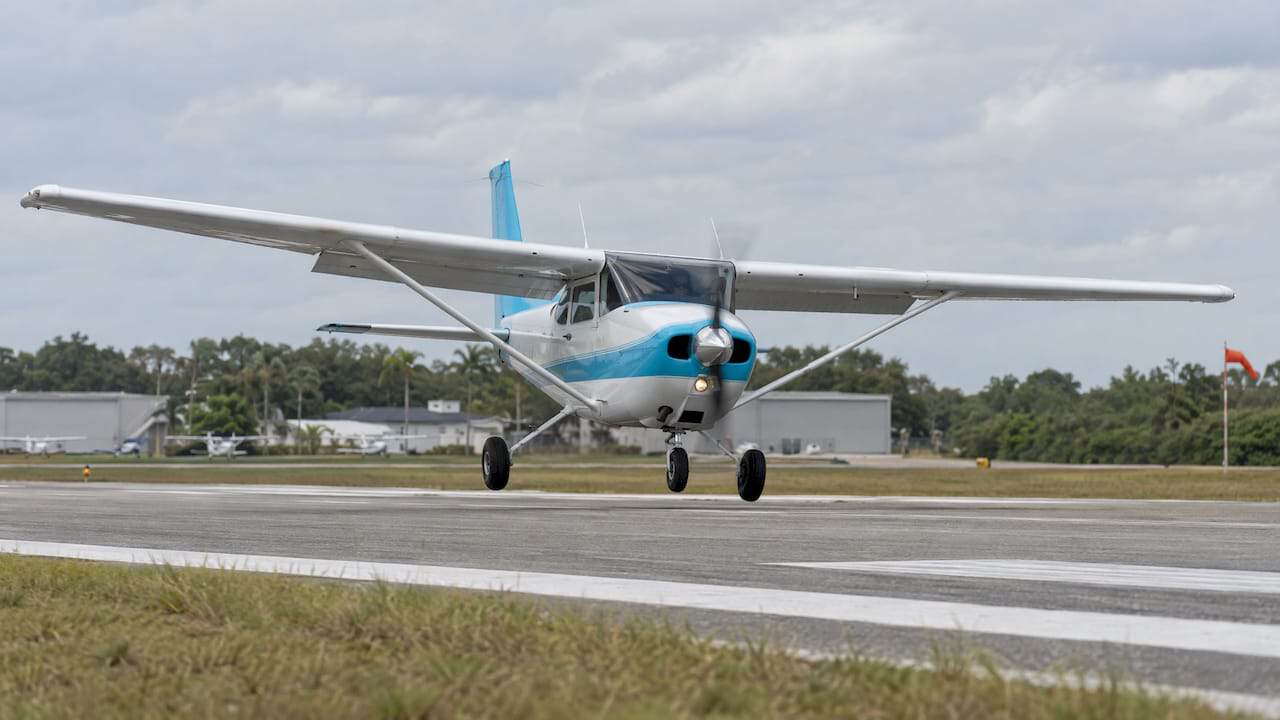
The fastest way to get good at crosswind landings is to practice them in a fixed order: coordinated cross-control at altitude, then low approaches over a long runway, then full landings, each one flown with an instructor who can name the exact moment control slipped. At Florida Flyers Flight Academy, our Part 141 training is built around that kind of progression, and our in-house FAA checkrides mean the skill you build is tested without long waits for an examiner.
Manualul de zbor al avionului FAA explains that crosswind landings are a little more difficult than crosswind takeoffs, because you must keep accurate control while your speed is falling rather than rising. Two things work against you on the ground. Wheel friction keeps the airplane from moving with the air mass, and the extra side area behind the main gear makes it weathervane into the wind. As you slow down, your ailerons get less effective while the wind keeps lifting the upwind wing. Side load on the tires while drifting can even cause a roll-over in a tricycle-gear airplane.
So the practice goal is simple: arrive at touchdown with the airplane aligned with the runway and no sideways drift, then keep it that way until you stop.
The handbook describes two usual methods.
Wing-low (sideslip). You use rudder to hold the nose aligned with the runway and aileron, with just enough bank into the wind, to cancel drift. The ground track and the fuselage stay aligned with the centerline through final, roundout, touchdown and rollout. AOPA’s student training page describes it as the most commonly taught crosswind technique. It also notes that sideslips tend to work well in light training aircraft, according to AOPA’s 2025 article.
Crab and kick. You fly the final approach with the nose pointed into the wind so the ground track stays on the centerline, then use rudder just before touchdown to straighten the fuselage. It is easier to fly on final but demands precise timing of the decrab. The same AOPA article notes it is often used in large multiengine aircraft, which matters if your path leads toward airline equipment.
A combination is also common: hold the crab until short final, then move into a sideslip once in ground effect. A Civil Air Patrol newsletter from February 2026 names two errors to avoid: landing while still crabbed, and suddenly leveling the wings after a sideslip. Either can cause loss of directional control after touchdown. It also says low-time pilots may find wing-low all the way down safer than transitioning from a crab.
This order follows the drill structure that instructors use to separate coordination from the pressure of the runway.
A CFI teaching guide published in May 2026 describes a six-step drill credited to SAFE’s David St. George: rudder-only nose control, rudder boxing, opposite-rudder slip practice, Dutch rolls near stall speed, low centerline slow flight, and then full crosswind landings. The idea is to find the simple coordination skill in the air before bringing it to the runway. If you cannot hold a heading with rudder while banking against drift at 3,000 feet, you will not do it at 30 feet.

AOPA recommends low approaches to a long runway. On the first passes, overfly at approach speed, perhaps with the first notch of flaps. Use aileron to move from one side of the runway to the centerline and back. Then use rudder to keep the nose parallel to the centerline. Only when both feel natural do you attempt a full landing.
Folosește această secvență:
The teaching guide above suggests a single debrief question: when did the upwind wing rise? It points you to the exact moment you released an input, which is almost always the real error.
Practice only helps if you choose conditions you can learn from. Start by estimating the component. AOPA’s September 2026 clock-face tip maps the wind’s angle off the runway onto a clock: a wind 20 degrees off at 15 knots gives about 5 knots of crosswind, and a wind 50 degrees off at 16 to 24 knots gives roughly 13 to 20 knots.
Bold Method gives a simpler rule of thumb: at 30 degrees off the runway the crosswind is about half the wind speed, at 45 degrees about 75%, and at 60 degrees or more roughly the full speed. The same page explains that the maximum demonstrated crosswind comes from a test at 90 degrees at a velocity of at least 0.2 Vso. AOPA’s tip puts it plainly: it is not a limit, but the value above which the manufacturer did not test the airframe. Set your own personal minimum below it, and raise it gradually with your instructor.

FAA’s list of crosswind errors is a useful checklist for your debriefs. The ones students meet most often:
Most of these trace back to the approach. If you are not on speed, on path, configured and trimmed by about 500 feet AGL in VFR (1,000 feet in IFR), go around. A stabilized-approach gate is the simplest crosswind safety tool you have. For more on the habits behind these errors, see our guide to Greșeli frecvente ale elevilor pilot.
The NTSB record shows how a crosswind turns a bad decision into damage. In a 1998 Telluride accident, a Mooney flew a go-around in a 20-knot wind gusting to 25, 130 degrees off the runway. The crosswind and tailwind components exceeded the chart limits, and the airplane struck a taxiway. Decide on the go-around trigger before you descend: drifting past centerline at the flare, or an unstable approach at your gate altitude. Then follow it every time.
If you want to read more about how wind shapes every phase of flight, our guides to wind as a weather factor și aileron function cover the background. For a type-specific walkthrough, we have a guide to landing the C172.
Crosswind proficiency is tested on the way to every certificate, and it matters most when you move to heavier, faster airplanes, where the crab-and-kick method is more common. Airbus guidance published on SKYbrary says that with crosswinds up to roughly 15 to 20 knots either a steady sideslip or a wings-level touchdown works, while stronger winds call for a crabbed approach with partial decrab and a maximum of about 5 degrees of crab at touchdown. Learning both methods early, as the FAA advises, prepares you for that step.
Gama de Private Pilot and Part 141 courses build crosswind work into structured training. If your goal is the airlines, the Programul de carieră pentru pilot de companie aeriană din SUA is priced at $49,950, and the Programul școlar de zbor al companiei aeriene cu preț fix is $85,900. We hold Self Examining Authority, so checkrides can be conducted in-house, and we support international students with M1 visa enrollment.

Crosswind skill is not a talent. It is a sequence of small habits, and the pilots who build them fastest are the ones who practice in a structured program rather than waiting for a windy day.
We design training so that coordination comes first, the runway comes second, and every landing ends in a debrief that names the one input that mattered. That discipline is what shortens the path from private pilot toward ATP, and it is why we teach both the wing-low and crab methods rather than favoring one.
Practice with purpose, and the wind becomes just another variable you have already flown.
Rainer
Start at altitude with rudder and aileron coordination, then fly low approaches over a long runway, then full landings. Take each step only when the one before feels easy. Debrief every landing with your instructor.
The wing-low (sideslip) method. The FAA recommends it in most cases, and it keeps the airplane aligned with the runway through touchdown and rollout. You should still learn the crab method as well.
Use a rule of thumb: about half the wind speed at 30 degrees off the runway, about 75% at 45 degrees, and nearly all of it at 60 degrees or more. The clock-face method gives the same estimate quickly in the cockpit.
It is the highest crosswind the manufacturer tested, not a limit, according to AOPA. Your own proficiency and personal minimums should keep you well within it.


