
Informazzjoni dwar il-Karriera tal-Bdot tal-Ajru

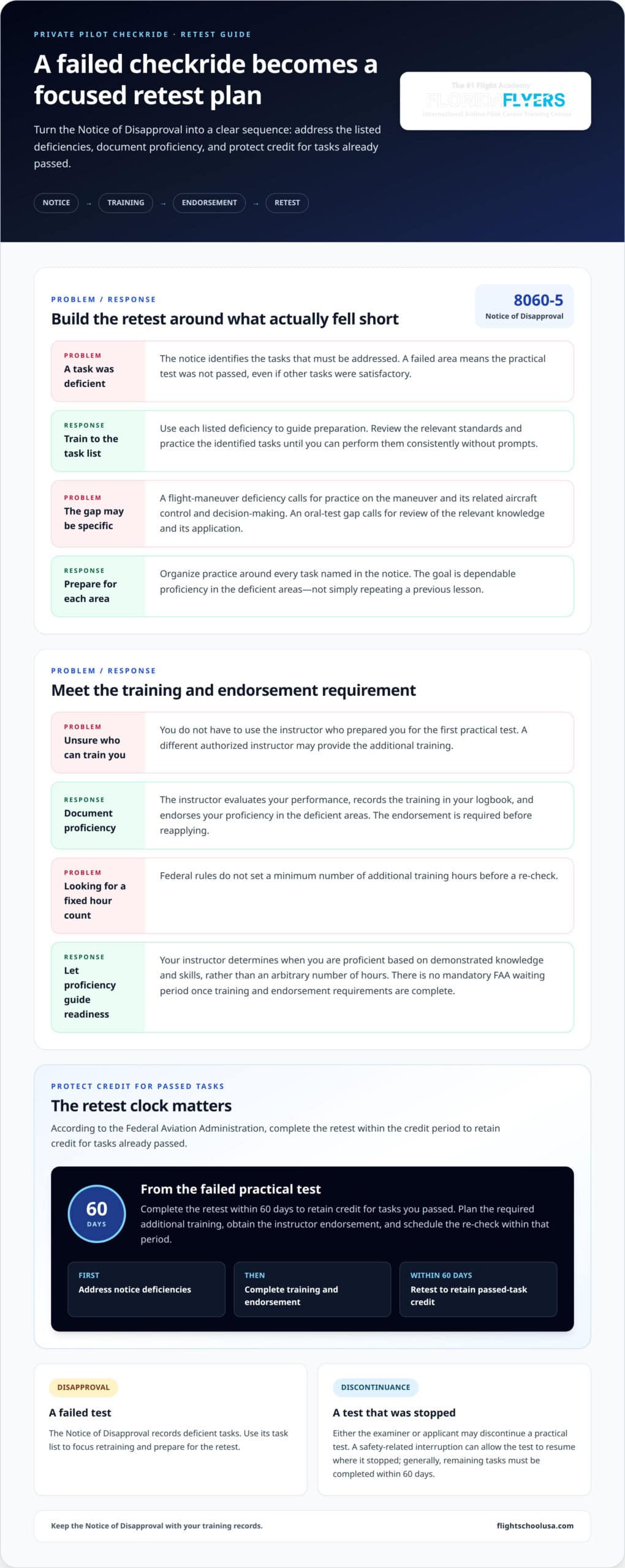
A failed private pilot checkride is a setback, not an automatic end to a pilot career. If you fail an area of operation, the examiner issues FAA Form 8060-5, a Notice of Disapproval; according to the Federal Aviation Administration, you have 60 days to complete a retest and retain credit for tasks you passed. Understanding what happens if you fail a checkride also means knowing that additional training and an instructor endorsement are required before you reapply.
It’s reasonable to worry that a failed attempt could affect future hiring decisions. The record matters, but so does how you respond: targeted retraining, stronger performance on the retest, and a clear account of what you learned can put the setback in context. This guide explains what a failure means, how retesting works, and what to consider as you continue toward a pilot career.
A failed practical test becomes part of your certification history, but it doesn’t automatically end your pilot career. The key distinction is whether the examiner issued a disapproval or discontinued the test, because each outcome affects retesting and credit differently.
After an unsatisfactory checkride, the examiner issues FAA Form 8060-5, the Notice of Disapproval, often called a pink slip. It identifies the deficient tasks that must be addressed before the retest. Read each listed task carefully: if a flight maneuver is identified, prepare to demonstrate that maneuver to the required standard, rather than treating the notice as a general failing grade.
The Notice of Disapproval records the result and guides your next training phase. The FAA records it in the airman database, and the failed checkride remains in your FAA airman file. Keep the notice with your training records. Its task list gives you a specific basis for retraining and helps explain the result if you later discuss the attempt.
A disapproval means you haven’t passed every required area of operation for that certificate. Under 14 CFR 61.43(c), failing any single area results in failure of the practical test; under 14 CFR 61.43(d), you aren’t eligible for the certificate until all areas are passed. A retest can preserve credit for passed tasks, so focus preparation on the deficiencies named in the notice.
In the United States, pilots have 60 days from a failed practical test to complete a retest and retain credit for tasks they passed, according to the Federal Aviation Administration. That deadline makes prompt planning important: arrange the required additional training, obtain the endorsement, and schedule the re-check within the credit period. A future employer may review certification history, so be prepared to describe the corrective steps you took.
If you believe the examiner’s decision was incorrect, identify the specific task and standard in question. Compare the Notice of Disapproval with your recollection of the oral or flight portion, then ask the examiner to clarify the deficiency. A precise question about a particular maneuver is more useful than a general objection to the result.
Keep the notice and relevant training records together, and discuss the disagreement with your instructor before deciding what to do next. Avoid assuming that disputing the result cancels the retest deadline: according to the Federal Aviation Administration, an applicant who discontinues a practical test generally has 60 days to complete the remaining tasks. A discontinuance differs from a disapproval; under 14 CFR 61.43(e), either the examiner or applicant may discontinue a test, and a safety-related interruption can allow the test to resume where it stopped.
No. You can receive additional training from a different authorized instructor before a private pilot retest. Under FAR 61.49, the essential requirements are focused retraining and an instructor’s logbook endorsement confirming proficiency in the deficient areas. The rule doesn’t set a federally mandated minimum number of training hours, so the work should address the skills that need improvement.
The instructor who provides additional training doesn’t have to be the one who prepared you for your first practical test. What matters is that the instructor evaluates your performance, records the training in your logbook, and endorses your proficiency in the areas that need correction. Changing instructors doesn’t remove these requirements.
Use the deficient tasks to guide your training. If the evaluation identified a weakness in a flight maneuver, for example, focus on the procedure, aircraft control, and decision-making involved. If the gap concerned an oral-test subject, review your understanding and application of that material with your instructor. The goal is dependable proficiency, not simply repeating a previous lesson.
There’s no federally mandated minimum number of additional training hours before a re-check. Your instructor assesses your performance and determines when you’re proficient in the deficient areas. That assessment should be based on demonstrated knowledge and skills, not an arbitrary number of hours. A practical test may cover more than one deficient task, so organize preparation around each area identified.
Before reapplying, complete the required training and obtain a logbook endorsement from the authorized instructor who provided it. The endorsement documents instruction on the areas where your performance fell short and confirms that you’re considered proficient in them. Without it, you haven’t met the stated prerequisite for reapplying. There’s no mandatory FAA waiting period once you’ve completed the required training and received the endorsement.
Changing instructors can be useful when a new explanation or training approach helps clarify a difficult skill. It can also require time for the new instructor to understand your experience and assess your performance. Whether you stay with your original instructor or work with another, keep your preparation tied to the deficiencies and the applicable standard. Strong taħriġ fit-titjir builds readiness for the retest and supports the discipline needed for a future airline path.
A retest takes more than finding an open appointment. Address the disapproval, complete the required preparation, and preserve credit for tasks you’ve already passed.
Build your preparation around the deficient tasks listed on the Notice of Disapproval. Review the relevant standards, then practice each task until you can perform it consistently without prompts. If the examiner identified a weak flight maneuver, for example, revisit its setup, execution, and completion. This targeted approach keeps your preparation tied to the original result.
Before reapplying, complete additional training with an authorized instructor and obtain the required logbook endorsement. The endorsement documents training in the deficient areas and the instructor’s assessment of your proficiency. Keep the Notice of Disapproval with your training record so the retest preparation follows the documented deficiencies, not an incomplete recollection of the original checkride.
In the United States, pilots have 60 days from a failed practical test to complete a retest and retain credit for tasks they passed, according to the Federal Aviation Administration. Treat the deadline as part of your scheduling plan: training, endorsement, examiner availability, and retest arrangements all need to fit within that window.
The 60-day period applies to preserving credit, not to skipping preparation. If you miss it, credit for passed tasks expires and you must retake the entire practical test. Track the date of disapproval and organize the remaining steps promptly. A calendar reminder can help you manage the deadline while leaving time to address the deficiencies properly.
A retest may involve an examiner-time fee, separate from the cost of additional instruction. The amount can depend on the examiner and the scope of the re-check. Include these expenses in your plans: completing training without arranging the examination can cause further delays.
Before booking, clarify what the retest fee covers, including whether it applies to the listed deficient tasks or a broader evaluation. A different examiner may choose to examine tasks beyond those you failed. That can affect the time required and the overall cost, so consider the planned scope when arranging your retest.
Once training and documentation are in order, coordinate a date with the examiner and confirm what the re-check will cover. Bring the Notice of Disapproval, your logbook endorsement, and relevant training records. These documents help establish which tasks earned credit and which deficiencies remain. If the retest cannot be completed within the 60-day period, prepare for the possibility of repeating the full practical test rather than only the identified tasks.
A checkride failure doesn’t automatically close the airline career path. Among pilots hired at major U.S. airlines in 2023, 72% had at least one documented checkride failure. The reported figure for private pilot checkride failures was 34%. These figures show that a failed attempt can appear in the records of successful hires, but they don’t predict any individual student’s outcome.
The certificate level and checkride type also matter when employers review a pilot’s history. In 2023, 22% of pilots hired at major U.S. airlines needed multiple attempts to pass a commercial pilot checkride. The same hiring data reports initial-attempt failures among 41% of CFI hires and 18% of ATP or type-rating hires. Those percentages describe different stages, not interchangeable measures of one candidate’s qualifications.
Airline hiring reviews may include a pilot’s certification history under the Pilot Records Improvement Act, or PRIA. A documented checkride failure is therefore something to address accurately, rather than omit or minimize. Timing can shape the level of attention: failures within 24 months of an airline application receive the most scrutiny. A recent record calls for a clear explanation of the deficiency and the corrective steps taken.
The time since a failure can also affect how it is viewed. A failure from 0-6 months before an application calls for a detailed explanation and evidence of corrective action. One from 6-24 months earlier calls for an account of learning and improvement. Failures from 2-5 years earlier have minimal impact when followed by a clean record, while those older than 5 years are rarely significant in hiring decisions.
Repeated failures may prompt closer questions about training and consistency. The reported analysis found pilots with three or more failures were 23% more likely to struggle in airline initial training than those with zero or one. That association doesn’t determine an individual’s performance. It does underscore why a student should treat each examiner’s findings as specific training priorities, not simply as paperwork to clear.
Preparation after a failure can strengthen the explanation you give later. The reported comparison found pilots who completed additional training beyond the minimum performed 34% better in airline initial training than those who completed only the minimum. Keep the sequence clear: identify the deficient task, complete focused training, obtain the endorsement, and pass the retest. In a future interview, describe those actions directly, then explain how they changed your preparation and performance. A concise, factual account shows you understand the standard and took responsibility for meeting it.
You can raise a concern about the examiner’s decision, but distinguish disagreement from a documented error. Start with the Notice of Disapproval: identify the task, the stated deficiency, and the applicable practical-test standard. A focused review can clarify whether the concern is about a specific evaluation or simply an unsatisfactory result.
Ask the examiner to explain the finding in concrete terms. If the notice identifies a flight maneuver, for example, ask which part of its execution didn’t meet the standard. If the concern involves an oral response, identify the question and the knowledge or judgment the examiner expected. Keep the conversation professional and focused on the task, not assumptions about the examiner’s motives.
Write down the details while they’re fresh. Record the date, the task discussed, the examiner’s explanation, and relevant wording from the Notice of Disapproval. Compare your notes with your recollection and the practical-test standards for the certificate. Your instructor can help assess whether the issue points to a factual or procedural concern, or to a skill that needs more work.
Disagreement alone doesn’t erase the disapproval or show that the examiner’s decision was improper. A stronger concern identifies a specific discrepancy, such as a mismatch between the task described in the notice and the event you recall. A general statement that the test felt unfair is harder to assess because it doesn’t identify a standard, action, or finding for review.
If you believe the concern warrants escalation, preserve the Notice of Disapproval and your notes, then seek guidance on the appropriate FAA process. Don’t assume that a particular appeal procedure, deadline, or outcome applies to every case. Keep any discussion grounded in the specific decision and supporting records.
Meanwhile, separate the dispute from preparation for another practical test. If the examiner’s finding stands, address the listed deficiency with an authorized instructor and document the training. If you’re pursuing a review, keep the concern precise and retain relevant records. That disciplined approach protects your ability to explain the event accurately and keeps your next training decision tied to the actual task. For focused preparation, consider flight training for pilot certification.
Flight School USA helps aspiring pilots pursue professional aviation careers through flight training and career-focused programs. After a checkride failure, structured training can help you address skill gaps and keep your next certification goals in view. The Fixed-Price Career Program and Airline Ready Program support students planning a career pathway. The right fit depends on your training stage and objectives.
If you’re ready to plan your next steps after a failed checkride, contact Skola tat-Titjira USA to discuss your training goals.
Knowing what happens if you fail a checkride can turn uncertainty into a deliberate training plan. Treat the next phase as an opportunity to build lasting habits: prepare methodically, act on feedback, and connect your career goals to the standards you’re working toward.
Flight School USA supports aspiring pilots with career-focused training options. The Fixed-Price Career Program and CFI Fast Track Program serve different training pathways, while GI Bill Flight Training supports eligible veterans. Consider which direction aligns with your next step, whether you’re pursuing a career, preparing for instructor training, or using applicable veteran benefits.
A checkride result is one part of a larger professional journey. What matters now is how you apply the lessons, strengthen your skills, and move forward with discipline. Ikkuntattja l-Iskola tat-Titjir tal-Istati Uniti llum to discuss your pilot training goals and the path ahead.
If you’re asking what happens if you fail a checkride, the examiner records the unsatisfactory result and identifies deficient tasks in a Notice of Disapproval. You’ll need additional training and an authorized instructor’s endorsement before reapplying. Use the notice to organize preparation around specific areas, such as a maneuver or an oral knowledge item. The result is a setback to address, not an automatic bar to pursuing further pilot certificates.
Yes. A Notice of Disapproval is recorded in the FAA airman database and becomes part of your FAA airman file. That record differs from a test discontinuance, which isn’t recorded as a checkride failure, or “bust.” Keep the notice with your training documents so you can accurately explain the result and your follow-up steps if asked during later certification or employment reviews.
A Notice of Disapproval is valid for 60 days. During that period, you can retain credit for tasks you passed by completing the retest within the window. If the deadline passes, the credit expires and you must retake the entire practical test. Use the date on your notice to plan your training and appointment, and account for the time needed to address every listed deficiency.
A re-check may involve an examiner-time fee, separate from any training charge. The fee varies by examiner and region, so the total depends partly on who conducts the retest and how broadly the examination is scoped. A new examiner may assess tasks beyond the original deficiencies. Include examiner time and additional instruction in your plans, without assuming the re-check costs the same as the initial test.
There’s no mandatory FAA waiting period, but you must complete additional training and receive an authorized instructor’s endorsement before reapplying. Understanding what happens if you fail a checkride means knowing that preparation and the required endorsement come before scheduling. The timing depends on completing that preparation and finding an examiner appointment. Focus first on proficiency in deficient areas, then arrange the retest while passed-task credit remains valid.
Yes, you may use a different designated pilot examiner (DPE) for the re-check. A new examiner may assess tasks beyond those listed as deficient, so don’t assume the retest will be limited to the original items. Bring the Notice of Disapproval and relevant training records. Reviewing the listed deficiencies and broader practical-test standards with your instructor can help you prepare for the evaluation.
A retest usually focuses on the tasks listed as deficient on the Notice of Disapproval, rather than repeating every part of the practical test. Credit for passed tasks applies when you complete the retest within the valid period. The examiner may agree to continue the remaining tasks during the original test after an unsatisfactory task, but that doesn’t erase the disapproval. A different examiner may also broaden the re-check.
A failed checkride remains in your FAA airman file, so don’t assume the record disappears after you pass a retest. Its significance in a future airline application can depend on the context, including how you addressed the deficiency and your later record. Failures more than five years old are rarely a significant hiring factor. Keep your explanation factual, and describe the corrective training and improvement that followed.


