
Информации за кариера на пилот на авиокомпанија


What if a fixed training price makes your budget easier to plan but doesn’t guarantee the same total cost for every student? That distinction matters when you’re weighing fixed rate pilot training against hourly billing. A defined price can bring structure to a major career investment, but it shouldn’t be mistaken for unlimited flight time or a promise that every student will progress at the same pace.
It’s reasonable to want a clear picture of the financial commitment before you begin. The challenge is comparing programs on equal terms: a headline price means little unless you understand the training pathway it covers and which expenses may sit outside it. Your career goal, training needs, and program scope all matter.
This article explains what fixed-rate pricing can make predictable, what may still vary, and how to compare billing structures using consistent assumptions. You’ll also learn what to examine in a structured career pathway, including Flight School USA’s Fixed-Price Career Program, so you can assess whether it fits your professional goals and budgeting needs.
Fixed rate pilot training uses a defined program price rather than billing solely by each aircraft or instructor hour. The price may cover a particular career-training pathway, but the label alone doesn’t tell you which stages, resources, or expenses are included. The program terms set those boundaries.
That distinction matters. A fixed price can make planning more predictable, but it doesn’t automatically provide unlimited instruction, make every student’s training timeline identical, or guarantee certification, completion by a particular date, or employment. Students progress at different rates, so a useful budget should account for the program terms and your own circumstances.
In brief: Fixed pricing sets a financial framework for a defined training scope; it does not promise unlimited training or a guaranteed outcome.
“Fixed rate” and “fixed price” are commonly used to describe structured program pricing. In practice, they may refer to an agreed price for a specified training pathway, rather than a charge calculated anew for every hour. The program’s published scope and agreement explain what the price means.
With hourly billing, charges accrue according to aircraft use, instruction, or other services billed by time. With program pricing, a stated amount is associated with a defined scope. Neither label tells you by itself what the price covers, how additional training is handled, or which expenses are separate. Compare the terms, not just the name.
Career training involves a sequence of learning and practical milestones, so the billing method affects how you plan funds across the pathway. A clearly scoped program price can make budgeting more manageable and help you plan for continuity. Hourly billing can be harder to forecast because the final amount depends on the hours and services used.
Comparing headline figures alone can mislead. One figure may represent a broader training pathway, while another may apply to a narrower stage or use a different billing basis. Compare equivalent certificates, ratings, and training stages, then account for what each stated price represents. A general overview of школи за летање provides context on the range of training they offer, but individual program terms determine the details.
For aspiring career pilots, the goal is not simply to find the lowest-looking figure. It’s to understand the financial structure before committing, so the chosen pathway fits your professional objectives and personal budget. Flight School USA’s Fixed-Price Career Program offers a structured option for evaluating that decision. Assess it by its defined scope and pricing terms, while keeping individual progress in mind.
The reliability of a fixed price depends on the boundaries it sets. A career program may describe a sequence of certificates, ratings, and training stages, but the price helps you plan only when you understand which stages it covers and what assumptions apply to your progress. The regulatory framework for pilot certification, including 14 CFR Дел 61, provides context for requirements a training pathway is designed to address. It doesn’t define an individual program’s commercial terms.
A fixed rate is meaningful only when read alongside its written scope, assumptions, and terms. Without that detail, a fixed figure can appear more comprehensive than it is.
Start with the stages named in the program description. A career-track pathway could be organized around a progression through certificates and ratings, such as private, instrument, commercial, and instructor training. Those labels indicate the intended sequence, but they don’t establish how much instruction or which resources are covered. Look to the program terms for the actual scope.
Next, distinguish the pathway’s design assumptions from an individual student’s results. Students learn at different rates; someone who needs additional practice in a maneuver or procedure may require more instruction than another student. The written terms explain how that additional training affects the price. Don’t assume that fixed-price training means unlimited instruction, identical progress, or guaranteed completion.
For a fair assessment, note the stated training stages, what the program says is included, and any listed limits or conditions. Base your comparison on documented scope rather than general expectations about what a flight program might cover. This also makes it easier to spot differences between programs before comparing their prices.
Tuition or a program fee is not necessarily the same as the full personal cost of training. Across the broader market, potential expense categories include FAA written or practical exam fees, training materials or supplies, housing, and financing charges. These costs are handled according to the program terms and the student’s circumstances.
Separate costs into three groups as you review a plan:
This distinction prevents an optional expense from being mistaken for a universal requirement, or a necessary cost from disappearing from your personal budget. Flight School USA’s Програма за кариера со фиксна цена is a structured pathway to assess using this scope-and-assumptions framework.
Neither billing structure is automatically the better choice. Fixed pricing can support planning when the program scope and terms are clear; hourly billing ties charges more directly to the training time used. The meaningful comparison is between equivalent pathways, not a fixed-price headline and an isolated hourly rate.
| Точка на споредба | Fixed-rate or fixed-price program | Часовна наплата |
|---|---|---|
| Основа за фактурирање | A stated price for a defined program scope, subject to its terms. | Charges accrue according to the aircraft, instruction, or other services billed by time. |
| Предвидливост на буџетот | Can make planning more straightforward when inclusions, limits, and conditions are clear. | The total is harder to forecast if the training time required varies. |
| Структура на програмата | Often organized around a specified career-training pathway or set of stages. | May allow training to be arranged and paid for incrementally. |
| Progress-related exposure | How additional training affects the price depends on the written terms. | More training hours generally mean more time-based charges. |
A fixed price doesn’t necessarily include every possible expense. Exam costs, supplies, housing, or financing charges may be handled separately in some training arrangements. Compare the written scope and identify which costs are part of the program price, which may be separate, and which depend on your personal choices. Don’t assume either that all expenses are included or that a category is excluded without support in the terms.
A structured price may appeal if you’re planning to pursue a defined professional training pathway and want a clearer framework for budgeting. Its value depends on how closely the stated scope aligns with your intended certificates, ratings, and training stages. Review the payment structure alongside those details. A fixed figure alone doesn’t establish that the program covers your entire goal, reduces total spending, or guarantees a faster completion timeline.
Hourly billing connects charges to training undertaken, which may suit a student who prefers to progress incrementally or has a specific training stage in mind. The trade-off is that the total can be less predictable when the amount of instruction needed varies. To compare fairly, match the same career objective and training stages, then account for aircraft time, instructor time, and any other applicable charges rather than comparing hourly rates alone.
For a disciplined comparison, write down the training goal each option is designed to cover, its billing basis, and how progress beyond the stated assumptions is treated. Then assess fixed rate pilot training against an hourly plan using the same scope. This method clarifies the real trade-offs without treating either structure as universally superior.
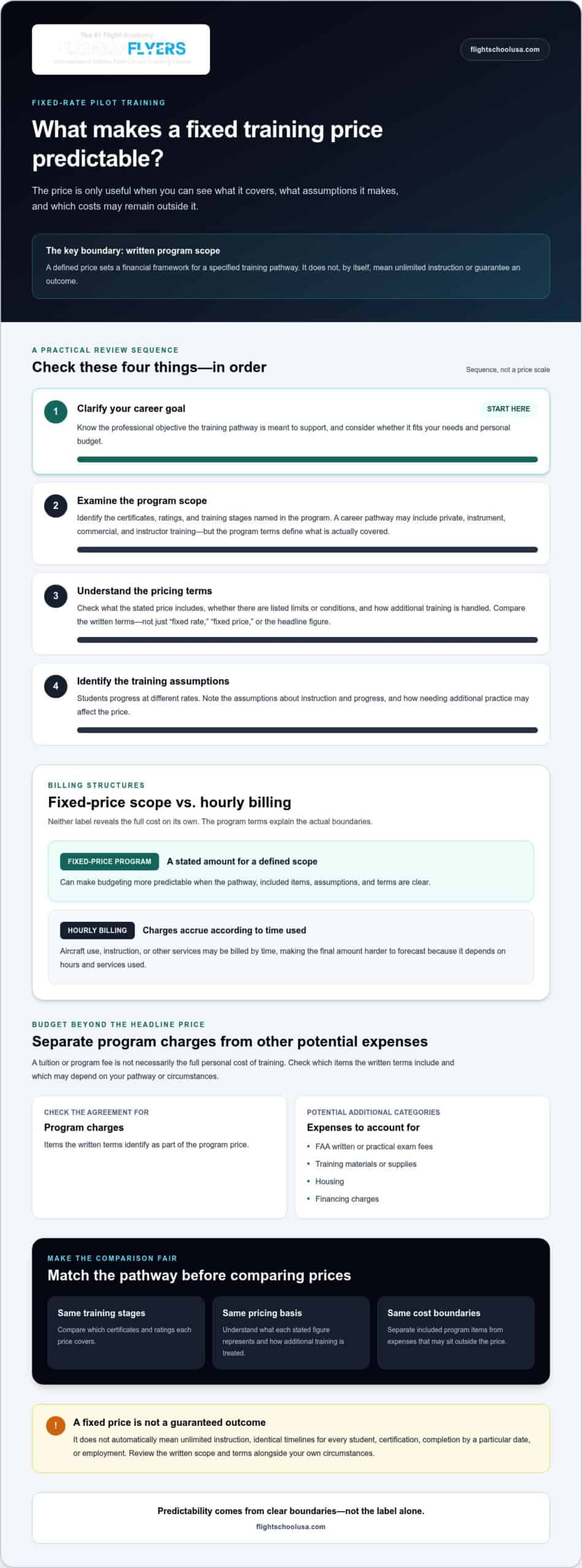
Evaluate the written pathway, not just the advertised price. A disciplined review helps you determine whether fixed rate pilot training aligns with your career objective and how much of your overall budget the program price represents. Compare equivalent certificates, ratings, and training stages across programs; otherwise, a lower figure may simply cover less training.
Work through these items in order, recording what the written program description and agreement state. This creates a consistent basis for comparing plans and identifying assumptions that could affect your personal budget.
This process also helps distinguish tuition structure from personal planning. Student housing, if relevant to your circumstances, is a living arrangement to consider separately from training scope. Financing can affect the amount you repay and when, but it doesn’t change which certificates or stages the program describes. Likewise, GI Bill Flight Training and eligibility considerations should be evaluated on their own terms; a fixed-price label doesn’t establish eligibility or benefits.
The fixed-price flight training program guide offers another framework for reviewing program scope and budgeting considerations.
Once you’ve mapped the scope, ask whether it supports the professional pathway you intend to pursue. Assess a career-track program against your intended training stages, not another student’s goal or a partial training package. CFI training may form part of a broader career plan, so account for its place in your objective without assuming every program groups it the same way.
For an airline-focused objective, the airline pilot career training guide can help you consider the larger professional pathway. Then compare that objective with the stated program scope and terms. Explore Flight School USA’s career training pathways as you assess the fit.
For aspiring professional pilots, the key question is whether a structured program aligns with their career objective and offers a pricing framework they can evaluate clearly. Flight School USA’s Fixed-Price Career Program is part of its professional pilot training pathways. The academy operates under FAA Part 141 and Part 61 certifications; these are distinct regulatory frameworks, so their requirements and training structures should not be treated as identical. A program’s certification context does not guarantee the same progress or outcome for every student.
Consider the program through the same lens used to assess any fixed rate pilot training plan: your intended career path, the stated program scope, and the pricing terms. Review the Flight School USA pilot training programs as you weigh whether this structured option fits your plans.
A defined career-training pathway is most relevant to students pursuing professional aviation, rather than those seeking flight experience without a career objective. Its structure can help organize planning around a stated sequence of training stages. That’s useful for mapping a professional goal to a program, but it does not establish a guaranteed completion date or mean all students will need the same instruction.
Keep the decision focused. First, identify the role or broader aviation direction you’re working toward. Then compare that objective with the program’s published scope and terms. A structured pathway supports deliberate planning when its boundaries are clear; individual training progress remains a separate consideration.
Before making a decision, use a consistent set of checks. Confirm that you’re comparing equivalent certificates, ratings, and training stages. Review the written billing terms and determine how they describe the program’s scope. Separate tuition from additional expenses that may apply, and consider how the agreement addresses progress-related training needs. Keep those findings together so you’re comparing the full structure, not just a headline price.
This framework keeps predictability in perspective: fixed pricing can provide a defined basis for planning, while individual progress and the program’s written terms still matter. Review Flight School USA’s program information against your objectives and these criteria to make a disciplined comparison.
Your next step is to turn a career ambition into a decision you can defend on paper. Write down the professional pathway you’re targeting, the training scope you need, and the financial assumptions you’re comfortable making. Then use those priorities to assess whether fixed rate pilot training gives you the planning structure you want, without treating a set price as a substitute for understanding the program terms.
Strong career decisions start with clear expectations. Review the program information, align it with your goals, and consider how the training pathway fits your personal plan. A careful comparison can help you begin with greater clarity and purpose.
Explore Flight School USA’s pilot training programs and take the next step toward a professional aviation career.
Usually, the terms describe similar pricing approaches, but the labels alone don’t establish identical coverage. In fixed rate pilot training, a program price is associated with a stated training scope; “fixed-price” is commonly used for the same type of structure. Review the agreement’s wording to understand what the price applies to, how the program defines its training stages, and how it handles conditions or additional charges.
No. A pricing structure doesn’t guarantee a completion date. Your pace can depend on factors such as training frequency, demonstrated proficiency, scheduling, and any additional practice needed. For example, a student who needs more time to master a particular skill may progress differently from a student who is ready to move on. Treat any stated timeline as a planning guide unless the program terms explicitly define otherwise.
Flight School USA offers GI Bill Flight Training, but benefit use depends on your eligibility and the applicable program requirements. A fixed-price structure alone doesn’t determine whether benefits apply to a particular training plan. Before budgeting, distinguish the program’s pricing terms from your individual benefits and confirm what training arrangement applies to your situation through the relevant VA process.
Whether written exams or practical test expenses are included depends on the specific program terms. For example, a price may cover instruction while an examiner’s fee is handled separately, or the agreement may describe a different arrangement. Review each exam-related item, including written tests, practical tests, and any retest conditions, so you can identify what the program price covers.
International students can pursue U.S. flight training through Flight School USA’s M1 Visa Admission Services. Enrollment and the ability to train depend on meeting applicable admission and immigration requirements; a fixed-rate price doesn’t itself grant admission or authorize study. International applicants should consider the training program and the required visa process as connected but distinct parts of their preparation.
Training frequency is a separate planning question from pricing. Match your available time to the program’s stated enrollment format and schedule, and consider how consistently you can train around progress milestones. Reviewing the schedule alongside your personal availability helps you assess how the program structure fits your training plan.


