

A well-planned flight-training goal can still run into problems if your visa file tells a different story. For international students, the m1 visa flight training requirements involve more than completing a visa application. Your vocational program, school enrollment documents, financial evidence, and training-related steps need to fit together. A gap or inconsistency can delay your plans.
It’s understandable to be unsure which requirements belong to immigration and which relate to flight training. M-1 status is generally for vocational study, while F-1 status is associated with academic study. Choosing the right pathway starts with understanding your program’s purpose. You’ll also need to keep the visa application, school documentation, aviation security screening, and any FAA or program-specific training prerequisites separate.
This guide covers the main M-1 eligibility considerations, documents to prepare, and ways to organize your admissions plan. You’ll learn how to distinguish immigration steps from flight-training requirements and identify practical next actions. Flight School USA provides M-1 visa admission services for international students preparing for enrollment and the documentation process.
An M-1 visa is a nonimmigrant student classification for eligible international students pursuing qualifying vocational or other nonacademic study in the United States. For a flight student, the key question is whether the intended program and school authorization fit M-1 rules. The fact that a program involves aircraft does not by itself determine eligibility. An M-1 visa provides a basis to seek entry for approved study; it does not approve enrollment or authorize every training activity.
The process involves several separate decisions. A school decides whether to admit a student to its program and, when applicable, its designated school official issues Form I-20 to an eligible student. The student then applies for a visa, and a consular officer decides whether to issue it. At the U.S. border, a Customs and Border Protection officer makes a separate decision about admission. Approval at one stage does not guarantee approval at another.
d' M-1 Visa overview offers general background on the category. For decisions and current requirements, rely on U.S. government instructions. For a broader look at planning flight study as an international student, see the U.S. flight school guide for international students.
M-1 may be relevant when the primary purpose of study is vocational flight training rather than an academic course of study. That distinction alone doesn’t establish eligibility. The program structure, the school’s authorization to enroll M-1 students, and the applicant’s circumstances all matter. Define your training objective and understand how the school’s program is classified before planning around a visa category. The m1 visa flight training requirements depend on this fit, not simply on your career goal.
M-1 and F-1 are both student classifications, but they serve different educational purposes. M-1 is for qualifying vocational or nonacademic study; F-1 is generally for academic study at an eligible school or program. Flight training can be part of different educational structures, so “pilot training” alone doesn’t determine which category applies. Program eligibility and the school’s authorization are central.
Neither category is universally preferable. The appropriate route depends on what you’ll study, how the program is structured, and whether the school is authorized for that category. Treat the classification as an early planning decision: match your intended course of study to the school’s documented program before assembling your application. This helps keep vocational training, academic study, and immigration eligibility distinct.
Organize your application around four connected areas: your eligibility as a student, enrollment in a qualifying program, evidence that you can fund your planned study and stay, and accurate application records. These requirements relate to one another but are not interchangeable. An aviation credential or security clearance, for example, does not replace immigration documents. The m1 visa flight training requirements depend on your circumstances and the school and program you plan to attend.
Use the U.S. government’s Student visa to study in the U.S. guidance and the current instructions from the U.S. embassy or consulate handling your application. Those instructions set out the required forms, supporting evidence, and any country-specific details. Meeting a checklist does not guarantee visa issuance; consular officers consider the complete application and individual circumstances.
You need enrollment in an eligible vocational program at a school authorized to enroll M-1 students. For an eligible student, the school’s designated official issues Form I-20, the Certificate of Eligibility for Nonimmigrant Student Status. The document records key details about the school and planned course of study and is used in the student-visa process.
Admission and I-20 issuance are school processes, not visa approvals. Make sure the information on the I-20 matches your intended training and the details in your visa application. Flight School USA provides M-1 visa admission services to help international students organize school-enrollment and documentation steps. Explore Flight School USA’s M-1 visa admission services als Ausgangspunkt.
Prepare a file that is complete, current, and consistent. The exact checklist can vary, so use the official instructions for your application location rather than treating this list as a substitute.
Before submission, compare names, dates, program details, and funding information across your records. A mismatch can prompt questions even when the underlying information is accurate. Keep originals and organized copies available, and be ready to explain your study purpose and financial plan clearly. Don’t assume a particular document guarantees approval or that an additional document is always required. The current consular checklist and the officer’s assessment govern the application.
A strong application file is more than a stack of documents. It should present one accurate, consistent account of who you are, the vocational flight training you intend to pursue, and how you plan to fund your studies and living expenses. The current U.S. embassy or consulate instructions determine which forms and supporting records you must submit, so use your appointment checklist as the controlling reference.
Start with the official instructions for your application location and appointment. Separate required forms from supporting evidence, then arrange the records so you can locate each item quickly. A document may be useful evidence without being a universal requirement, so don’t treat sample checklists as exhaustive or binding.
Review funding carefully when it comes from more than one source. For example, if a family member is supporting your studies, make sure your explanation and evidence accurately reflect that arrangement. Don’t present planned funding as money already available or submit documents that imply a different plan.
Prepare concise, truthful answers about your intended vocational program, why it fits your study objective, and how you’ll pay for tuition and living costs. Your explanation should align with the program details on your school records and the information in your application. Rehearse the key facts, not a script. Memorized answers or unsupported claims can create confusion.
Before the interview, consider whether you can explain these points plainly:
Answer the question asked, be accurate about your circumstances, and say when you don’t know rather than guessing. The m1 visa flight training requirements involve both documentation and a clear explanation of your study plan, but neither polished answers nor a complete file can control the decision. Complete, consistent documentation supports review, but it cannot ensure visa approval.
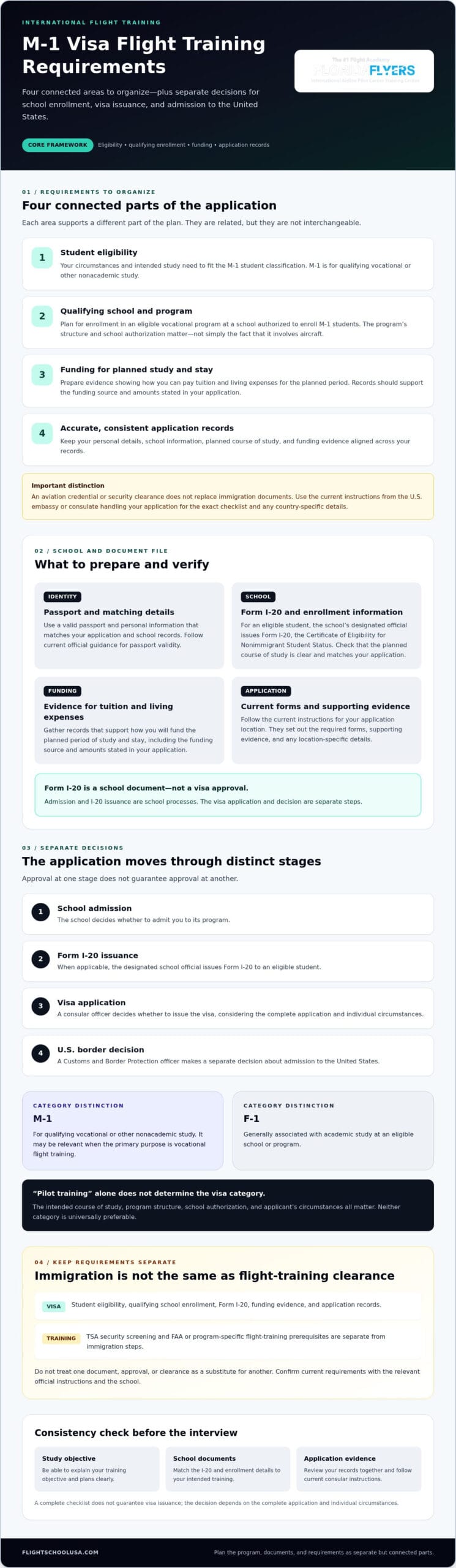
Keep the different approval systems distinct. An M-1 visa addresses immigration, while TSA security screening and FAA rules concern flight training and aviation activity. School admission and program prerequisites are separate as well. One approval does not automatically satisfy the others, and the applicable requirements can depend on the student, training activity, and program.
| Beräich | Wat et adresséiert | Wat soll een getrennt halen |
|---|---|---|
| Immigratioun | M-1 student status and the visa process for eligible vocational study. | Visa issuance does not itself complete school enrollment, TSA screening, or FAA requirements. |
| TSA-Sécherheetskontroll | Security requirements that may apply to flight training under the current Flight Training Security Program. | Applicability and process depend on current TSA rules and the student’s circumstances. This is not the visa decision. |
| FAA and program prerequisites | Flight-training and certification standards, plus any school-specific prerequisites. | Medical certification or English proficiency relates to training or certification where applicable, not automatically to M-1 visa eligibility. |
School admission and the school’s immigration documents establish an enrollment pathway. TSA’s Flight Training Security Program is a separate security process. Students should follow the current TSA instructions that apply to their training. Don’t assume every student follows the same sequence or that visa approval completes this step.
FAA medical certification is another distinct consideration. The FAA identifies a third-class medical certificate as the minimum for a student pilot to fly solo. This training-related standard should not be confused with a blanket M-1 visa eligibility requirement. English proficiency may also be relevant to a school’s or program’s training prerequisites, but don’t treat it as an automatic visa rule without support from current official guidance.
Not necessarily. Visa approval does not, by itself, confirm that enrollment is complete, applicable TSA requirements are satisfied, or the student meets the prerequisites for a particular training activity. Separate steps may need to be completed before specific flight training begins. Requirements and sequence can vary, so follow the school’s admissions plan alongside current government instructions.
benotzt m1 visa flight training requirements as a framework for separating immigration from aviation compliance, not as a single all-purpose clearance. Before treating a start date as ready, identify which requirements apply to your intended program and training activities, then track each process independently. This avoids the common mistake of interpreting one approval as permission to proceed through every other system.
Fluchschoul vun den USA M-1 visa admission services help international flight-training students organize enrollment and documentation steps while keeping visa preparation distinct from aviation requirements.
A disciplined admissions plan starts with a clear training objective, then connects it to an appropriate program and a well-organized application. Treat immigration preparation and flight-training compliance as related but distinct workstreams. This helps you identify the next action without assuming that school admission, visa issuance, or one aviation clearance completes every other requirement.
Define the vocational training you intend to pursue, then review how the program fits that goal. Build a personal checklist from current school instructions and official immigration guidance, and track training-related requirements separately. This keeps program selection, visa documentation, and aviation readiness aligned without treating them as a single approval process.
This sequence makes the m1 visa flight training requirements easier to manage as connected tasks. It also helps identify practical needs early. For full-time students, housing is one consideration to include in overall study preparation, although housing is not an immigration requirement.
Flight School USA provides M-1 visa admission services for international students pursuing professional flight training. The academy operates under FAA Part 141 and Part 61 certifications, which relate to its flight-training framework, not visa eligibility or approval. Keep those aviation details separate from the immigration decision and grounded in your intended program.
Use admissions planning to bring your training objective, school records, and personal document checklist into a coherent sequence. Flight School USA’s support focuses on school enrollment and M-1 documentation; it does not guarantee a visa decision or a particular training outcome. Continue to follow current official instructions, since the requirements that apply depend on your circumstances and planned training.
Start planning your M-1 flight training with Flight School USA.
Turn your training goal into a practical plan. Write down the vocational outcome you’re pursuing, the questions you still need answered, and the records you’ll need to organize. Follow current official instructions and treat immigration and aviation requirements as separate parts of the process. A steady, accurate approach matters more than rushing to assemble paperwork.
Flight School USA supports international students with M-1 visa admission services alongside professional flight training. Full-time student housing can also be part of planning for your study period. These resources can help you map out school and training considerations connected to the m1 visa flight training requirements, while visa decisions remain with the relevant authorities.
Take the next step by organizing your training objective and admissions records with Flight School USA’s M-1 visa admission services.
Not necessarily. The appropriate immigration category depends on the school and the structure and purpose of the program. M-1 is associated with vocational study, but flight training alone doesn’t determine the correct category. For example, a student considering a program that combines flight instruction with academic study should assess the program as a whole. Use current government guidance and the school’s admissions process to identify the relevant pathway before applying.
For a student applying from abroad, Form I-20 is a central document in the M-1 process. The school issues it after the applicable enrollment steps, and its details inform parts of the visa application. Check that your name, program information, and other identifying details are accurate. The I-20 is not a visa, and receiving one doesn’t guarantee that a visa will be issued.
Present credible evidence explaining how you’ll cover your planned study and living expenses. The appropriate records depend on your funding arrangement: a student using personal funds may prepare different evidence from one whose costs are supported by a family member. Make sure the documents reflect the actual source and availability of funds, and be prepared to explain any large or recent deposits truthfully. Follow the current consular checklist.
No. An M-1 visa concerns immigration, while TSA security screening is a separate process for flight training when applicable. A student may have a visa but still need to complete relevant security steps before a particular training activity. Don’t treat one approval as proof that another agency’s requirements are satisfied. Use current TSA instructions and the school’s guidance to understand which process applies to your planned training.
Possibly, but the category must fit the specific program and school, not just the student’s preferred outcome. M-1 generally concerns vocational study, while F-1 relates to qualifying academic study. A flight-training program’s educational structure is therefore important. Before choosing a category, compare the program’s purpose and eligibility with current official guidance, then ensure the application accurately describes the study you intend to undertake.
No. A visa doesn’t automatically satisfy every school, security, or training prerequisite. Before beginning a planned activity, make sure the related enrollment steps are complete and any applicable TSA screening or program requirements have been addressed. A student should distinguish eligibility to enter the United States from readiness to take part in a specific flight-training activity. Keep each approval and requirement in view separately.
M-1 students generally aren’t authorized to work during their studies, so don’t build a funding plan around employment in the United States. Limited practical training after program completion may be available to eligible students, subject to applicable rules and authorization. Employment violations can have immigration consequences. Before accepting work or making post-training plans, review current government requirements and seek qualified immigration advice for your individual circumstances.


