
Авиакомпаниянын учкучунун карьерасы жөнүндө маалымат


Regional airlines in the United States were hiring in 2025, but meeting the flight-hour threshold is only part of becoming a competitive applicant. According to the Federal Aviation Administration, the standard minimum for an Авиакомпаниянын пилоту certificate is 1,500 total flight hours, while some eligible graduates may qualify for a Restricted ATP at a lower threshold. Understanding how to get hired by a regional airline means preparing for both the certificate requirements and the airline’s selection process.
Getting hired by a regional airline can feel demanding: you need to build experience, present a strong application, and perform under interview pressure. This guide explains pilot qualifications, how hiring windows and interviews fit into the process, and why regional flying can be a starting point for a broader airline career. You’ll also learn how focused flight training can help you work toward the experience and credentials airlines expect, with next steps shaped by your current qualifications and career goals.
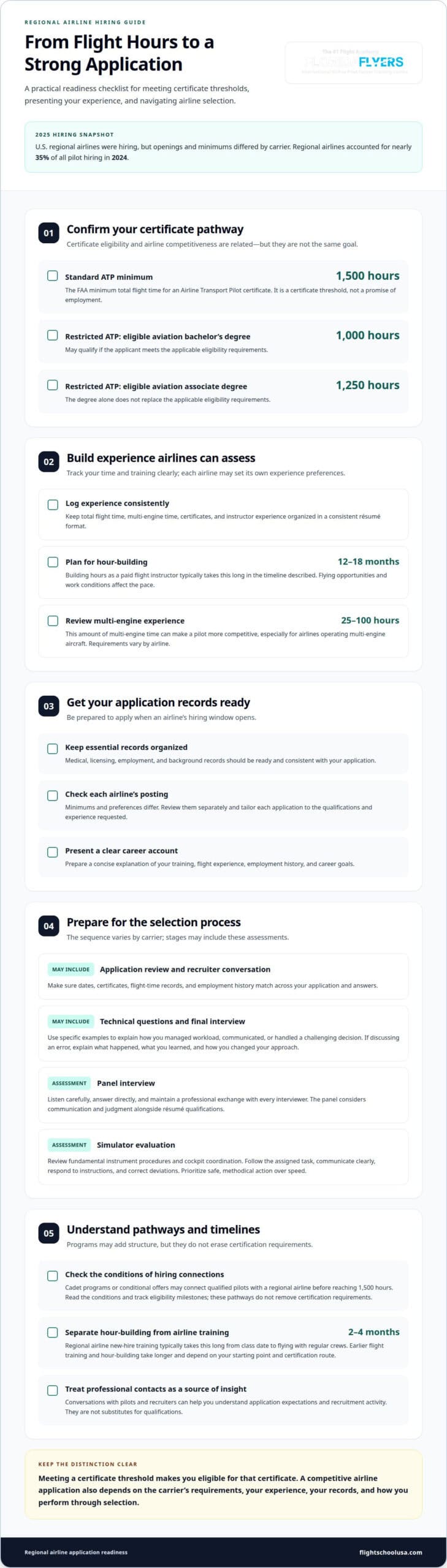
Yes. U.S. regional airlines were hiring in 2025, although openings and minimums differed by carrier. Regional airlines accounted for nearly 35% of all pilot hiring in 2024. That activity makes regional flying a potential entry point, not an automatic job offer. Applicants still need the required certificates, competitive experience, and a strong application. A practical answer to how to get hired by a regional airline begins with understanding which qualifications apply to your own pathway.
For most pilots, the central licensing milestone is the Airline Transport Pilot certificate. According to the Federal Aviation Administration, its minimum flight-hour requirement is 1,500 total hours. That figure is a certificate threshold, not a guarantee of employment. Airlines can set their own experience preferences, and an applicant’s credentials and records also matter. Pilots planning how to get hired by a regional airline should treat certificate eligibility and airline competitiveness as related, but distinct, goals.
Some U.S. aviation graduates may qualify for a Restricted ATP certificate with fewer hours. According to the Federal Aviation Administration, an applicant with a bachelor’s degree in aviation may qualify with 1,000 flight hours. An applicant with an associate degree in aviation may qualify with 1,250 flight hours, according to the Federal Aviation Administration. These pathways depend on meeting the applicable eligibility requirements; the degree alone does not replace them.
Training turns certification requirements into a progression of skills and logged experience. Pilots commonly build hours through flight instruction after earning instructor qualifications. In the timeline described, building hours as a paid instructor typically takes 12-18 months. The pace depends on flying opportunities and work conditions, so treat that timeline as a planning reference, not a fixed schedule.
Multi-engine experience can strengthen an application, especially when a regional airline operates multi-engine aircraft. Requirements vary by airline, and 25-100 hours of multi-engine time can make a pilot more competitive. Before applying, review each posting’s minimums separately. Track total time, multi-engine time, certificates, and instructor experience in a consistent résumé format.
Hiring and training timelines have separate stages. Regional airline new-hire training typically takes 2-4 months from class date to flying with regular crews. Earlier flight training and hour-building take longer and depend on the pilot’s starting point and route to certification. Training costs also vary with prior experience, required instruction, and whether ATP-CTP training is purchased independently or provided through an employer.
Pay and benefits depend on the airline, position, and employment terms. The U.S. Bureau of Labor Statistics reported a median annual wage of $217,240 for airline pilots as of May 2023, but that figure covers airline pilots generally, not regional first officers specifically. Compare the written offer’s compensation and benefits details rather than treating a national median as a regional-airline pay estimate.
Regional airline hiring can include an application review, interviews, and practical assessments. Prepare accurate records and be ready to demonstrate disciplined decision-making at each stage.
Interview stages are assessments airlines use to evaluate an applicant’s qualifications, communication, and professional judgment. The sequence varies by carrier, but may include an application review, a recruiter conversation, technical questions, and a final interview. Each stage has a different purpose. Clear, consistent answers help recruiters compare your experience with the role’s stated requirements.
Prepare a concise account of your training, flight experience, and employment history. Use specific examples to explain how you managed workload, communicated, or handled a challenging decision. Keep dates, certificates, and flight-time records consistent with your application. If asked about an error, explain what happened, what you learned, and how you changed your approach.
A panel interview brings several airline representatives into one conversation, while a simulator evaluation observes your performance during a simulated flight task. These assessments let airlines consider communication and applied judgment alongside résumé qualifications. Listen carefully to each question, answer directly, and maintain a professional exchange with every interviewer.
In a simulator, follow the assigned task and use clear crew communication. The evaluation may focus on how you manage workload, respond to instructions, and correct deviations, not just polished performance. Review fundamental instrument procedures and cockpit coordination beforehand. If you’re uncertain, explain your reasoning and prioritize safe, methodical action over speed.
Hiring connections are formal pathways that link qualified pilots with an airline’s recruitment process. A cadet program or conditional offer may allow a pilot to connect with a regional airline before reaching 1,500 hours. These pathways can provide structure, but they don’t remove certification requirements. Read the program’s conditions carefully and track the milestones tied to eligibility.
Professional contacts can also help you understand application expectations and upcoming recruitment activity. Treat conversations with pilots and recruiters as opportunities to learn, not as substitutes for qualifications. Ask focused questions about interview format or required documents, then use the answers to prepare. Under 14 CFR part 111, airlines must search a pilot’s past work in the Pilot Records Database. Accurate employment details therefore matter throughout the process.
ATP-CTP training includes 30 hours of ground school plus simulator time. Prepare to explain how your training supports airline operations, then connect each answer to a relevant example. Pilots developing their qualifications can explore airline-focused flight training as part of a deliberate career plan.
Regional airline roles have different qualification profiles. Pilots need the certificates and flight experience listed for the position; flight attendants, mechanics, and other applicants need role-relevant training, credentials, and experience. Requirements depend on the specific job posting, so assess each position separately.
For pilots, medical eligibility and licensing are separate considerations. A certificate establishes authority to perform specified pilot duties, while medical qualification addresses fitness for those duties. Keep both current and ensure the details match your application. If a medical issue affects your eligibility, understand its documentation and status before discussing it with an airline recruiter.
Age requirements depend on the certification or job involved. The Federal Aviation Administration states that applicants must be at least 18 years of age. Separately, according to the Federal Aviation Administration, U.S. airline pilots are subject to mandatory retirement at age 65. These are distinct points: one concerns a minimum age, while the other sets an upper limit for airline pilot service.
Language ability also matters in airline operations. Applicants must communicate clearly in interviews and demonstrate precise, professional communication in work-related scenarios. For example, a pilot discussing a crew coordination challenge should explain the situation, the information shared, and the action taken. Clear answers help interviewers assess judgment without confusing communication style with technical credentials.
Background screening requires accurate employment history. Under 49 CFR 40.25, airlines must obtain drug and alcohol testing records from a pilot’s past DOT-regulated employers, according to the U.S. Department of Transportation. Give complete employer details and consistent dates. A discrepancy between an application and employment records can complicate screening, so explain gaps or changes accurately.
Before applying, organize the materials that support your eligibility. Tailor your résumé to the role, then compare its dates and qualifications with your application records. Pilots should have certificates, flight experience, and employment details ready to discuss. Mechanics should focus on maintenance-related training and relevant work history. Flight attendants should prepare examples that demonstrate service judgment and clear communication.
Different airline positions require different evidence of readiness. A pilot interview may examine operational decision-making, while a flight attendant interview may focus on communication and passenger-facing judgment. A mechanic’s hiring process may emphasize technical experience and careful procedures. Don’t assume pilot requirements apply to every employee or that a general résumé covers specialized qualifications.
Use the job posting as your checklist. Identify each stated credential, experience category, and screening step, then prepare a direct explanation for each. For example, if asked about a transition in your work history, state the dates and reason plainly. Accurate, consistent records support a credible application at every stage.
Hiring windows open and close as airlines adjust staffing needs, so prepare before applications appear. A ready application helps you act promptly without sacrificing accuracy.
Keep your application materials current and match them to each airline’s posted requirements. Openings can attract applicants quickly, while incomplete records create avoidable delays. Maintain an up-to-date résumé, certificate details, flight-time summaries, and employment history. Review each posting for required qualifications and apply when your records support them.
Build a simple tracking system for airline careers pages and application status. Record the date you applied, the position, and any requested follow-up. AOPA noted renewed pilot hiring momentum in January 2026, a useful reminder to monitor recruitment activity rather than rely on a single annual hiring season. Set aside time to review new postings regularly.
Before submitting, tailor your résumé to the role without changing the facts. Make relevant experience and qualifications easy for recruiters to find. Pilots should clearly distinguish their flight experience, while mechanics should foreground maintenance experience. Use consistent dates and terminology across your résumé, application form, and supporting records.
Application weaknesses can prevent an airline from advancing a candidate. An avoidable error may obscure otherwise relevant experience. Common problems include missing fields, inaccurate employment dates, unsupported qualifications, and a résumé that doesn’t address the posted requirements. Review every section before submitting, and correct discrepancies rather than leaving unexplained gaps.
Some regional airlines used weekly new-hire classes in late 2025, and American, United, and Delta together hired about 500 pilots per month. That market activity doesn’t mean every applicant meets every carrier’s criteria. Apply to roles that align with your current qualifications, and avoid presenting a target credential as already earned.
Use a final application review in a fixed order:
If an airline requests clarification, respond with concise, consistent details. For example, explain a gap by stating its dates and relevant context without adding unsupported claims. Keep interview examples aligned with your written application. Careful preparation can’t control an airline’s hiring decision, but it can prevent incomplete or conflicting information from weakening your candidacy.
Regional flying can provide airline operating experience and a path toward later career options, but progression depends on hiring cycles, qualifications, and personal priorities. U.S. regional airlines mostly operate aircraft with 50 to 76 seats, placing pilots in scheduled airline operations while they build experience.
Work schedules and relocation expectations depend on the airline, assigned base, routes, and crew needs. A pilot who lives far from the assigned base may need to relocate or manage a commute. Before accepting an offer, consider how the base location and schedule fit your family responsibilities, rest, and personal commitments.
The first officer role builds operational experience within an airline crew structure. Historically, a captain upgrade has taken about two to five years, depending on the hiring cycle. That range describes a past pattern, not a fixed promotion timetable. Hiring demand, company requirements, and a pilot’s qualifications can all affect when an upgrade becomes available.
Progression beyond a regional airline also varies. Some pilots pursue a flow program, where a regional airline pathway may connect with a major airline. One reported estimate put that progression at up to eight years. Assess the regional role on its own merits rather than treating a future transition as immediate or automatic.
Regional experience can build familiarity with airline procedures, crew coordination, and scheduled operations. It also gives pilots opportunities to develop sound judgment in routine and changing conditions. For example, a first officer can strengthen communication by briefing clearly, sharing relevant information, and responding methodically when a flight plan changes.
Evaluate an offer across several dimensions, not just the next career step:
These factors matter because career progression and lifestyle are linked. A faster upgrade may appeal to one pilot, while another may prioritize a manageable base or schedule. Compare the actual role with your objectives, and don’t plan around an assumed promotion date. View regional flying as a professional chapter that can build relevant experience, not as a guaranteed bridge to another airline.
Flight School USA’s Airline Ready Program is a career-focused next step for pilots preparing to pursue airline opportunities. Consider this pathway when aligning your training, qualifications, and application goals with regional airline hiring requirements. It gives your career preparation a clear focus as you work toward the next stage of professional aviation.
If you’re earlier in training, the Fixed-Price Career Program or CFI Fast Track Program may better fit your current stage. Eligible veterans can also explore GI Bill Flight Training. The right option depends on your progress and the qualification milestones ahead. Contact Flight School USA to discuss your airline career preparation.
The question of how to get hired by a regional airline becomes more manageable when your next training step matches your current qualifications. Choose a clear milestone, then build a disciplined plan around the experience and preparation still ahead. Consistent progress matters more than chasing a career timeline that may not fit your circumstances.
Flight School USA offers the Fixed-Price Career Program and CFI Fast Track Program for pilots pursuing structured training pathways. Veterans can also explore GI Bill Flight Training. Consider which option aligns with your training stage and professional goals, then use that choice to focus your next steps.
Ready to discuss your aviation career path? АКШнын учуу мектебине кайрылыңыз to explore your options and move forward with purpose.
Yes, you can pursue regional airline work by targeting a role that matches your qualifications and experience. First, decide whether you’re pursuing a pilot, flight attendant, mechanic, or another position. Then compare your training and work history with current job-posting requirements. Pilots should plan a professional flight path; applicants for other roles should present job-specific skills and credentials clearly.
Apply through the airline’s recruitment process and provide the records requested for the specific position. Prepare a résumé, employment history, qualifications, and relevant certificates or training details. Pilots should organize flight experience and certificate information; mechanics can foreground technical work history. Follow each application’s instructions, use consistent dates, and save a copy of your submission so you can answer follow-up questions accurately.
Hiring openings and crew bases change with airline staffing needs, so no fixed list applies throughout the year. Check each current job posting for the airline, position, and assigned base. Base location can affect commuting, relocation, and daily logistics. Before applying, compare the posted base with your practical location preferences and consider whether you could relocate if the position requires it.
Hiring commonly involves an application review, interviews, assessments, and background screening, though carriers set their own processes. Interview questions may ask how you handled a disagreement, responded to changing information, or communicated under pressure. Prepare concise examples that explain your actions and reasoning. Pilots should also provide accurate employment details, since airlines obtain drug and alcohol testing records from past DOT-regulated employers under 49 CFR 40.25.
Requirements depend on the job and the airline’s posting. Pilot applicants need the certificates and flight experience specified for the position. Flight attendants, mechanics, and other employees need qualifications relevant to their duties, such as applicable training or technical experience. Treat the listed requirements as role-specific criteria rather than assuming one credential applies across the airline. Match each required qualification with clear evidence in your application.
Aspiring pilots can progress through flight training, earn the required certificates, and build experience through eligible flying work such as flight instruction. Keep an orderly record of flight activity and training milestones for future applications. A Restricted ATP pathway may apply to some eligible graduates, so confirm which route fits your education and qualifications. Plan hour-building around available flying opportunities and the credentials each target role requires.
Some regional airline pathways include cadet programs or conditional offers before a pilot reaches the standard hour threshold. Program terms vary, so review the required milestones, eligibility criteria, and any commitments carefully. Flight schools can also offer career-focused training to prepare aspiring pilots for professional aviation. Flight School USA’s Airline Ready Program is one training option aligned with airline career preparation.
Pay and benefits vary by airline, position, and employment terms. The reported median annual wage of $217,240 for airline pilots is not specific to regional first officers, so compare the compensation and benefits in the written offer.


