

Are pilots genuinely satisfied with their careers, or does the reality of the job outweigh the appeal? Pilot job satisfaction is more complex than a ranking or an individual account can show. Prestige and earning potential may draw people to aviation, but they don’t tell you how a particular role’s schedule, responsibilities, and daily demands will feel.
Public rankings and pilots’ experiences can seem contradictory because satisfaction varies across career paths. Survey results describe groups of respondents, not a guarantee of what you’ll experience. The more useful question is which conditions support satisfaction and whether they match your priorities.
This article breaks down the main dimensions of pilot job satisfaction, explains how to interpret survey findings carefully, and compares realities that can differ between pilot roles. You’ll also find practical questions to help assess whether aviation fits your professional goals and preferred lifestyle. Understanding both the demands and the rewards is an essential part of preparing for a pilot career.
Pilot job satisfaction is a multidimensional assessment of how well a pilot’s work meets their expectations across factors such as compensation, meaning, work environment, and skills use. It is not a prediction of how any one person will feel. A single happiness rating offers a snapshot, but it can’t show which parts of the job are working well or where the trade-offs lie.
CareerExplorer reports that pilots rate their career happiness at 3.8 out of 5 stars, placing the career in the top 15%. That is a reported rating, not proof that pilots across every role and career stage share the same experience. Nor is it a personal forecast. Someone who values predictable time at home may assess a role differently from someone who prioritizes travel or operational responsibility.
CareerExplorer separates career satisfaction into compensation, meaning, personality fit, work environment, and skills use. These dimensions help explain why a positive overall rating can coexist with very different individual experiences. Strong compensation, for example, doesn’t automatically mean a pilot finds the work meaningful or the environment suitable.
Evaluate each dimension against your own priorities. Ask yourself:
Rank these factors rather than treating them as equally important. For example, if schedule predictability matters more to you than travel, make that distinction explicit. A ranked list gives you a practical standard for comparing a career path with your expectations.
CareerExplorer’s figure uses a five-star rating scale. The available reporting for the 3.8 score does not specify a survey date, sample size, or respondent breakdown, so those details shouldn’t be assumed. Readers can note what CareerExplorer reports, but can’t establish from that figure alone how closely respondents represent the wider pilot workforce.
Keep the finding separate from broader conclusions. A rating describes responses gathered under a particular source’s method; it doesn’t establish that every pilot is satisfied. Sample size can affect how stable a result is, self-selection can influence who responds, and broad role definitions may combine pilots with substantially different work. Treat the score as one reference point. For a sound career decision, compare it with the specific duties, work setting, and priorities that matter to you.
A pilot’s role and working conditions can shape satisfaction independently of the job title. The word ұшқыш covers work with different missions, schedules, team structures, and responsibilities. A pilot focused on scheduled passenger operations may experience a different working rhythm from someone flying corporate trips, carrying out military missions, or instructing students. Comparing satisfaction without comparing the work itself can obscure what matters most.
Airline pilots operate within passenger schedules and established crew structures. Corporate pilots support an organization’s or client’s travel needs, while military pilots work within mission priorities and command structures. Flight instructors divide their attention between operating an aircraft and helping students develop their knowledge and skills. These descriptions are broad; duties and working arrangements vary within each field.
Compare the practical demands of the roles you’re considering:
No category guarantees a better lifestyle or higher satisfaction. Compare the actual demands of a role with the conditions in which you do your best work.
Career fit can change as experience and personal priorities evolve. Early in a career, structured learning, skill development, and gaining experience may be central considerations. With experience, a pilot may place greater weight on autonomy, leadership, type of operation, or schedule preferences. These are possible shifts, not a universal progression; seniority or time in the profession doesn’t guarantee a particular assignment or lifestyle.
Before committing to a path, compare its responsibilities with your priorities now, then consider how those priorities could change. Would you welcome a role centered on instruction, or do you prefer working within a larger crew? How much schedule variability feels manageable? Which non-flying duties are part of the role, and do they appeal to you? Specific answers are more useful than relying on a job title alone.
For aspiring pilots, career-focused preparation can help connect training goals with the demands of professional flying. Exploring career-focused flight training is one way to consider how deliberate preparation fits into your longer-term plans. Training can build readiness, but it can’t determine future job satisfaction.
Rankings can help frame the question, but they don’t provide a single, interchangeable measure of whether pilots are happy at work. A career score, a self-reported satisfaction rating, and a wage statistic each describe something different. Read each result according to its source and scale, then consider what it leaves out about an individual pilot’s role and priorities.
The figures below come from different publishers and measures. They shouldn’t be combined into one score or treated as if they came from the same survey. CareerExplorer’s reported ratings offer a view of career happiness and selected dimensions; the U.S. News figure is an overall career score, not a direct satisfaction result. The wage statistic provides compensation context, not evidence of happiness.
| қайнар көз | Өлшеу және масштабтау | Reported result |
|---|---|---|
| CareerExplorer | Career happiness, 5-star scale | 3.8 out of 5; listed in the top 15% of careers |
| CareerExplorer | Compensation satisfaction and meaningfulness, 5-star scale | 3.4 out of 5 for compensation; 3.6 out of 5 for meaningfulness |
| АҚШ жаңалықтары | Overall career score, 10-point scale | 6.4 out of 10 in the supplied profile excerpt, not a job-satisfaction score |
| Еңбек статистика бюросы АҚШ | Median annual wage for airline pilots, copilots, and flight engineers | May 2024 data, reported at about $226,600 to $232,140 in 2026 sources |
Publication dates and methodology matter. The available CareerExplorer figures don’t establish a survey date, sample size, or respondent breakdown, and the U.S. News ranking year and scoring method should be verified before describing its figure as current. Until those details are established, treat the numbers as attributed results, not a complete measurement of today’s pilot workforce. BLS wage data describes a defined occupational group and period, not how satisfied each person is with their pay.
A favorable rating can coexist with demands that matter greatly to a particular pilot. Depending on the role, schedules and time away may be important considerations, while another pilot may place greater weight on compensation, teamwork, or the meaning they find in the work. These factors vary by position and circumstances; no single trade-off applies to everyone.
Pay and meaningfulness are distinct. A person can value the purpose of the work while wanting different compensation, or feel well-compensated while finding other aspects less rewarding. That distinction helps explain why a satisfaction rating and a salary figure may point in different directions without contradicting each other.
For compensation context, compare the measures carefully with the 2026 airline pilot salary guide. Use earnings as one input in your assessment of pilot job satisfaction, alongside the working conditions and priorities that shape your own definition of a good career.
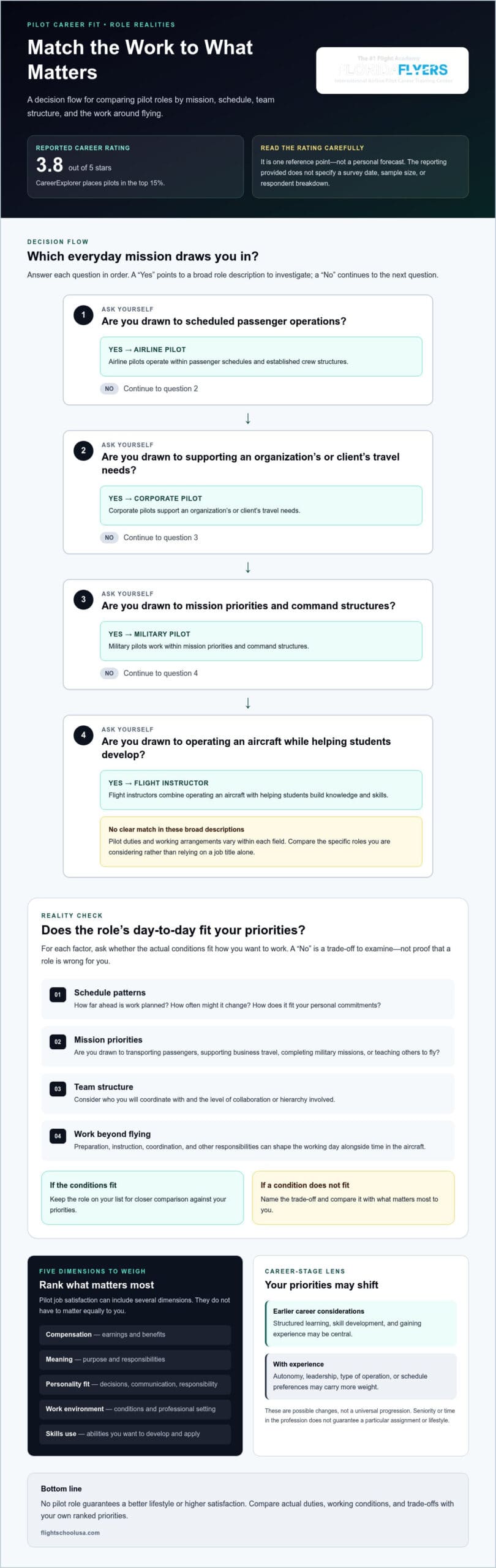
A useful career-fit assessment is not a pass-or-fail test. It’s a disciplined way to identify what you value, compare those priorities with the work itself, and surface questions that deserve better answers before you commit. The result shouldn’t predict whether you’ll be satisfied; it should clarify which conditions you’re prepared to accept and which could undermine long-term fit.
Make the comparison concrete. Create two columns: “conditions I prefer” and “what this role requires.” Include travel, schedule demands, decision-making responsibility, technical tasks, collaboration, and mission purpose. Then mark which differences you can accept, which need more investigation, and which could become persistent sources of dissatisfaction. This written exercise is more useful than assigning yourself a score; a checklist can organize your thinking, but it can’t forecast your experience.
Test your expectations by speaking with people in the pilot roles you’re considering. Ask about a typical work period, how duties extend beyond flying, which parts of the role they find demanding, and what changed as they gained experience. Compare those perspectives with current, credible career information. One person’s account is useful context, not a universal description, so focus on details that apply to the specific work setting you have in mind.
As you build practical knowledge, revisit why aviation appeals to you and whether the full professional role still aligns with your priorities. For structured preparation connected to career goals, кәсіби ұшу дайындығын зерттеу as a step in informed planning, not a promise of future pilot job satisfaction.
Career planning doesn’t end with deciding that flying appeals to you. Professional preparation can help you understand the discipline, standards, and progression involved in pilot training, while giving you a more informed basis for considering the work ahead. It can’t determine whether you’ll enjoy a particular role or guarantee employment, salary, or pilot job satisfaction.
Structured training turns preparation into a sequence of defined learning and skill-development goals rather than an abstract career idea. As you progress, you can reflect on how you respond to study, practical flight experience, and the responsibilities involved in becoming a professional pilot. That experience can help you test assumptions about aviation, though it isn’t a substitute for learning about the day-to-day realities of a specific job.
Flight School USA operates under FAA Part 141 and Part 61 certifications and offers career-focused programs, including the Airline Ready Program and CFI Fast Track. These programs support professional preparation. Understanding the training pathway and its requirements can help you connect career ambitions with the work of building skills and readiness.
For a broader look at the preparation pathway, the airline pilot career training guide can help you consider how training relates to professional goals. Use career materials alongside your own priorities: a training plan may clarify what preparation involves, but no curriculum can establish in advance how satisfying a future role will feel.
Return to your written priorities and compare them with the career realities you’ve identified. Consider whether the demands of preparation and the responsibilities of your intended role align with what you want from work. If an important question remains unanswered, identify it specifically and seek current, role-relevant information before treating an assumption as fact.
Flight School USA’s career-focused training offers a structured way to pursue pilot preparation, including the Airline Ready Program, CFI Fast Track, and Fixed-Price Career Program. Exploring these professional training programs can be a practical next step for aspiring pilots weighing their goals against the commitment involved. Approach the decision deliberately: preparation builds knowledge and readiness, while career fit remains a personal judgment shaped by the role and your priorities.
Use your priorities as a working guide, not a fixed verdict. As you learn more about professional aviation, revisit what you want from your work and whether the responsibilities of your intended path still align. A thoughtful approach to pilot job satisfaction starts before choosing a training route: build a clear picture of the career you’re preparing to pursue.
Flight School USA has prepared aspiring pilots since 2008 and operates under FAA Part 141 and Part 61 certifications. Its career-focused options include the Airline Ready Program and CFI Fast Track. Structured preparation can support readiness and informed planning, but your career experience will depend on your role and personal priorities.
Explore the programs and consider how they fit your goals. АҚШ-тың Flight School кәсіби ұшқыштарды даярлау бағдарламаларымен танысыңыз as you plan your next step. With realistic expectations and deliberate preparation, you can move toward an aviation career with greater clarity and confidence.
Some pilots are happy with their work, but experiences differ. CareerExplorer reports a career-happiness rating of 3.8 out of 5 for pilots; that figure describes its respondents, not every pilot. Before relying on it, look for the survey’s date, sample size, and methodology. For your own decision, consider how a role’s routine duties, schedule, and working relationships might affect you, not just whether the career sounds appealing.
It can be demanding, but stress varies with the position, operating environment, and individual. A pilot handling consequential decisions may experience pressure differently from someone balancing instruction with their own flying duties. Consider what situations challenge you: time-sensitive decisions, changing plans, high responsibility, or extended periods away. Learning how those factors appear in the specific role you’re considering is more useful than labeling the entire profession stressful or stress-free.
Yes. A pilot may find the work rewarding while accepting schedule demands, but the balance is personal. For example, someone with few fixed commitments might view travel differently from someone responsible for regular caregiving. Think through how you’d handle a schedule change that affects an important personal event. That concrete scenario can reveal more about your preferences than a general question about whether you enjoy travel or can tolerate time away.
Some do, while others may prefer different responsibilities or work settings. To assess instructional flying, consider whether you enjoy explaining procedures, observing a learner’s progress, and communicating clearly as skills develop. Also reflect on how you’d feel sharing attention between operating the aircraft and supporting someone else’s learning. Those preferences can help you judge the work on its own terms, rather than assuming instruction suits every aspiring pilot.
Neither salary nor meaning alone determines satisfaction. CareerExplorer reports separate ratings for compensation satisfaction and meaningfulness, which can reflect different parts of respondents’ experience. In practice, consider what a higher income would need to offset, if anything, and how much purpose matters in your daily work. Your answer may also depend on schedule, workplace, and responsibilities, so identify which factors are essential rather than assuming pay settles the question.
Yes. Enjoying aircraft, aviation news, or the experience of flying doesn’t necessarily mean every professional role will suit you. A person might love the technical side of flying but dislike a particular workplace routine or amount of travel. Write down what you enjoy about aviation, then compare each item with the routine duties of a role you’re considering. This separates enthusiasm for the field from fit with a specific job.


