

In an industry where 359,151 student pilots are currently vying for a seat in the flight deck, the greatest threat to your professional progression isn’t the checkride; it’s the financial volatility of an open-ended syllabus. You’ve likely felt the anxiety of unpredictable fuel surcharges and the frustration of variable instructor availability slowing your momentum. These variables don’t just delay your certification; they threaten to exhaust your capital before you ever reach the 1,500-hour threshold required for airline employment. Selecting a high-performance fixed price flight training program is the elite choice for aviators who demand financial certainty and refuse to let market fluctuations dictate their career trajectory.
This 2026 strategic guide masters the financial mechanics of professional aviation training to ensure you maintain a competitive edge. We’ll demonstrate why a fixed-price career program serves as the ultimate risk-mitigation tool for serious candidates. You’ll discover how to leverage elite institutional backing to accelerate your timeline to the airlines. We’ll also break down the transition from zero experience to the Airline Ready Program, ensuring your path remains compliant with evolving FAA Part 141 standards while providing the total immersion necessary for professional excellence.
The aviation industry in 2026 demands a level of financial discipline that mirrors the rigors of the cockpit itself. For most aspiring pilots, the choice between hourly billing and a program pelatihan penerbangan rega tetep is the difference between a calculated investment and a high-stakes gamble. A fixed-price program is a binding contractual commitment to a specific curriculum for a set fee, providing a definitive ceiling on your educational expenses. In contrast, the traditional pay-as-you-go model operates on estimates that are frequently shattered by market fluctuations. Relying on hourly rates means you are effectively assuming the school’s operational risks, including maintenance overhead and rising insurance premiums.
Hourly billing exposes students to the immediate impact of operational cost spikes. Fuel surcharges alone can unexpectedly increase training costs by 15-20% mid-program, forcing many to pause their progress until additional capital is secured. This creates a destructive cycle of re-learning. When variable scheduling or budget gaps extend the training timeline, students spend thousands of dollars repeating maneuvers to regain proficiency rather than advancing. These models lack the urgency of a structured career track, often resulting in training creep where the path to meeting pilot licensing and certification requirements takes twice as long as projected. Budget exhaustion is a common outcome for those who fail to account for these variables from the outset.
Ngadopsi a program pelatihan penerbangan rega tetep functions as a strategic hedge against the persistent inflation seen across the training sector in 2026. It eliminates checkbook fatigue, a primary cause of student attrition where the mental load of funding each flight hour detracts from instructional focus. By guaranteeing the availability of aircraft and elite instructors within the program fee, this model ensures that your progress is never stalled by administrative or financial bottlenecks. This certainty allows for 100% focus on cockpit performance and checkride preparation. Professional aviators view the Fixed-Price Career Program not as a budget option, but as a sophisticated risk-management strategy designed to protect their most valuable asset: their time. It’s the only way to ensure that your path to the flight deck remains direct, predictable, and fully funded.
A profesional program pelatihan penerbangan rega tetep isn’t merely a bundle of flight hours; it’s a unified career bridge. While many schools list ratings like individual menu items, an elite program integrates Private Pilot, Instrument, Commercial, and Multi-Engine ratings into a single, high-velocity progression. This “Zero to Hero” structure ensures that every flight hour serves a dual purpose: meeting FAA requirements while building the specific competencies required by major airlines. It’s a methodical approach that eliminates the fragmentation common in decentralized training environments. This integration is the hallmark of a premier institution that prioritizes career results over simple flight time accumulation.
Beyond the cockpit, the program synthesizes advanced ground school and high-fidelity simulator time into the core tuition. This isn’t supplementary; it’s foundational. We incorporate a “Command Presence” curriculum that focuses on crew resource management, situational awareness, and professional deportment. This prepares candidates for the psychological rigors of airline interviews long before they reach the 1,500-hour mark. For those who demand excellence, our Fixed-Price Career Program provides the structure needed to master these high-stakes skills and ensures that every student is ready to transition into a commercial flight deck with confidence.
Part 141 schools are the backbone of fixed-price certainty because they operate under a rigid, FAA-approved syllabus. This structure is vital for understanding flight training costs and forms the basis of a reliable program pelatihan penerbangan rega tetep. Elite institutions often possess FAA self-examining authority, which eliminates the weeks of downtime typically lost to checkride wait times. By mirroring the procedural discipline of an air carrier, students develop the professional habits necessary for immediate success.
Residential training is a strategic tool for completion, not a luxury. By utilizing dedicated Student Housing, candidates enter a 24/7 aviation environment that fosters peer-to-peer learning and professional accountability. Living on-site removes the logistical friction of daily commutes and external distractions that often derail momentum. This total immersion approach significantly increases ROI by reducing the total calendar time required to reach professional standards. It ensures you reach the airlines with maximum efficiency while maintaining a singular focus on your training goals.
Evaluating flight training costs through a purely hourly lens is a fundamental strategic error. While the pay-as-you-go model presents a lower initial barrier to entry, it masks the total capital outlay required to reach professional standards. A program pelatihan penerbangan rega tetep provides a definitive cost structure that protects your investment from the training creep discussed in previous sections. This model isn’t just about tuition; it’s about Career Velocity. By following a structured, high-intensity path, you’re positioned to enter the airline job market up to six months earlier than those navigating variable hourly schedules. The financial impact of this acceleration is massive when you consider that a pilot’s earning potential is heavily back-loaded toward their final years of seniority.
Candidates often ask what happens if they reach proficiency in fewer hours than the program allocates. In a professional context, focusing on minimums is a novice mistake. Elite training isn’t about meeting the bare FAA requirements; it’s about achieving a level of mastery that guarantees success in airline initial operating experience. By enrolling in a program pelatihan penerbangan rega tetep, you’re prioritizing mission readiness and timeline certainty over hourly accounting. Even the most prestigious institutions, including the U.S. Air Force Undergraduate Pilot Training, utilize firm-fixed-price structures because they prioritize results over administrative minutiae.
Every month spent in training is a month of lost seniority. In the 2026 hiring environment, delaying your entry into a regional or major carrier by just 180 days can result in hundreds of thousands of dollars in lost lifetime earnings. This is why top-tier candidates use a fixed-price model to hit airline pilot salary benchmarks as quickly as possible. You aren’t just paying for flight time; you’re buying a guaranteed seat in a training aircraft during periods of peak demand, ensuring your timeline remains intact.
Fixed-price contracts simplify the capital acquisition process for serious students. Lenders like Sallie Mae prefer defined tuition numbers over open-ended estimates, making the loan approval process more efficient. For veterans, the strategic use of GI Bill flight training benefits is most effective when applied to a fixed-price structure. It ensures all certifications are covered without the risk of out-of-pocket surcharges. Transparency in pricing isn’t a luxury; it’s a prerequisite for professional financial planning in a high-stakes industry.
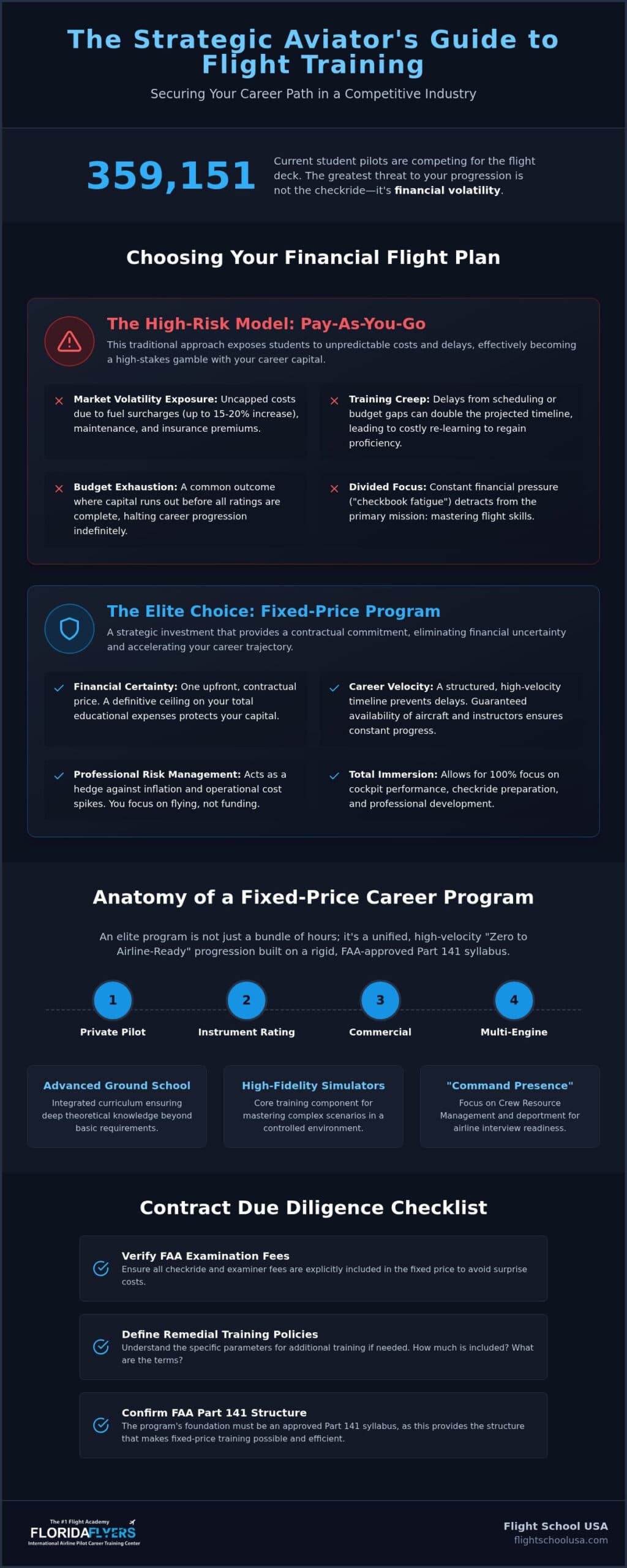
A profesional program pelatihan penerbangan rega tetep is a legal instrument, not just a marketing promise. You must scrutinize the specific terms of any agreement to ensure it provides the immunity from market volatility discussed earlier. A true fixed-price contract must define “all-inclusive” with absolute precision. Verify whether the fee covers FAA knowledge test fees, which average approximately $175 per test, and FAA checkride examiner fees that currently range from $600 to $1,000. Excluding these line items can result in thousands of dollars in unbudgeted expenses. You should also demand transparency regarding the school’s aircraft-to-student ratio. A guaranteed price is irrelevant if the institution lacks the fleet capacity to support your high-velocity timeline.
Overage policies represent another critical area for due diligence. Rigorous programs should define the parameters for remedial training and specify what happens if a student requires additional hours to reach proficiency. Elite schools don’t just offer “budget” equipment; they maintain a modern fleet with standardized glass cockpits to ensure your training mirrors airline environments. If you’re ready to commit to a professional standard, you can apply for the Fixed-Price Career Program to secure your path with a proven institutional leader.
Confirm that your agreement includes a total exemption from fuel surcharges. In an era of energy price instability, this is a non-negotiable requirement for financial certainty. Ensure the curriculum integrates the CFI Fast Track to facilitate the transition from commercial pilot to the 1,500-hour airline requirement. Your contract should also explicitly list “Airline Ready” components, such as advanced systems training and Crew Resource Management (CRM). These are essential for navigating the complex hiring standards of 2026 and aren’t always included in basic commercial syllabi.
Longevity is the ultimate indicator of contract reliability. An institution established in 2008 has navigated multiple industry cycles and possesses the operational maturity to honor long-term financial commitments. Evaluate the school’s safety culture as a primary metric of professional standing; safety and procedural accuracy are the foundations of an elite career. Finally, verify the efficacy of their career placement services. A fixed-price program is an investment in a specific outcome, and the school’s ability to bridge the gap between training and airline employment is a critical component of its total value proposition.
Flight School USA stands as the definitive authority for aviators who prioritize results, efficiency, and professional gravity. Our Fixed-Price Career Program is more than a financial arrangement; it’s a rigorous academy designed to produce the next generation of airline commanders. We don’t just train you to pass a checkride. We prepare you to lead a crew. This “Airline Ready” philosophy ensures that your transition from a program pelatihan penerbangan rega tetep to a commercial cockpit is seamless and professional. Every aspect of our curriculum is built on the foundation of regulatory compliance and high-level discipline. We are the gatekeepers of industry standards, ensuring that every graduate possesses the technical proficiency required by the world’s leading carriers.
We take a protective stance regarding your career progression by offering specialized support systems that eliminate administrative friction. For veterans, we streamline the application of GI Bill Flight Training benefits to ensure a seamless transition into civilian aviation without financial surprises. International students receive a comprehensive roadmap through our M1 Visa admission services, providing access to the prestige and rigor of U.S. certification standards. To maintain your training momentum, we provide dedicated student housing that facilitates total immersion. Living the professional pilot life from day one isn’t a suggestion; it’s a strategic tool for faster completion and deeper technical mastery. This environment fosters peer-to-peer accountability and ensures you remain focused on your ultimate objective.
Our academy operates with a no-nonsense attitude toward professional development and regulatory adherence. We act as an elite career mentor for those who demand excellence and refuse to accept the volatility of traditional training models. Choosing a program pelatihan penerbangan rega tetep with Flight School USA is a definitive statement of intent. It signals to the industry that you are a disciplined professional who values strategic risk management and career velocity. The path to the flight deck is complex, but your financial and instructional roadmap should be absolute. Take command of your future and join a powerhouse of industry knowledge that delivers measurable results. Success in the 2026 aviation market requires a partner that is as serious about your career as you are.
Apply for the Fixed-Price Career Program Today and secure your position in the next generation of professional pilots.
The transition to a professional flight deck requires more than just logged hours; it demands a strategic allocation of capital and an unwavering commitment to procedural excellence. By securing a program pelatihan penerbangan rega tetep, you eliminate the financial instability that often derails aspiring aviators. You’ve seen how career velocity and institutional credibility serve as the primary drivers for reaching the 1,500-hour threshold with maximum efficiency. As an FAA Part 141 Certified Elite Academy, we provide the rigid structure and high-stakes environment necessary for airline success.
Whether you require comprehensive GI Bill and M1 Visa support or seek total immersion through dedicated career-track student housing, your path to command is defined by the partners you choose. Don’t leave your professional future to the volatility of hourly estimates. Take control of your progression and join an institution that treats your certification as a critical legal standing. Your journey to the left seat begins with a single, disciplined decision.
Secure Your Future in the Fixed-Price Career Program
A profesional program pelatihan penerbangan rega tetep includes all essential components to transition from zero experience to a commercial pilot. This encompasses ground school instruction, high-fidelity simulator sessions, aircraft rental for all syllabus requirements, and dedicated instructor time. It’s a contractual commitment to a specific curriculum, ensuring that the student is not penalized for the school’s operational overhead or administrative maintenance costs throughout the training duration.
True fixed-price contracts serve as a strategic hedge against aviation industry inflation. At Flight School USA, the agreement is designed to eliminate exposure to fuel surcharges and unpredictable insurance premium hikes. While students must verify specific inclusions regarding FAA exam fees, the core training costs remain absolute. This financial certainty allows candidates to maintain a singular focus on cockpit performance without the distraction of fluctuating market rates.
The duration of a structured career track depends on the student’s commitment to full-time immersion, though Part 141 programs are engineered for high velocity. By following a rigid, FAA-approved syllabus, students can often reach commercial certification significantly faster than those in decentralized environments. Utilizing on-site student housing further accelerates this timeline by removing daily logistical friction and fostering a 24/7 aviation environment dedicated to professional progression and regulatory compliance.
Veterans can utilize GI Bill Flight Training benefits to fund their professional development at our academy. We provide specialized support to streamline the certification of benefits, ensuring a seamless transition into civilian aviation. This allows eligible service members to leverage their entitlements toward a program pelatihan penerbangan rega tetep, providing a clear financial roadmap that avoids the out-of-pocket surcharges frequently associated with variable hourly billing models.
Overage policies are clearly defined within the initial contractual agreement to maintain transparency and professional accountability. If a student requires remedial training beyond the allocated syllabus hours, the specific rates for additional instruction are disclosed upfront. However, the structured nature of our Airline Ready Program is designed to maximize instructional efficiency, ensuring that most dedicated candidates reach the required proficiency levels within the primary program parameters.
While the core tuition focuses on flight instruction and certification, we offer dedicated student housing as a critical tool for total immersion. These residential services are typically billed as a separate component of the professional roadmap to allow for individual flexibility. Living on-site is a strategic choice that enhances career velocity by placing the student in a high-performance environment with peers, effectively reducing the total calendar time required for completion.
International students benefit immensely from the financial certainty of a fixed-price structure when meeting M1 Visa admission requirements. U.S. immigration authorities and financial sponsors prioritize defined tuition numbers over vague estimates. Our M1 Visa admission services provide a comprehensive roadmap for international cadets, ensuring they can access the prestige of U.S. flight training while maintaining strict compliance with all regulatory and financial standing requirements throughout their tenure.
Fixed-price programs at elite academies integrate a Command Presence curriculum that transcends basic FAA maneuvers. We focus on Crew Resource Management and advanced systems training, mirroring the procedural discipline of major air carriers. This comprehensive approach ensures that graduates are not just technically proficient pilots but are also professionally prepared for the psychological and technical rigors of airline interviews, providing a distinct competitive advantage over those trained in casual environments.


