

Teaching can be a strategic next step in a pilot career, not a pause in it. In the United States, a certified flechtynstrukteur course prepares eligible pilots for the CFI practical test; candidates must be at least 18, pass the Fundamentals of Instruction and aircraft-category knowledge tests, and complete the required training and endorsements. Flight instructor candidates must also complete spin training and receive a spin endorsement.
You may be considering flight instruction to build experience, deepen your aviation knowledge, or help other pilots develop their skills. These are meaningful reasons, but the role also demands careful preparation, sound judgment, and close attention to certification requirements.
This guide explains why pilots become instructors, what CFI eligibility involves, and how accelerated CFI-A and CFI-I training is structured. It also outlines the paths instruction can open, from teaching private and commercial pilot students to adding instrument or multi-engine instruction privileges.
Flight instruction turns aviation knowledge into practical coaching. You learn to explain procedures, assess a student’s performance, and adapt lessons to their needs. For example, a student struggling with crosswind landings may benefit from a focused demonstration followed by targeted practice. Teaching can sharpen your own proficiency while preparing you to guide future pilots. It also carries real responsibility: your decisions influence how another pilot handles an aircraft.
Effective instruction is tailored to the student, not simply repeated. Identify what the student understands, explain what needs work, then observe them applying each correction. Simulator practice can help learners rehearse procedures and decision-making before using those skills in an aircraft. Treat the simulator as preparation, not a replacement for flight training. Debrief each exercise to connect actions with outcomes.
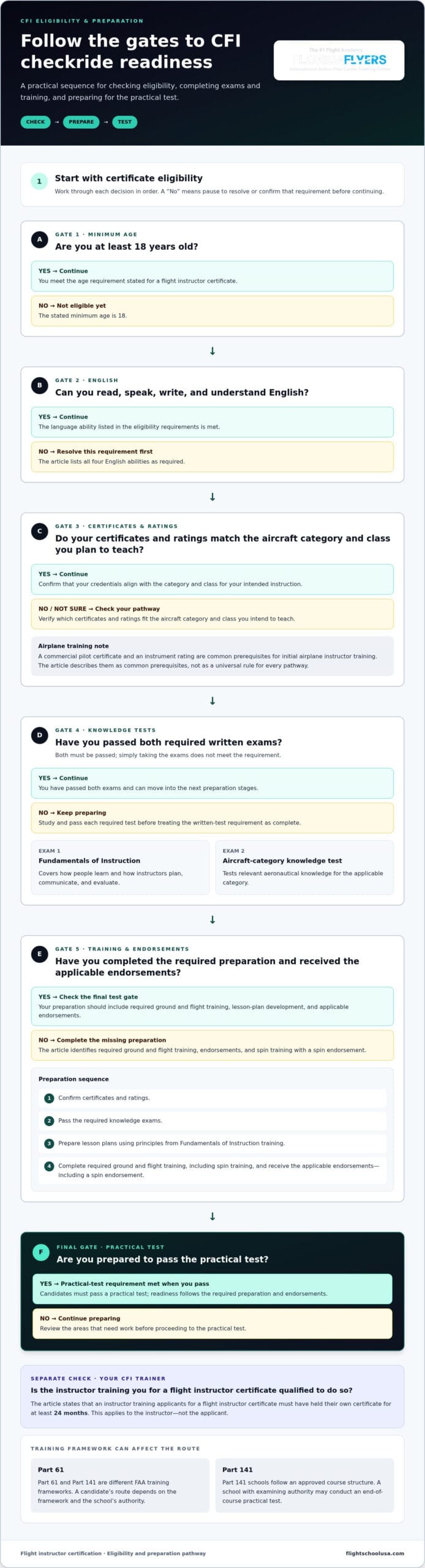
Part 61 and Part 141 are different FAA training frameworks. Part 141 schools follow an approved course structure, and a school with examining authority may conduct an end-of-course practical test. A CFI candidate’s route depends on the training framework and the school’s authority.
When choosing an FAA-approved flight school for CFI training, compare the program structure, instructor support, aircraft and simulator access, and practical-test preparation. Find out how flight and ground instruction are scheduled and how candidates prepare for required endorsements. Choose a program whose process fits your eligibility, training needs, and career goals.
Flight training and checkride package costs depend on what is included and how much preparation you need. Compare aircraft and simulator time, ground instruction, instructor support, and practical-test preparation. Review how additional training is handled and whether endorsements are included. The total training required depends on your proficiency, not just the package label.
Becoming an instructor also brings real challenges. You must prepare thoroughly, communicate clearly, and recognize when a student needs more practice before advancing. Candidates must complete required ground and flight training, receive the applicable endorsements, and complete spin training with a spin endorsement. Missing a step can delay checkride readiness. Teaching also requires sustained attention to safety and student progress, even when a lesson does not go as planned.
Approach the role as a professional responsibility, not simply a way to accumulate experience. Set specific lesson objectives, use simulator sessions to rehearse relevant skills, and debrief each flight with actionable feedback. This disciplined cycle develops teaching ability and student proficiency together. A well-prepared instructor helps students understand not only what to do, but why each decision matters.
Start by separating certificate eligibility from a school’s enrollment prerequisites. In the United States, a pilot must be at least 18 years old to qualify for a flight instructor certificate, according to the Federal Aviation Administration. Candidates must also be able to read, speak, write, and understand English. A commercial pilot certificate and an instrument rating are common prerequisites for initial airplane instructor training. Confirm that your certificates and ratings match the aircraft category and class you intend to teach.
Written and practical tests assess whether you can teach, not just perform. Applicants seeking flight instructor privileges must pass two written exams: the Fundamentals of Instruction exam and an aircraft-category-specific knowledge test. The first covers how people learn and how instructors plan, communicate, and evaluate. The second tests relevant aeronautical knowledge for the category. You must pass both exams; taking them without passing does not meet the requirement. The candidate must also pass a practical test.
For the CFI written exam score requirement, the standard is to pass each required knowledge test. Prepare for the exams separately, then review missed concepts before moving into oral teaching practice. Organize your study around the Fundamentals of Instruction, the applicable category knowledge areas, and the aircraft’s operating information. For example, an airplane applicant can connect a lesson on aircraft systems to the specific aircraft’s handbook and limitations. Use current test-preparation materials and group notes by subject instead of memorizing isolated answers.
Required instructional subject areas include the fundamentals of instruction and the knowledge needed for the aircraft category. Candidates also develop lesson plans using principles from Fundamentals of Instruction training. A useful plan states the lesson objective, explains key concepts, gives the student a practical example, and describes how to assess understanding. For a lesson on stalls, connect the explanation to recognition, recovery, and the aircraft’s applicable procedures. This structure helps students develop sound judgment alongside flying skills.
Before training, lay out the sequence: confirm certificates and ratings, complete the required knowledge exams, prepare lesson plans, receive required ground and flight training, and secure the applicable endorsements. Flight instructors training applicants for a flight instructor certificate must have held their own certificate for at least 24 months, according to the Federal Aviation Administration. That rule concerns the instructor who trains CFI applicants, not the applicant’s age or experience.
Use a structured flight training pathway to organize exam preparation, ground instruction, and practical-test readiness. A clear study plan helps connect aviation fundamentals to the teaching decisions you’ll make with students, whether they later pursue private, commercial, or airline flying.
Flight ynstruksje lets pilots turn aviation knowledge into a skill they can apply with students. It also creates a distinct career direction: teaching private and commercial pilot students, rather than focusing only on personal flying or another cockpit role. A certified flight instructor course develops the ability to explain procedures, demonstrate sound judgment, and assess whether a student can apply a lesson safely. The benefit is professional growth through responsibility, not an automatic route to an airline position.
Teaching can strengthen a pilot’s grasp of foundational knowledge. A student may ask why a maneuver works, how weather affects a planned flight, or what a checklist item means. The instructor must explain clearly, identify the relevant risk, and check the student’s understanding. This makes knowledge active. For example, teaching a departure briefing means connecting aircraft performance, conditions, and decision-making in one practical discussion.
Instructing also provides a structured way to develop communication and evaluation skills. A useful lesson has a clear objective, a demonstration, student practice, and a debrief. If a learner struggles with a procedure, isolate the task, explain it differently, and observe another attempt. This builds the student’s proficiency while teaching the instructor to diagnose performance instead of repeating the same explanation.
These ratings create distinct instructional paths. A CFI may provide instrument-rating instruction only with an instrument instructor rating, or CFII. Choose an additional qualification based on the type of teaching you want to do and the experience needed to teach that subject. A rating grants defined privileges, but does not guarantee a particular job or career outcome.
Some instructors may later teach future flight instructor candidates. In the United States, the Federal Aviation Administration requires instructors training applicants for a flight instructor certificate to have given at least 200 hours of instruction. That threshold highlights the depth of teaching experience involved in preparing another instructor. It also shows why the role can progress from teaching basic flight skills to guiding candidates through advanced instructional responsibilities.
Before pursuing instruction, identify your main reason: deepening your aviation knowledge, teaching students, or working toward additional instructor ratings. Then connect the initial CFI privileges to your goals. Review the relevant knowledge-test subjects, practice explaining lessons aloud, and consider which student needs you can support effectively. A deliberate choice makes teaching a purposeful professional role grounded in preparation and consistent standards.
An accelerated academy concentrates instructor preparation into a structured sequence of ground, aircraft, and simulator work. The format demands steady preparation: pilots must connect aviation knowledge, flight experience, and teaching methods rather than treat each activity as separate. The stated academy schedule includes 104 hours of classroom instruction, 10 hours of individual ground instruction, 14 hours of dual instruction in a Cessna 172 or Piper 100i, and 6 hours of dual simulator instruction.
Classroom sessions build the instructional framework. Candidates learn to explain aviation concepts, organize lessons, and evaluate student performance. Individual ground instruction allows time to address specific gaps and practice presenting material. For example, a candidate can rehearse a lesson on aircraft performance, then refine the explanation based on instructor feedback. This preparation matters because a CFI must teach concepts clearly, not merely demonstrate a maneuver.
The aircraft portion brings lesson delivery into the cockpit. During dual instruction, candidates practice explaining and demonstrating flight tasks while managing the aircraft and monitoring safety. A Cessna 172 or Piper 100i provides the training platform named in this academy format. Candidates can prepare to teach a maneuver, demonstrate it, then observe how a learner responds. The instructor’s feedback helps identify where the explanation, demonstration, or correction needs improvement.
Simulator sessions let candidates rehearse procedures and instructional scenarios in a controlled setting. A session can focus on explaining a decision, responding to a developing situation, or practicing a lesson sequence. Simulator practice supports flight training, but does not replace aircraft instruction. Debrief each session and turn it into a specific improvement plan, such as clarifying a briefing or making a correction more direct.
CFI-A and CFI-I prepare instructors for different teaching privileges. CFI-A training covers instruction for Private and Commercial Pilot students. CFII training prepares instructors to teach Instrument Rating students. An accelerated program can organize these subjects efficiently, but candidates still need to master the applicable regulations, prepare lessons, and demonstrate instructional competence during practical-test preparation.
Before starting, organize study materials, lesson plans, and personal flight records so classroom concepts connect with flight experience. Use each ground session to address a specific knowledge gap, then apply what you learn in the simulator or aircraft. This disciplined sequence helps candidates develop as instructors and prepare to teach pilots with different needs and experience levels.
Flight instruction can lead in several directions, depending on the skills and ratings you develop. An initial CFI-A can teach Private and Commercial Pilot students. Adding a CFII allows you to instruct Instrument Rating students, while an MEI qualifies you to teach pilots in multi-engine aircraft. Each step changes the subjects you can teach and the experience you bring to future aviation roles.
For some pilots, the next step is more specialized instruction. Teaching instrument students, for example, calls for precise explanations of procedures and careful assessment of each student’s decisions. Multi-engine instruction has a different focus: helping learners understand aircraft handling and operating procedures in that category. These paths build specialized teaching skills, and each requires the applicable instructor rating and privileges.
Instructing can also support a broader commercial pilot career plan. You’ll practice briefing, decision-making, communication, and performance evaluation, all relevant to professional aviation work. An airline-focused goal may shape the experience you seek, but an instructor rating alone doesn’t qualify you for an airline position. Treat instruction as one stage in a career plan, alongside the certificates, ratings, and experience required for your intended flying role.
Use a practical progression plan rather than collecting ratings without a purpose:
Endorsements and ratings should support a clear professional objective. For instance, a pilot interested in instrument instruction can map out the CFII path, then focus on teaching procedures and evaluating student performance. A pilot interested in multi-engine training can plan around the MEI qualification and its instructional scope. This approach connects each training decision to the work you intend to do.
Career growth also depends on how you use each teaching assignment. Keep lesson plans organized, note where students commonly need clarification, and refine your explanations after debriefs. These habits show practical instructional development and help you identify skills to strengthen next. They also make career discussions more specific: you can describe the students you teach and the responsibilities you’re prepared to take on.
If flight instruction is part of your professional aviation plan, plan your next flight training step around the rating and teaching role you want to pursue.
Flight School USA gives aspiring instructors a structured next step through its Fixed-Price Career Program and CFI Fast Track Program. If you’ve completed the prerequisites and are ready to pursue instructor training, these offerings connect your career plan with flight training. The Fixed-Price Career Program supports a broader pilot-training pathway, while the CFI Fast Track Program is relevant to candidates focused on becoming instructors. Veterans can explore GI Bill Flight Training, and international students can use M1 Visa Admission Services to support flight training in the United States. Choose the pathway that fits your current training stage and professional objective. For program information and next steps, contact Flight School USA.
Your next step is to turn the goal of teaching into a deliberate training plan. Before starting a certified flight instructor course, identify the type of instruction you want to provide and map the preparation required. A clear target helps you make focused decisions about your training and the skills you want to develop.
Flight School USA offers a Fixed-Price Career Program and a CFI Fast Track Program for pilots planning their training progression. GI Bill Flight Training is also available to eligible veterans. Choose the pathway that fits your circumstances and aviation goals, then take the next step with a focused conversation about your plans.
Kontakt opnimme mei fleanskoalle Feriene Steaten to discuss your flight-training direction and how to move forward. Every capable instructor begins by committing to teach with discipline and purpose. Your next chapter can start with that decision.
Applicants must be at least 18 years old, according to the Federal Aviation Administration, and able to read, speak, write, and understand English. Initial airplane CFI candidates generally need the applicable commercial pilot certificate and instrument rating, then must pass the required knowledge exams and practical test. Check that your pilot certificates and ratings match the category and class you intend to instruct in before planning your training sequence.
For an initial CFI certificate, there is no FAA minimum training-hour requirement stated in the applicable requirements. Candidates must complete required ground and flight training, obtain the required endorsements, and complete spin training with a spin endorsement. Focus on demonstrating consistent instructional ability, not simply accumulating time. Your preparation must address both teaching knowledge and aircraft performance, developing the skills needed for the practical test.
A certified flight instructor course typically combines ground instruction, lesson preparation, flight practice, and practical-test preparation. In the accelerated academy format described here, training includes classroom, individual ground, aircraft, and simulator instruction. For example, candidates practice presenting aviation concepts, then apply teaching techniques during flight exercises. CFI-A and CFI-I training prepare instructors for different teaching privileges, so course content depends on the rating pursued.
Training duration depends on your preparation, schedule, and progress toward instructional proficiency. A pilot who has mastered the required knowledge and consistently demonstrates flight tasks may progress differently from someone who needs more practice or lesson-plan refinement. An accelerated academy concentrates instruction into a structured program, while the overall timeline also depends on completing exams, required training, endorsements, and practical-test preparation.
Price depends on the training format, the instruction and aircraft time included, simulator use, and the preparation you need. Adding an instructor rating or requiring extra practice can also affect the overall training plan. Compare what the course includes, such as ground instruction, flight training, and practical-test preparation. The price for a specific training plan depends on the details and is provided after a quote request.
Applicants seeking flight instructor privileges must pass two written exams: the Fundamentals of Instruction exam and an aircraft-category-specific knowledge test, followed by a practical test. Prepare to explain concepts clearly, present instructional material, and demonstrate relevant flying skills. The practical test assesses your teaching ability as well as your piloting competence. Organize your lesson materials so you can explain each topic logically and respond clearly during evaluation.
A newly certificated CFI can teach Private and Commercial Pilot students. A CFII adds eligibility to teach Instrument Rating students, while an MEI qualifies an instructor to teach in multi-engine aircraft. Salary depends on the employment arrangement, assigned duties, and the amount and type of instruction performed. To assess a career opportunity, compare the teaching role with your long-term aviation goals and consider which additional instructor rating would expand your instructional scope.


