

The standard path to a commercial cockpit is intentionally designed as a high-stakes filter, and for many veterans, the most formidable barrier isn’t the flight check; it’s a credit score. While your service earned you significant education benefits, the reality of gi bill flight training no credit required remains elusive for those who don’t understand the regulatory nuances of VA funding. You’ve likely discovered that the VA won’t cover your Private Pilot License (PPL) and that the 2026-2027 annual vocational cap of $17,661.89 barely scratches the surface of a professional rating. This financial shortfall, coupled with the requirement for high credit scores at traditional lenders, often stalls a career before it even leaves the ground.
You deserve a transition strategy that respects your discipline rather than your debt-to-income ratio. This guide provides a definitive roadmap to maximizing your Post-9/11 GI Bill assets while securing the supplemental funding necessary to reach airline-ready status. We’ll examine how to leverage Fixed-Price Career Programs to mitigate VA funding unpredictability and explore specific pathways to bridge the PPL gap without relying on credit-based institutional loans. By the end of this analysis, you’ll have a clear, actionable plan to bypass financial gatekeepers and command your professional future in the flight deck.
The GI Bill is a tactical asset that requires precise execution. It’s not an unlimited resource. In 2026, the Post-9/11 GI Bill rate for vocational flight training is capped at $17,661.89 annually. While this represents a 3.3% increase from the previous academic year, it remains a fraction of the total investment required for a professional pilot career. Veterans must distinguish between degree-granting university programs, which often offer higher funding caps but take years to complete, and vocational Part 141 academies designed for rapid career entry.
জন্য অনুসন্ধান gi bill flight training no credit required is driven by a stark reality: most veterans cannot secure high-interest, credit-based loans to cover the substantial funding gap left by VA caps. Relying on credit scores of 700 or higher is a systemic barrier that prevents talented aviators from entering the industry. Success in 2026 requires a funding strategy that treats your benefits as a foundation, not the entire structure. You must identify programs that offer financial pathways independent of traditional credit checks to ensure your training doesn’t stall when the annual VA cap is reached.
The Post-9/11 GI Bill is the preferred instrument for most because it pays tuition directly to the institution and provides a Monthly Housing Allowance (MHA) based on local BAH rates. Conversely, the Montgomery GI Bill-Active Duty (MGIB-AD) operates on a reimbursement model. This requires you to pay for your training upfront and wait for the VA to process your claim, which can severely compromise your liquidity. Understanding the history of the G.I. Bill reveals how these benefits evolved to meet modern educational costs, yet the choice between them dictates your immediate out-of-pocket requirements and cash flow management.
Regulatory adherence is non-negotiable. The VA exclusively approves FAA Part 141 flight schools for vocational training because of their rigid, structured curricula. Unlike Part 61 schools, which offer more flexibility but less oversight, Part 141 institutions are audited for training efficiency and safety standards. This high-intensity environment mirrors military discipline, making it the logical choice for veterans. You must verify a school’s VA approval status before committing your entitlement. Utilizing a Fixed-Price Flight Training Program at a certified academy ensures that your gi bill flight training no credit required strategy remains compliant while protecting your capital from market volatility.
The most significant obstacle to your commercial aviation career isn’t the complex aerodynamics or the rigorous FAA examinations. It’s a regulatory technicality. The VA requires a Private Pilot License (PPL) as a non-negotiable prerequisite for vocational flight benefits. This means you must secure your PPL before any GI Bill funding for subsequent ratings like Instrument, Commercial, or Multi-Engine becomes accessible. For many, this initial entry cost creates a financial chasm that traditional lenders are unwilling to bridge, especially for those seeking gi bill flight training no credit required সমাধান.
Traditional financial institutions categorize flight training as a high-risk venture for individuals without established, elite-tier credit profiles. This creates a “Credit Gap” where the initial capital requirement stops most veterans before they even begin. If you attempt to secure traditional flight school loans with sub-optimal credit, you’re often met with predatory interest rates that can cannibalize your future airline pilot salary. The PPL Prerequisite remains the primary barrier to entry for 2026 veterans seeking a professional aviation career. Most commercial lenders require a FICO score above 700, effectively grounding qualified candidates who have the discipline but lack the credit history.
আবিষ্কার gi bill flight training no credit required pathways means looking beyond traditional bank loans. You need a strategic deployment of capital that doesn’t rely on a perfect credit report. Elite academies often provide internal school payment plans or structured entry modules that allow you to fund your PPL through personal savings or military credit union products that prioritize your service history over commercial credit scores. These credit-independent strategies ensure that your training progression remains uninterrupted while you prepare for the VA-funded phases of your education.
By utilizing a Fixed-Price Career Program, you can lock in your initial costs and avoid the financial volatility of pay-as-you-go models. This level of financial certainty is critical when you’re self-funding the first phase of your career. Once the PPL is secured, the transition to a VA-funded Commercial track becomes a streamlined administrative process. This allows you to leverage your remaining GI Bill benefits for the high-ROI certifications required to reach the airlines. If you’re ready to secure your future, you can begin the process by exploring our flight training pathways designed for veteran success.
Success in professional aviation requires more than just technical proficiency; it demands a rigorous financial strategy. The traditional “pay-as-you-go” model is a significant risk for veterans operating under the 2026-2027 VA vocational funding cap of $17,661.89. In a modular, hourly-rate system, any training inefficiency or weather delay directly translates into out-of-pocket expenses. When these costs exceed the annual VA allotment, students without high credit scores often find their progression halted. This is why identifying gi bill flight training no credit required pathways is secondary to selecting a program that guarantees cost certainty from day one.
A Fixed-Price Flight Training Program serves as a financial firewall. By locking in the cost of your ratings, you eliminate the threat of fuel surcharges or remedial flight fees that the VA refuses to reimburse. This model ensures that your training remains a mission-focused operation rather than a variable expense. It provides the security needed to focus on check-ride preparation instead of debt management, allowing you to bypass the need for supplemental, credit-based loans entirely.
Hourly rates are inherently volatile and offer no protection against market fluctuations. In contrast, a fixed-price career track provides a defined financial ceiling for your entire certification process. This structured approach prevents “over-flight” costs and mid-program price hikes that frequently derail modular students. When you compare the total investment, a career-track program offers a significantly higher ROI by ensuring you reach the commercial stage without the administrative friction of multiple funding gaps. It’s the most disciplined way to manage your 2026 training budget.
The transition from a commercial pilot to an airline-ready professional requires 1,500 flight hours. For a veteran, the most efficient way to bridge this gap is through instruction. The CFI Fast Track Program transforms you from a consumer of flight hours into a professional who is paid to build them. This “earn while you learn” model is the ultimate gi bill flight training no credit required solution, as it replaces the need for further tuition with a professional salary. Major airlines prioritize candidates with instructional experience because it demonstrates a mastery of regulatory standards and a high level of cockpit discipline. By choosing this path, you secure your 1,500 hours while establishing the professional reputation required for a legacy carrier seat.
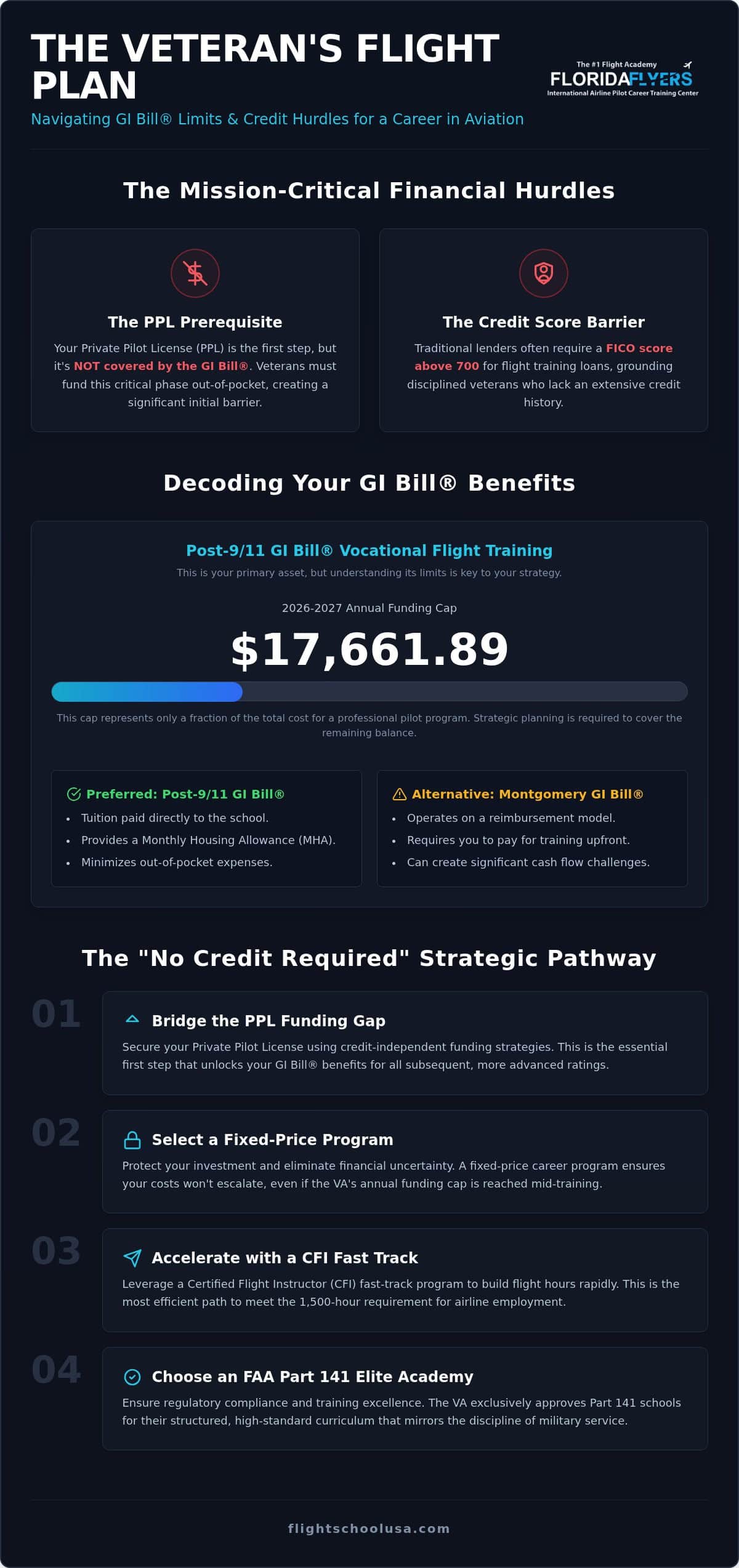
Transitioning from military service to a commercial cockpit requires a strategic deployment plan that accounts for both regulatory requirements and financial constraints. Your objective is to reach airline-ready status with minimal debt and maximum efficiency. Success in this mission depends on following a precise sequence of administrative and medical milestones. By identifying gi bill flight training no credit required pathways early, you protect your career progression from the common pitfalls of credit-based financing.
A First-Class Medical Certificate is the only acceptable standard for those with long-term airline career objectives. While a Second-Class medical permits commercial operations, it’s insufficient for the Airline Transport Pilot (ATP) requirements you’ll eventually face. You must pre-empt disqualifying conditions before committing your GI Bill assets. In the 2026 regulatory environment, medical certification is an urgent priority. Failing to secure this document at the start of your training is a professional risk that could lead to significant financial loss if a medical issue is discovered later in your progression.
The School Certifying Official (SCO) is your primary liaison for ensuring your training remains compliant with VA regulations. Their role is critical for processing your monthly stipends and managing the 2026 vocational cap of $17,661.89. During your initial consultation, you should discuss how to handle gap funding and whether the academy participates in initiatives designed to reduce out-of-pocket costs. Ensuring your Airline Pilot Career Training is fully documented is essential for maintaining your legal standing with the VA. If you’re ready to initiate your transition, you can begin by reviewing our gi bill flight training enrollment requirements to secure your position in our next intake.
Veterans don’t just seek flight hours; they demand a high-performance environment that mirrors the discipline of military operations. While local flight clubs offer a casual approach to aviation, they frequently lack the standardized oversight required for a seamless transition to the airlines. Elite Part 141 academies function as rigorous gatekeepers of industry standards, ensuring that every hour logged is a step toward professional mastery. Selecting Professional Pilot Training over decentralized “mom and pop” operations is the most logical decision for a veteran whose career timeline is non-negotiable.
The structure of an FAA Part 141 curriculum is specifically designed to benefit the veteran mindset. It prioritizes Standard Operating Procedures (SOPs) from the first day, instilling a level of cockpit discipline that mirrors the rigors of an airline flight deck. This adherence to regulatory codes and certification standards ensures that you aren’t just learning to fly; you’re learning to operate within a complex, high-stakes system. Graduating from a nationally recognized career academy carries a level of prestige that local clubs cannot replicate, positioning you as a premier candidate for legacy carriers.
Strategic success in aviation requires immersion, not just attendance. On-site student housing eliminates the distractions of a daily commute, allowing you to dedicate your full attention to ground school and flight maneuvers. This environment fosters a professional network within the academy walls, where you can collaborate with peers who share your high-level discipline. By maximizing study time and reducing fatigue, residential training accelerates your certification timeline. It ensures that your focus remains strictly on the technical and legal requirements of your professional standing.
Achieving the transition to a commercial cockpit is the ultimate objective of navigating gi bill flight training no credit required pathways. Every administrative hurdle and training hour is a calculated investment in your future Airline Pilot Salary. In the 2026 aviation market, the demand for disciplined, veteran aviators has never been higher. By selecting an elite institution that respects the weight of your service, you ensure that your transition from military professional to airline pilot is executed with the precision and authority your career deserves.
The path to a commercial cockpit requires the same tactical precision you utilized during your military service. You’ve identified that while the VA provides a critical foundation, the 2026 funding caps and the PPL prerequisite necessitate a sophisticated financial strategy. By prioritizing fixed-price career tracks and instructional pathways, you eliminate the risks associated with market volatility and credit-based loan rejections. This approach ensures that your pursuit of gi bill flight training no credit required remains a viable, high-ROI career transition rather than a financial burden.
Flight School USA stands as a premier এফএএ পার্ট ১৪১ সার্টিফাইড একাডেমি, offering the discipline and structural oversight veterans demand. Our Fixed-Price Career Guarantee এবং dedicated veteran admissions support are designed to navigate the complexities of your benefits, ensuring you reach the airline-ready stage with maximum efficiency. Don’t let administrative barriers or credit scores ground your ambitions. Command your career progression and secure your seat in the flight deck.
Deploy Your GI Bill Assets: Join Our Elite Career Program Today. We’re ready to help you execute this transition with the authority and precision your service deserves.
Yes, your eligibility for VA benefits is based on your military service entitlement rather than a commercial credit score. This makes gi bill flight training no credit required a standard pathway for veterans transitioning into aviation. While the VA covers advanced ratings up to the annual limit, you must secure your Private Pilot License independently. Identifying credit-independent funding for that initial phase is the key to maintaining your training momentum without traditional bank loans.
The VA does not fund the Private Pilot License at vocational Part 141 flight schools. The PPL is a mandatory prerequisite that you must obtain before your GI Bill benefits can be applied to advanced ratings like Instrument or Commercial certifications. Most veterans fund this initial requirement through personal savings or specialized financing programs that prioritize their professional potential and service record over a traditional FICO score of 700 or higher.
For the academic year spanning August 1, 2026, to July 31, 2027, the maximum annual VA benefit for vocational flight training is $17,661.89. This represents a 3.3% increase from the previous year. It’s important to understand that this cap applies to tuition and fees only. Veterans utilizing the GI Bill for vocational flight training are not eligible for the monthly housing allowance or the book and supply stipend that university students receive.
If your training expenses surpass the $17,661.89 cap, you are responsible for the remaining balance. To mitigate this risk, we recommend enrolling in a Fixed-Price Career Program. This model provides financial certainty by locking in your costs and protecting you from the “over-flight” charges common in hourly-rate schools. It ensures your gi bill flight training no credit required strategy remains viable by preventing unexpected out-of-pocket expenses that could stall your progression.
Traditional aviation lenders typically require excellent credit, making them inaccessible for many veterans. However, you can explore credit-independent funding through military credit unions or internal academy payment plans. These alternatives focus on your professional standing and service history rather than a FICO score. By leveraging these specialized resources, you can bridge the funding gap for your Private Pilot License and move into the VA-funded phases of your professional pilot training without credit barriers.
Yes, your GI Bill benefits can be applied to a CFI Fast Track Program if it is part of an approved FAA Part 141 curriculum. Earning your Certified Flight Instructor rating is a strategic move that allows you to earn a professional salary while building the 1,500 hours required for airline employment. This “earn while you learn” model is the most efficient way to transition from a student to a professional pilot without incurring additional debt.
The VA requires at least a second-class medical certificate to certify your enrollment in vocational flight training. However, if your objective is a career with a major airline, you should secure an FAA First-Class Medical Certificate before starting. This establishes your legal standing for the highest levels of professional aviation. Verifying your medical eligibility early protects your GI Bill assets by ensuring you aren’t disqualified after investing significant time and funding into your training.
Universities offer higher funding caps but require years of non-aviation coursework. For veterans seeking a rapid career transition, an elite Part 141 flight school is the logical choice. These academies provide a high-discipline environment that mirrors military standards and focuses exclusively on flight certification. This allows you to reach the 1,500-hour airline requirement and start earning a professional pilot salary years sooner than a traditional degree-granting program would permit.


