

Using your GI Bill to fund your initial Private Pilot License is the fastest way to exhaust your benefits before you ever reach a commercial cockpit. For veterans aiming for a professional aviation career, the strategy must be more precise than simply finding a local school. You need to understand exactly how to use gi bill for flight school to ensure you don’t run out of funding during the critical hours between your instrument rating and your commercial certification. The transition from military service to a professional flight deck is a high-stakes operation that demands a rigorous understanding of VA bureaucracy and the distinct advantages of Part 141 training environments.
You’ve earned these benefits through disciplined service, yet the path to a professional pilot command is often obscured by hidden costs and complex regulatory codes. This strategic guide serves as your definitive roadmap to achieving a Commercial Pilot License while maintaining maximum ROI on your education assistance. We will dissect the 2026 vocational flight training caps, clarify the prerequisites for VA-approved programs, and provide a methodical plan to accelerate your progression into a high-paying airline career. By the end of this briefing, you’ll possess the tactical knowledge required to navigate the VA system with the same precision you applied in the field.
Your education benefits are a strategic asset that must be deployed with surgical precision to reach the flight deck of a major airline. Before you begin your first pre-flight inspection, you must secure your Certificate of Eligibility (COE). This document is your most critical administrative requirement; it dictates the exact scale of your funding and your remaining entitlement. Mastering the differences between the Post-9/11 vs. Montgomery GI Bill is essential for any veteran evaluating how to use gi bill for flight school to its full potential.
The Post-9/11 GI Bill (Chapter 33) stands as the elite choice for vocational training. For the academic year beginning August 1, 2026, the VA has set the reimbursement cap for vocational flight training at $17,661.89. If you qualify for the 100% eligibility tier, the VA pays this amount directly to your Part 141 flight school. Entitlement isn’t deducted by days, but by the dollar amount spent on training. Every hour in the aircraft depletes a specific portion of your 36 months of benefits. This makes efficiency paramount. You can’t afford to waste these assets on redundant training or schools that lack a clear career-track focus.
Some veterans may still hold eligibility under the Montgomery GI Bill (Chapter 30), which follows a fundamentally different reimbursement protocol. Under Chapter 30, the VA reimburses 60% of the approved charges for flight training after the training is completed. This model requires the veteran to pay the full cost upfront and wait for reimbursement, creating a significant cash flow requirement. While it lacks the direct-pay convenience of Chapter 33, it may offer a tactical advantage for those who have specific benefit structures from older service contracts. However, most modern aviators find that Chapter 33 provides the most secure path to a commercial rating without the burden of heavy out-of-pocket expenses. Knowing how to use gi bill for flight school effectively means choosing the bill that maximizes your training hours while minimizing your financial risk.
The Department of Veterans Affairs maintains strict standards for flight training reimbursement. To qualify for vocational funding, you must enroll in an FAA-approved Part 141 flight school. Unlike Part 61 training, which is designed for flexible, hobbyist-level instruction, Part 141 schools operate under a rigorous, FAA-approved syllabus. This structure ensures every hour of flight time is accounted for and directly contributes to your professional certification. The VA will not reimburse Part 61 training because it lacks the oversight and standardized curriculum required to produce commercial-grade aviators. Selecting an elite Part 141 academy is the first tactical decision in understanding how to use gi bill for flight school effectively.
Degree-granting university programs often introduce unnecessary delays through general education requirements. Vocational flight training focuses exclusively on aviation mastery. This streamlined approach allows you to reach the flight deck significantly faster than your collegiate counterparts. By utilizing your $17,661.89 annual vocational cap for the 2026-2027 academic year at a dedicated training center, you concentrate 100% of your assets on ratings and flight hours. This precision ensures you don’t waste months of entitlement on subjects that do not advance your pilot seniority.
Before committing to a program, you must verify the school’s standing in the VA’s Web Enabled Approval Management System (WEAMS) database. This is a non-negotiable step in Applying for Aviation Benefits. Additionally, you must secure a valid FAA medical certificate before training begins. Elite academies often possess self-examining authority, which allows them to conduct internal checkrides. This authority signals a high level of institutional trust from the FAA and eliminates the scheduling bottlenecks common at smaller schools. For veterans who demand cost certainty, our Fixed-Price Career Program provides a structured environment that aligns perfectly with VA Part 141 requirements. Understanding how to use gi bill for flight school requires this level of detail to avoid administrative rejection and ensure a seamless career transition.
Veterans often encounter a critical roadblock known as the “Private Pilot Gap.” For vocational training, the VA mandates that you already possess a Private Pilot License (PPL) and a valid medical certificate before they release a single dollar of funding. This requirement prevents the GI Bill from covering your initial entry into aviation. Understanding VA GI Bill Flight Training Benefits is about more than just reading a brochure; it requires a tactical plan to fund that first license privately. By paying for your PPL out-of-pocket, you unlock the ability to use your earned assets for the far more expensive Instrument Rating (IR) and Commercial Pilot License (CPL).
Think of the PPL as the non-negotiable entry fee to a VA-funded career. While it requires an upfront personal investment, this maneuver preserves your GI Bill entitlement for the high-cost phases of training where the ROI is significantly higher. You must fast-track this initial phase to reach VA-eligible status as quickly as possible. This isn’t just about learning to fly; it’s about positioning yourself to capture the maximum $17,661.89 annual vocational cap for the 2026 academic year. Every month spent dawdling on your PPL is a month you aren’t utilizing your veteran assets for professional-grade ratings. Accelerating through the PPL phase ensures you don’t stall before reaching the commercial milestones that matter to airline recruiters.
Once you’ve cleared the PPL hurdle, the strategic deployment of your benefits shifts toward the CPL and Multi-Engine ratings. The Multi-Engine rating is a high-cost asset that demands a significant portion of the annual cap, making it a prime candidate for VA coverage. However, the commercial license is only the beginning. To reach the 1,500-hour requirement for airline employment, you should consider using gi bill for cfi training. Our CFI Fast Track Program functions as the ultimate bridge to professional aviation. By timing your checkrides to align with the August 1st benefit reset, you can effectively double your training momentum. Mastering how to use gi bill for flight school means looking past the initial solo and focusing on the long-term objective of reaching the captain’s seat. This disciplined approach ensures your benefits last long enough to secure your first high-paying airline position.
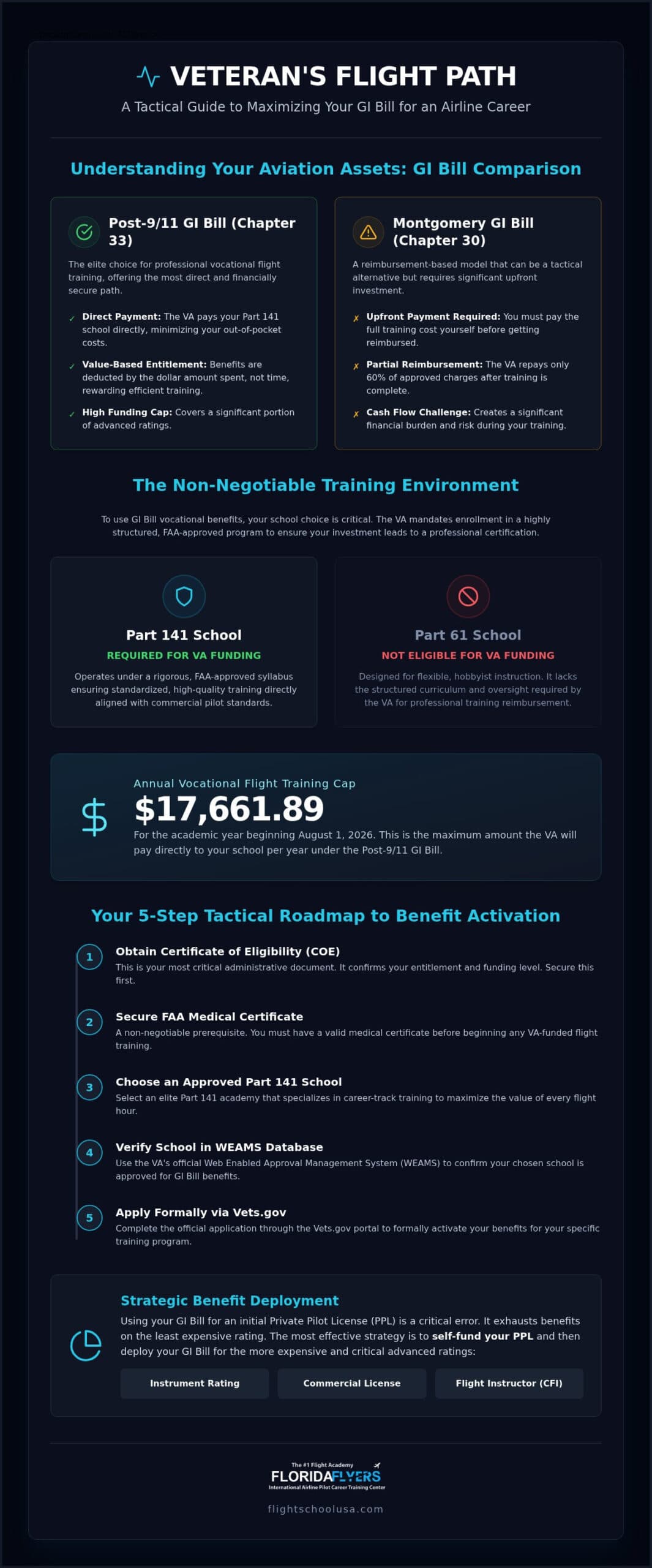
Executing the transition from military service to a professional flight deck requires more than ambition; it demands the precise execution of administrative protocols. To successfully navigate the VA system, you must follow a sequential roadmap that prioritizes regulatory compliance. Skipping a single step can result in months of delayed funding or the total rejection of your application. This tactical guide outlines exactly how to use gi bill for flight school to ensure your training remains fully funded and on schedule for the 2026 academic year.
Securing your FAA medical certificate is the primary gatekeeper of your aviation career. The VA will not authorize payment for a single flight hour until you possess a valid Second-Class or First-Class Medical Certificate. While a Second-Class certificate is the minimum requirement for commercial operations, aspiring airline pilots should pursue a First-Class certificate immediately to confirm they meet the most rigorous industry standards. Veterans with service-connected disabilities must be proactive. Consult an Aviation Medical Examiner (AME) months before your intended start date to identify potential deferrals. Resolving medical paperwork early prevents your training from stalling before you even reach the cockpit.
Once your medical clearance is secure, you must submit VA Form 22-1990 through the Vets.gov portal. This action generates your Certificate of Eligibility (COE), which functions as your financial orders for flight training. You must read this document carefully to identify any flight-specific limitations or remaining months of entitlement. Your School Certifying Official (SCO) at the academy will be your primary liaison for benefit verification. Common errors on Form 22-1990, such as selecting the wrong chapter or failing to update your banking information, are the leading causes of administrative delays. Precision in this phase is as critical as precision in the landing pattern.
After receiving your COE, the remaining steps focus on institutional integration and compliance:
Our specialized GI Bill Flight Training track is designed to guide you through every stage of this roadmap with military-grade discipline. Understanding how to use gi bill for flight school effectively means treating the application process as your first mission in the cockpit. Compliance is not optional; it is the foundation of your professional pilot career.
Veterans transitioning to professional aviation require an environment that mirrors the discipline and high standards of their military service. We provide professional Student Housing to facilitate an immersive training atmosphere, ensuring that your focus remains entirely on flight mastery. This is not a casual flight club; it’s a high-performance academy designed for those who demand excellence. Choosing the right institution is the final tactical decision in mastering how to use gi bill for flight school to secure your future in the cockpit.
One of the greatest risks in vocational training is the exhaustion of VA benefits before completing a critical rating. Our fixed price flight training program eliminates this financial uncertainty by providing a guaranteed cost structure for your ratings. This protection of your earned assets is vital when navigating the complexities of annual VA funding caps. We are an elite Part 141 academy that maintains a strictly regulated instructional voice, prioritizing your certification and professional standing above all else. Our commitment to transparent, professional-grade cost structures ensures you never face the “running out of funds” scenario that plagues less structured programs.
Reaching the 1,500-hour milestone is the final operational hurdle before you can claim a seat at a major carrier. Our CFI fast track program serves as your strategic bridge to employment, allowing you to build the necessary flight time while perfecting your instructional skills. Transitioning veterans are uniquely positioned to excel in this role, bringing a level of discipline that is highly valued by airline recruiters. When you examine the airline pilot salary 2026 outlook, the urgency of completing your training with efficiency becomes clear. The compensation levels for professional pilots have reached historic highs, making every month you spend in training a significant investment in your future earnings.
Our airline pilot career training path is the gold standard for those moving from military service to a professional cockpit. We provide the career placement support and industry connections necessary to ensure our graduates don’t just finish their ratings, but actually secure their first officer positions. Understanding how to use gi bill for flight school is only the first step; executing that plan at a premier institution is what separates hobbyists from professional aviators.
Mastering how to use gi bill for flight school is the first mission in your transition from military service to a professional pilot command. You’ve identified the necessity of the Private Pilot Gap strategy and the importance of choosing a Part 141 certified environment to protect your earned assets. It’s a high-stakes operation that requires strict adherence to VA protocols and FAA certification standards. By focusing your entitlement on advanced ratings and utilizing the CFI Fast Track, you position yourself for a high-paying airline career with maximum efficiency.
Flight School USA serves as the premier gatekeeper for veterans who demand excellence. As an FAA Part 141 Certified Academy, we provide the cost certainty of our Fixed-Price Career Program and the immersion of professional student housing. We don’t just offer training; we provide a rigorous roadmap to reach the 1,500-hour requirement. Your discipline has brought you this far, and our expertise will take you the rest of the way to the flight deck. Your transition to a professional pilot career begins with a single, decisive action.
Secure Your Command: Apply Your GI Bill at Flight School USA
No, the GI Bill does not typically cover 100% of vocational flight school costs. For the 2026 to 2027 academic year, the Post-9/11 GI Bill vocational cap is $17,661.89. This reimbursement limit applies specifically to flight training at private vocational schools. Veterans often face out-of-pocket expenses once this annual cap is reached. You must strategically plan your training hours to align with these funding limits to minimize personal financial exposure.
You cannot use the GI Bill for a standalone Private Pilot License at a vocational school. The VA mandates that a veteran must already possess a PPL and a valid medical certificate before vocational benefits are authorized. This requirement makes the PPL an initial personal investment. Once you hold your PPL, you can then learn how to use gi bill for flight school to fund advanced ratings like Instrument and Commercial.
The 2026 annual cap for vocational flight training under the Post-9/11 GI Bill is $17,661.89. This reimbursement limit is effective for the academic year running from August 1, 2026, to July 31, 2027. This amount is paid directly to the school for approved training costs. It’s critical to monitor your entitlement usage, as any costs exceeding this annual threshold must be covered by the student or other financial resources through personal funding.
Yes, you must secure a valid FAA medical certificate before the VA will authorize any vocational flight training benefits. While the VA requires at least a second-class certificate for commercial training, we recommend obtaining a first-class medical certificate if your goal is an airline career. This ensures you meet the physical standards required for the highest levels of professional aviation before you commit your time and earned benefits to the program.
To transfer your benefits, you must submit VA Form 22-1990 through the official Vets.gov portal to obtain your Certificate of Eligibility (COE). This document serves as the formal authorization of your remaining months of entitlement. Once you receive your COE, you must provide it to the School Certifying Official at your chosen Part 141 academy. This administrative process is the foundational step in understanding how to use gi bill for flight school effectively.
Active duty service members can use their GI Bill benefits for flight training, but certain restrictions apply regarding housing allowances. While on active duty, you aren’t eligible for the Monthly Housing Allowance (MHA) under the Post-9/11 GI Bill since you already receive a military housing stipend. Many service members choose to wait until they transition to veteran status to maximize the total value and financial support provided by their education assets.
If you fail a checkride, the VA will not reimburse the cost of a repeated flight test or the additional flight hours required for remedial training. The GI Bill is designed to fund the minimum requirements of an approved Part 141 syllabus. Any hours flown beyond the approved course curriculum due to performance issues become a personal financial responsibility. This high-stakes environment demands disciplined preparation and a commitment to excellence during every instructional flight.
A Part 141 school is the only viable option for veterans seeking vocational reimbursement. The VA strictly prohibits the use of GI Bill benefits for Part 61 training because it lacks the structured syllabus and rigorous FAA oversight found in Part 141 programs. For a professional career trajectory, the Part 141 environment provides the necessary institutional credibility and regulatory compliance required to produce airline-ready pilots while ensuring your benefits are applied correctly.


