
Informacije o karieri letalskega pilota


Why do most veterans exhaust their GI Bill benefits before they ever reach the 1,500-hour mark required for a commercial flight deck? For the 2026-2027 academic year, the vocational flight training cap is strictly set at $17,661.89, which is why selecting the best flight schools for veterans is a high-stakes decision that dictates your career trajectory. You understand that military precision requires a clear mission profile, yet it’s common for the transition to civilian aviation to be obstructed by complex VA paperwork and unpredictable hourly training costs.
Mastering the complexities of your 2026 benefits is the only way to identify the elite academies that bridge the gap between military service and a professional airline flight deck. We’ll provide a strategic roadmap through Part 141 certification requirements and the Fixed-Price Career Program model to ensure you maintain total cost predictability. This guide details how to leverage professional pilot programs to secure your placement in a high-caliber aviation career without the risk of benefit exhaustion.
Deployment of veteran benefits requires more than just intent; it demands a calculated understanding of federal reimbursement structures. To secure a seat at the best flight schools for veterans, you must first verify that the institution operates under FAA Part 141. This designation isn’t merely a preference; it’s a regulatory requirement for VA funding eligibility that ensures a structured, high-stakes curriculum. The Certificate of Eligibility is the veteran’s primary tactical document, serving as the official verification of entitlement levels and remaining benefit duration. For a broader historical context on these entitlements, you can review this G.I. Bill Overview to understand how these programs evolved into their current professional training frameworks.
The Post-9/11 GI Bill represents the most powerful funding vehicle for modern aviators. For the academic year spanning August 1, 2026, to July 31, 2027, the VA has established a maximum reimbursement cap of $17,661.89 for vocational flight training. This figure applies to those with 100% eligibility and is adjusted annually. Unlike degree-granting programs that may offer broader tuition coverage, standalone vocational tracks require precise financial planning to avoid benefit exhaustion. Students often utilize the Monthly Housing Allowance (MHA) to stabilize their personal finances while undergoing immersive training. Success in this track involves sequencing your Instrument, Commercial, and Multi-Engine ratings to fit within the VA’s fiscal year, ensuring no training day is wasted due to funding delays.
The Montgomery GI Bill (Chapter 30) operates on a distinct reimbursement model that favors those with available liquid assets. Under Chapter 30, the VA reimburses 60% of approved flight training costs directly to the veteran after the training has been completed and paid for. While this requires the student to cover 100% of the costs at the point of service, it can be advantageous for those who’ve already exhausted other benefit types or who are pursuing specific certification increments. Managing this 60% reimbursement rate demands a rigorous budget and a no-nonsense approach to training efficiency. The best flight schools for veterans employ specialized certifying officials who assist in calculating the exact return on investment of Chapter 30 versus Post-9/11 assets, ensuring your military service translates into the maximum possible flight hours.
Veterans entering civilian aviation must view their training through the lens of mission accomplishment and regulatory compliance. The choice between FAA Part 141 and Part 61 isn’t merely a matter of personal preference; it’s a high-stakes decision that dictates your eligibility for federal funding. For standalone vocational training, the VA almost exclusively funds Part 141 programs because they provide a structured, audited environment that mirrors the rigors of military training protocols. According to the Official VA Flight Training Benefits, a veteran must possess a private pilot certificate and at least a second-class medical certificate to initiate vocational flight training under the GI Bill. Identifying the best flight schools for veterans requires prioritizing institutions that maintain these strict federal oversight standards to protect your career trajectory.
Part 141 schools operate under a highly structured syllabus that requires direct FAA approval and frequent oversight. This framework includes mandatory stage checks and quality control measures designed to ensure every student meets specific proficiency benchmarks before advancing to the next phase of flight. For the military professional, this environment is a familiar landscape of high-performance expectations and disciplined progress. Efficiency is the primary tactical advantage here. While Part 61 regulations require 250 flight hours for a Commercial Pilot Certificate, a Part 141 program allows you to reach the same milestone in just 190 hours. This 60-hour reduction significantly accelerates your timeline to a professional flight deck and preserves your limited benefit months.
Part 61 training is often characterized by its flexibility, but for a veteran utilizing fixed-term benefits, that lack of structure is a significant liability. Without a mandatory, FAA-audited syllabus, training can become fragmented, leading to “benefit bleed” where hours are logged without achieving critical certification milestones. Most importantly, the VA does not provide reimbursement for standalone vocational training at Part 61 schools. If you select an academy without the proper Part 141 certification, you’re essentially choosing to self-fund your entire professional transition. This financial risk is often too great for those aiming for a rapid entry into the airline industry.
The best flight schools for veterans maintain an unwavering focus on regulatory compliance and administrative accuracy to ensure student funding remains secure. This involves a dedicated School Certifying Official (SCO) who manages the interface between the FAA’s training requirements and the VA’s reimbursement cycles. To ensure your training remains on track and within a predictable budget, you should consider the Fixed-Price Career Program, which aligns elite Part 141 standards with total financial transparency.
Identifying the best flight schools for veterans requires an objective assessment of operational infrastructure. A premier academy must maintain a fleet that mirrors the technology found on a modern commercial flight deck, specifically prioritizing glass cockpit availability across all training airframes. Uncompromising maintenance standards are mandatory; a grounded aircraft is a mission failure that derails your certification timeline. You should evaluate the instructor-to-student ratio as a primary indicator of institutional health to avoid scheduling bottlenecks that bleed your benefits through inactivity. Elite institutions provide a clear bridge to professional employment, often incorporating a CFI Fast Track Program to facilitate rapid hour building. Government initiatives like the Forces to Flyers Program underscore the national importance of this transition, but the burden of selecting a high-performance environment rests on the individual veteran.
The standard “pay-as-you-go” model represents a significant tactical risk for those utilizing GI Bill assets. Hourly rates are subject to extreme volatility from fuel surcharges and insurance fluctuations, which can quickly exceed the 2026 VA vocational cap of $17,661.89. A fixed price flight training program eliminates this uncertainty by providing a locked-in cost for the duration of the course. This model ensures absolute financial command, allowing you to focus strictly on flight proficiency rather than administrative cost overruns. By removing hidden fees such as examiner costs and landing surcharges, you protect the longevity of your benefits and ensure you reach the flight deck without financial interruption.
Full-time immersion is the most efficient path to professional certification. The best flight schools for veterans offer on-site student housing to facilitate a 24/7 focus on the professional mission. Residential training eliminates commute-related fatigue and fosters a high-velocity environment where students collaborate within a disciplined cohort. Proximity to the flight line is a critical metric for any high-performance academy. Being steps away from the hangar ensures you can capitalize on every available flight window, regardless of shifting weather patterns. This immersive approach leads to significantly higher completion rates and prepares you for the rigorous, schedule-driven lifestyle of a commercial airline pilot.
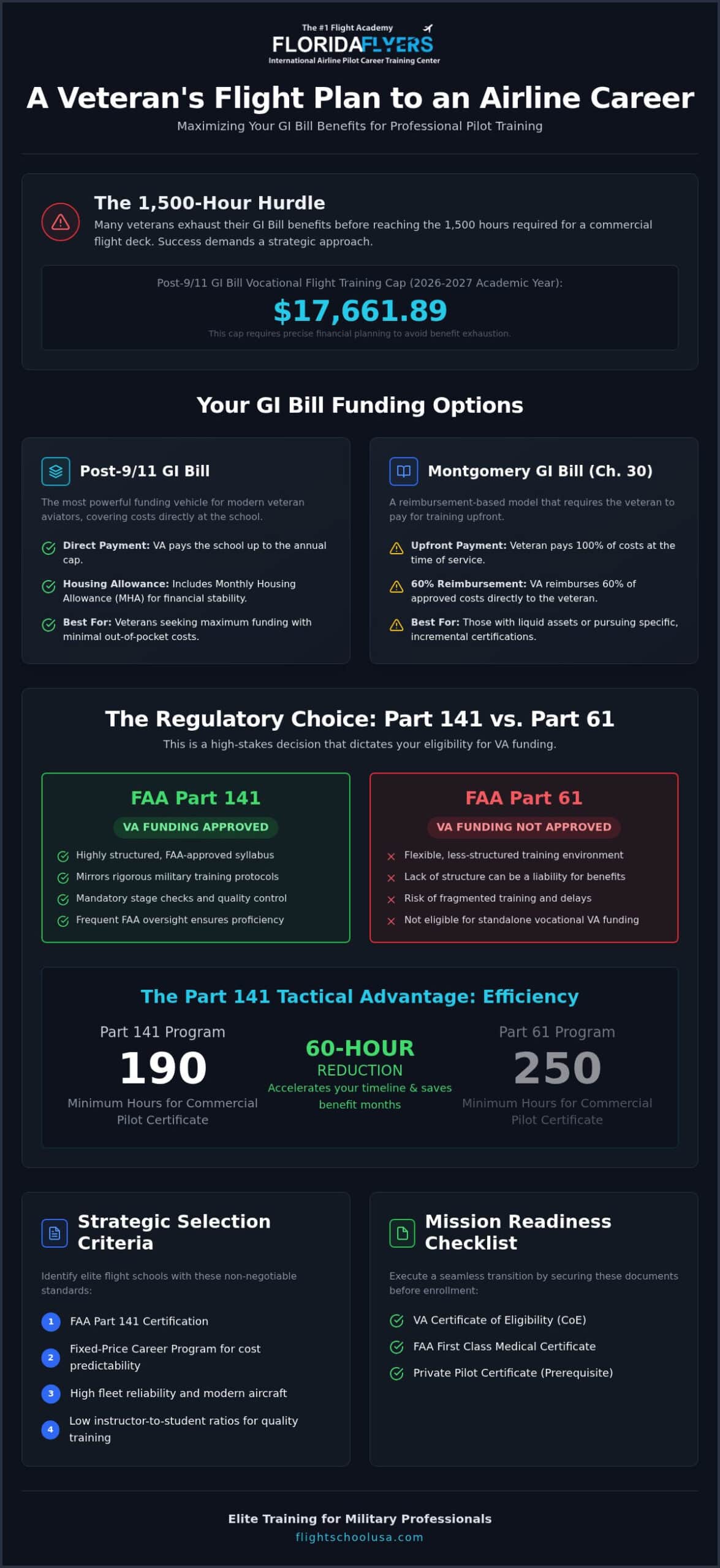
Executing the transition from military service to a commercial flight deck requires a tactical approach to administrative compliance. It’s a mission where the paperwork is as critical as the flight hours. The best flight schools for veterans distinguish themselves by providing a dedicated Veteran Liaison who understands the friction points of VA benefit deployment. Your primary objective is to synchronize your Certificate of Eligibility (COE) with a Part 141 training syllabus that maximizes your entitlement duration. This documentation phase isn’t a mere formality; it’s the foundational layer of your professional standing as an aviator.
The FAA First Class Medical Certificate is your non-negotiable point of entry. Many veterans wait until they’ve selected an academy to undergo this evaluation, which is a significant tactical error. If you have existing VA disability ratings, you must find an Aviation Medical Examiner (AME) who is experienced in navigating veteran health profiles and potential medical deferrals. A medical deferral can ground your career before it begins, so securing this clearance is the first “go/no-go” decision in your training timeline. You don’t want to invest time in benefit applications only to discover a disqualifying condition during your physical. This medical mission ensures you’re legally and physically prepared for the rigors of high-altitude operations.
Once you’ve secured your medical clearance, you must apply for your COE through the va.gov portal to verify your percentage of eligibility. If you’re transferring from another institution, the VA Form 22-1995 is the regulatory tool required to update your training location without interrupting your funding stream. You should also ensure that any previous military flight experience is formally evaluated; the best flight schools for veterans will credit relevant hours toward your ratings to reduce your total time to completion. Strategic timing is also paramount for your personal financial security. You should align your enrollment date to maximize your Monthly Housing Allowance (MHA) payments, ensuring your personal budget remains stable while you focus on the rigors of training. Developing a timeline that accounts for the VA’s August 1st fiscal reset is the only way to avoid mid-year funding gaps that can stall your momentum.
Navigating these regulatory requirements is a complex process that demands professional guidance. To ensure your deployment into the aviation industry is handled with precision, you should explore the Airline Ready Program to see how we bridge the gap between military service and a commercial career.
Flight School USA stands as the definitive authority in professional aviation for former service members. While many institutions claim to support the military, few provide the high-performance environment required to bridge the gap between military discipline and a commercial flight deck. As one of the best flight schools for veterans, we operate as a high-stakes academy that demands excellence from every student. Our airline pilot career training track is engineered for those who view aviation as a serious profession, not a hobby. We serve as a “transition to command” center, ensuring your military background translates directly into civilian cockpit leadership.
Financial volatility is a primary risk to career progression in the civilian sector. To mitigate this risk, we offer the Fixed-Price Career Program, providing total cost certainty for your professional mission. This model protects your GI Bill assets from the “benefit bleed” common in hourly training models. By locking in costs, you maintain financial command. This ensures that your focus remains strictly on the rigors of achieving certification rather than administrative cost overruns or shifting fuel surcharges.
Rapid hour building is the next tactical objective in your career path. Our CFI Fast Track Program is designed for high-velocity growth, moving you from student to instructor with unmatched efficiency. To support this full-time focus, we provide on-site student housing specifically designed for high-performance pilots. This immersive environment ensures you’re steps away from the flight line, allowing you to capitalize on every training window while maintaining the discipline of a professional cohort. It’s an environment where military standards meet elite aviation training.
The Airline Ready Program serves as the final, critical phase of your transition to the commercial flight deck. This program focuses on finalizing your technical skills while addressing the specific leadership demands of civilian airline operations. We leverage an extensive network of industry partners to facilitate elite airline placement for our graduates. We don’t just train pilots; we prepare the next generation of airline commanders through a rigorous, results-oriented curriculum.
Navigating the intersection of FAA Part 141 requirements and VA billing cycles requires institutional expertise. Flight School USA functions as a powerhouse of regulatory knowledge, streamlining the compliance process so your training never stalls. As a dedicated FAA Part 141 center, we offer the structure and oversight required to protect your legal standing and benefit longevity. Our specialized admissions team handles the complexities of VA documentation, allowing you to focus on the mission at hand. Contact our Veteran Admissions Team today to deploy your benefits.
The transition from military service to a professional cockpit requires more than just logging flight hours; it demands the strategic deployment of your GI Bill assets within a high-performance framework. By prioritizing FAA Part 141 certification and the financial certainty of a fixed-price model, you eliminate the risks of benefit exhaustion and administrative delays. Identifying the best flight schools for veterans is the first step in ensuring your training remains on a predictable, professional trajectory toward a commercial airline career.
Flight School USA provides the elite infrastructure and specialized veteran transition support necessary to navigate the 2026 regulatory landscape with precision. Our academy is Certificirano po FAA delu 141 in ponuja a Garancija kariere s fiksno ceno to protect your financial standing throughout your training mission. You’ve already demonstrated the discipline required for high-stakes operations; now it’s time to apply that expertise to your future in the sky. Apply Now for Veteran Flight Training at Flight School USA and take the final step toward your professional flight deck career. We’re ready to help you execute this transition with the excellence your service deserves.
No, the GI Bill doesn’t fund standalone Private Pilot training. To initiate vocational flight training at the best flight schools for veterans, you must already possess a PPL and a valid medical certificate. This prerequisite ensures that VA funds are directed toward professional certifications rather than recreational flying. Veterans typically fund their initial license out-of-pocket before transitioning to VA-funded Instrument or Commercial ratings.
For the 2026-2027 academic year, the maximum benefit for vocational flight training is $17,661.89. This cap applies to students with 100% eligibility attending non-degree programs. If you enroll in a private institution, the tuition and fee reimbursement cap is $30,908.34. These rates reflect a 3.3% increase from the previous year, highlighting the need for precise financial management of your entitlement.
The VA provides a Monthly Housing Allowance (MHA) under the Post-9/11 GI Bill, but it doesn’t directly pay for meal plans. This stipend is based on the military’s Basic Allowance for Housing for an E-5 with dependents. Students attending entirely online receive a maximum of $1,261.00 per month. Utilizing on-site student housing at professional academies helps stabilize these costs while maintaining a full-time focus on your training.
You should utilize the VA’s WEAMS database to verify institutional eligibility. This platform allows you to filter schools by “Flight” and “Part 141” status. Identifying the best flight schools for veterans requires confirming that both the school and the specific training syllabus have current FAA and VA approval. Always coordinate with the school’s Certifying Official to ensure your desired program is fully compliant.
Yes, you can utilize your benefits while serving on active duty, but there are significant financial trade-offs. You won’t receive the Monthly Housing Allowance because you’re already receiving military housing or BAH. The VA will pay the school directly for tuition and fees up to the annual cap. Many service members wait until they’ve separated to maximize the housing stipends provided during full-time training.
Most veterans exhaust their benefits well before reaching the 1,500-hour airline minimum. You must develop a tactical plan to build hours through employment. Enrolling in a CFI Fast Track Program allows you to transition from student to instructor rapidly. This professional role enables you to earn a salary and log the remaining flight hours required for a commercial airline flight deck without further benefit depletion.
The VA reimburses licensing and certification test fees up to $2,000 per test. This coverage includes FAA written exams and practical checkrides required for your ratings. For every $2,578.64 in fees paid during the 2026-2027 cycle, the VA will charge one month of your entitlement. You must submit a formal reimbursement request with proof of payment to the VA to recover these costs.
Receiving VA disability compensation doesn’t automatically disqualify you from obtaining an FAA First Class Medical Certificate. However, you must disclose all medical conditions and disability ratings to your Aviation Medical Examiner. The FAA focuses on your current functional ability to safely operate an aircraft. Certain psychological or neurological ratings may require a more detailed deferral process, so you should consult an AME before initiating your training.


