Your FAA medical certificate may be issued at your AME appointment if the required documentation has been reviewed and you meet the medical...
Your FAA medical certificate may be issued at your AME appointment if the required documentation has been reviewed and you meet the medical standards. If your application needs further FAA review, the certificate may not be issued that day. Knowing how to prepare for an FAA medical exam means planning ahead, especially before making any changes to medication.
It’s understandable to focus on the exam itself, but your application, medical records, and treatment history also shape how the appointment proceeds. This guide explains how to complete MedXPress, find and schedule an Aviation Medical Examiner (AME), and prepare the documents you may need. It also covers why changing medication close to the exam can complicate a steady treatment plan, and what to organize before you arrive.
Түлхүүр Takeaways
- Know what can determine whether your medical certificate is issued at the AME appointment or sent for further FAA review.
- Complete your MedXPress application accurately and plan your exam within the required submission window.
- Prepare relevant medical records, medication information, and identification before your appointment.
- Review your treatment plan well ahead of the exam, and avoid last-minute medication changes without medical guidance.
- Explore Flight School USA’s career-focused flight training programs when you’re ready to connect medical preparation with your pilot training goals.
When do I get my medical certificate?
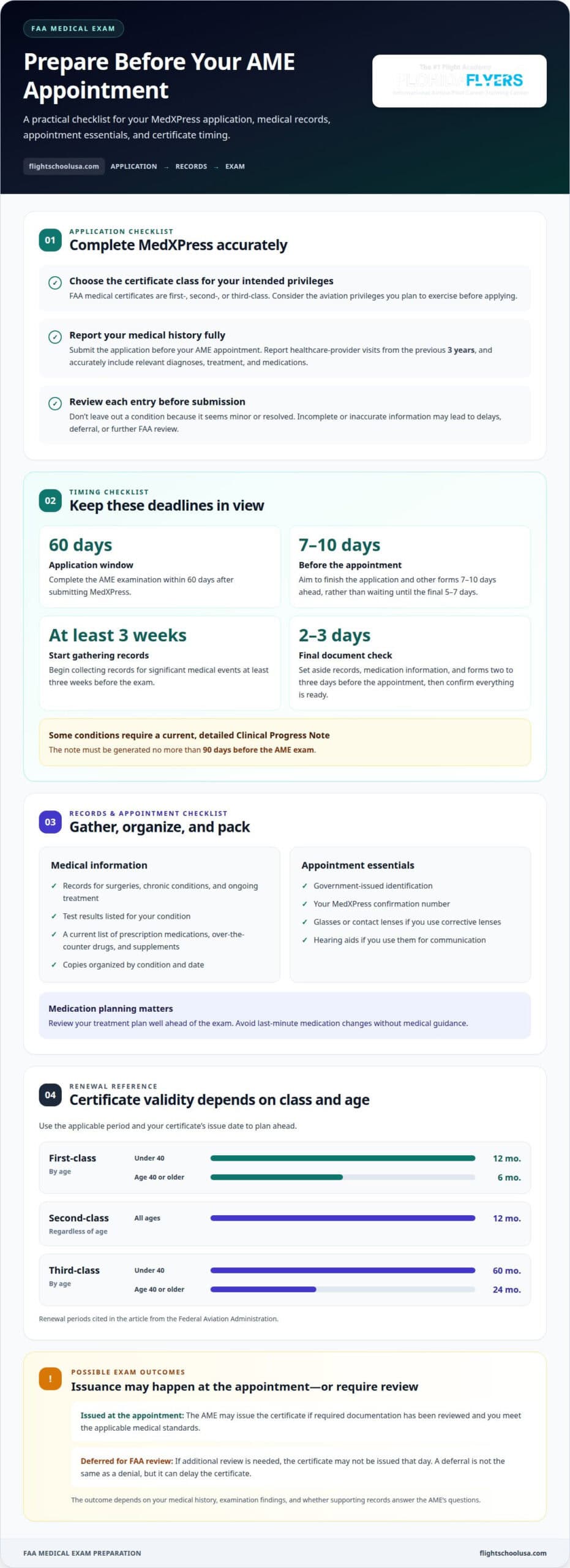
- Plan for the result that fits your examination. An AME may issue your certificate after the appointment if the required documentation has been reviewed and you meet the applicable medical standards. If the AME needs additional FAA review, the application may be deferred rather than issued immediately. A deferral is not the same as a denial, but it can delay the certificate. FAA medical certification standards are set forth in 14 C.F.R. part 67, according to the Electronic Code of Federal Regulations. The outcome depends on your medical history, examination findings, and whether supporting records answer the AME’s questions.
- Gather records before the appointment. Start collecting records for significant medical events at least three weeks before your exam. Bring documentation for surgeries, chronic conditions, and ongoing treatment, along with test results listed for your condition. Some conditions require a current, detailed Clinical Progress Note generated no more than 90 days before the AME exam. Keep copies organized by condition and date. A complete medical history helps the AME review your application against the relevant records, while missing or unclear documentation can lead to delays or further FAA review.
- Pack identification and application details. Bring a government-issued identification card and your MedXPress confirmation number. Include relevant medical records and a current list of prescription medications, over-the-counter drugs, and supplements. If this is your first FAA medical exam, these items help the AME connect your application with your identity and medical history. Set the documents aside with your appointment details rather than relying on memory at check-in. Having copies ready can make the review more efficient if the AME needs records or test results to assess a condition.
- Bring the vision and hearing aids you use. Pack your glasses or contact lenses if you rely on corrective lenses, and bring any hearing aids you use for communication. The exam may include vision testing, an audiogram, an EKG when required, and urine collection and testing. Hearing may also be assessed through conversational voice testing at six feet. Set aside your records, medication information, and forms two to three days before the appointment. Use that time to confirm everything is together and your corrective lenses or hearing aids are ready to use.
Applying for an FAA medical certificate through MedXPress
- Select the certificate class for your intended privileges. FAA medical certificates are issued in first-, second-, and third-class categories. Pilots need the class that applies to the aviation privileges they plan to exercise. Consider your flying goals before applying, since the class affects examination requirements and renewal timing. Preparing for an FAA medical exam includes identifying which certificate class fits your plans. If a medical condition raises questions, organize relevant information before submitting your application.
- Complete the MedXPress application online. Applicants must submit the FAA medical application before the AME appointment. Report healthcare-provider visits from the previous three years and answer medical-history questions accurately. Include relevant diagnoses, treatment, and medications. Don’t omit information because a condition seems minor or resolved. Incomplete or inaccurate disclosures may cause delays, deferral, or additional FAA review. Review each entry before submission, since correcting submitted forms can be difficult.
- Schedule the examination within the application window. Complete your AME examination within 60 days after submitting MedXPress. Aim to finish the application and other forms 7-10 days before the appointment, rather than waiting until the final 5-7 days. This provides time to correct errors and prepare relevant documents. A practical part of how to prepare for an FAA medical exam is keeping your MedXPress confirmation number accessible, since it connects your submitted application with the examination.
- Plan renewal before your certificate expires. First-class renewal periods are 12 months for pilots under 40 and 6 months for pilots age 40 or older. Second-class certificates have a 12-month renewal period regardless of age. A third-class certificate is valid for 60 months for pilots under 40 and 24 months for pilots age 40 or older, according to the Federal Aviation Administration. Use the applicable period and your certificate’s issue date to plan ahead.
- Keep your application consistent with medical care. If you’re receiving treatment, report your medical history accurately and provide relevant records. A physician’s diagnosis, treatment plan, and documentation can help explain how a condition is managed. Don’t decide on your own that a condition is disqualifying. The AME assesses your application and determines whether further FAA review is needed. Complete, consistent information gives the examiner a clearer basis for evaluating your application.
Би нисэхийн эмнэлгийн шинжээчийг хэрхэн олох вэ?
- Locate an AME through the FAA’s examiner search. An Aviation Medical Examiner conducts the FAA medical examination and evaluates whether you meet the standards for aviation duties. Search for an AME by location, then consider appointment availability and whether the examiner’s practice can accommodate records relevant to your medical history. If you have a condition such as hypertension or asthma, organize its documentation before booking. These conditions may qualify for CACI, a process that can allow an AME to issue a certificate when the required documentation is provided.
- Understand what issuance means. If the AME determines that you meet the applicable medical standards, the examiner may issue your medical certificate after the appointment. The examination includes a review of your application and medical history, along with a physical assessment. Vision and hearing are among the areas assessed. Bring condition-specific records and required tests so the AME can review relevant evidence. Issuance depends on whether the examination and documentation satisfy the applicable requirements.
- Prepare for CACI or Special Issuance review. CACI applies to some conditions, including hypertension and asthma, when the required medical documentation supports AME issuance. Special Issuance is a separate FAA certification pathway provided for under 14 C.F.R. § 67.401. Prepare the records and supporting paperwork before the appointment, including documents relevant to the condition being evaluated. The AME may need to defer the application if required paperwork is missing or the condition requires FAA review.
- Recognize a deferral without treating it as a denial. A deferral means the AME sends the application to the FAA for review or further investigation. It does not, by itself, mean the FAA has denied certification. Special Issuance also does not automatically ground a pilot. However, in many cases, aviation privileges requiring medical certification cannot be exercised while a deferred application awaits FAA review. Plan your flight activity around your current certification status.
- Know the next step if the FAA denies the application. A denial differs from an AME deferral: it means the application was not approved through that review. Applicants may appeal a denial, and the FAA provides instructions for the appeal process. Keep the decision and relevant medical records together, then follow the FAA’s stated process. If your case involves a condition that may fit CACI or Special Issuance, prepare complete supporting documents for the applicable review rather than assuming the initial outcome ends every certification option.
Scheduling an Aviation Medical Examiner appointment
Schedule with an Aviation Medical Examiner (AME) whose appointment timing fits your certification plans. Before booking, consider how your medical condition and required records may affect the examination.
-
Find an Aviation Medical Examiner
Use the FAA’s AME search tool to locate an examiner and identify an appointment option. Before choosing a date, consider whether your medical history may require supporting records or additional tests. For example, applicants with hypertension or asthma may need documentation for CACI consideration. Prepare condition-related questions and records before the visit, rather than arriving without information the AME needs to assess your application.
-
Schedule the Appointment and Seek Guidance
Choose an appointment date that allows time to assemble records and complete MedXPress within its 60-day examination window. If you have a medical condition, understand its possible certification implications before scheduling. Discuss your health and treatment with your physician, and organize relevant records for the AME. Don’t stop or alter prescribed treatment simply to prepare for an examination; a stable, documented plan gives the examiner clearer information.
- Set expectations for the physical examination. An FAA medical exam typically takes about 30 minutes, though the details depend on the required evaluation. The AME personally reviews your medical history, oversees tasks performed by office staff, and performs the physical examination. Expect checks of height, weight, pulse, and blood pressure. The examiner also evaluates your vision and hearing, so bring corrective lenses or hearing aids that you use.
- Prepare for tests that may form part of the visit. The examination may include vision testing, an audiogram, and a urine sample for collection and testing. An EKG is included when required. The AME may also assess conversational voice hearing at six feet. These procedures contribute to the overall medical evaluation; they do not replace accurate answers about your health. Bring relevant medical records so the examiner can consider test findings alongside your history.
- Reschedule if illness or injury affects your condition. If you become sick or injured before the appointment, reschedule rather than attend while unwell. An AME evaluates your condition on the examination day, so an acute illness may affect the assessment. Before choosing a new date, consider whether you need updated records or test results. Arrive prepared to answer questions about your current health, treatment, and any changes since submitting your application.
Avoiding medication changes close to the exam
- Review every medication well before your appointment. About 20-25 days before the FAA medical exam, gather a complete list of prescriptions, over-the-counter medicines, and supplements. Include each product’s name, dose, and reason for use, plus any recent changes. The AME evaluates your health and medication use on the examination day. An accurate list helps connect your treatment history with your application and medical records. Don’t leave out occasional medicines or supplements because you consider them insignificant.
- Discuss proposed changes with your treating physician. Don’t stop, reduce, or replace a prescribed medication just to influence an examination result. Your physician’s treatment recommendations address your health, while the AME evaluates medical fitness for aviation. A change made without clinical guidance may disrupt treatment or make your condition less stable. If you have concerns about medication, raise them with your physician early, then document the medical advice and any resulting treatment plan.
- Avoid last-minute changes unless your physician directs them. The preparation guidance cautions against changing medications during the last 10 days before an FAA medical exam. That timing matters because the AME assesses your actual condition and current treatment, not a temporary adjustment made for the appointment. If your physician determines a change is medically necessary, follow that care plan and keep the relevant records. Do not delay needed treatment solely to preserve an exam date.
- Make your submitted history match your treatment records. Before submitting MedXPress, compare your medication list with your records and medical history. For example, if a prescription changed recently, report the change accurately rather than listing only the previous dose. Gather records that explain the diagnosis, treatment, and clinical progress. Clear documentation helps the AME assess the full picture and can reduce avoidable questions, delays, or further FAA review. Medication use alone does not establish that an applicant will be denied.
- Keep the plan stable and explain changes clearly. Pilots managing a medical condition should follow their physician’s recommendations and maintain a well-documented treatment plan. Bring an updated medication list and records explaining any change, including when it occurred and why. Not all medications are FAA-approved, so the AME considers the medication alongside the underlying condition and available documentation. If treatment changes shortly before the exam, provide the context rather than concealing it. Plan your next steps in aviation with a clear understanding of your medical preparation.
АНУ-ын нислэгийн сургууль
Flight School USA is a next step for aspiring pilots ready to connect medical preparation with structured flight training. Once you understand your certification pathway, consider whether the Fixed-Price Career Program or CFI Fast Track Program aligns with your professional goals. Veterans can explore GI Bill Flight Training, while international students can consider M1 Visa Admission Services. These offerings support different routes into aviation, but they don’t replace FAA medical certification or an AME’s evaluation. Keep your training goals and medical certification requirements distinct as you plan your next steps. For program information and guidance on your flight training path, contact Flight School USA.
Build Your Next Step Around Your Pilot Goals
Medical certification is one part of a larger aviation plan. As you map out training, consider how your certification timeline, career objectives, and personal circumstances fit together. A clear sequence helps you make informed choices and keep important decisions from competing for attention. Use what you’ve learned about preparing for an FAA medical exam to approach the process deliberately, while leaving medical decisions to the appropriate professionals.
Your next step can be a focused conversation about flight training and the path you want to pursue. Flight School USA offers career-focused options for aspiring pilots, including programs for professional training and veterans using GI Bill benefits. Contact Flight School USA for guidance as you consider how training may fit your goals. Bring your questions and priorities to the conversation, then move forward with a plan that reflects your ambitions. A disciplined start can help you approach your aviation future with confidence.
Түгээмэл асуултууд
What happens if my AME defers my exam?
A deferral sends your application to the FAA for further review; it isn’t a denial. The FAA may ask you to submit additional medical information or records before deciding. Organize the request and the supporting documents together so your response addresses each item. The FAA commonly gives applicants a 60-day suspense period to provide requested information, and you may ask the FAA for a 60-day extension if you need more time.
What Could Delay or Deny Certification?
Incomplete paperwork, unclear application answers, missing medical records, or a condition requiring further FAA review can delay certification. An AME may defer an application when required documentation is missing or the case needs additional review. A medical condition alone doesn’t establish that the FAA will deny certification. Provide accurate information and supporting records so the AME can assess your case. If the FAA needs more evidence, respond to its request within the stated period.
What Happens if I Fail?
An AME may decline to issue a certificate at the appointment, defer the application, or determine that the FAA must review the case. These outcomes aren’t interchangeable: a deferral is not a final denial. If the FAA denies certification, applicants may appeal using the FAA’s appeal instructions. Keep the decision and related medical documents together. Read any request or notice carefully, because the required next step depends on the action described.
What Is an FAA Medical Exam?
An FAA medical exam is an evaluation by an Aviation Medical Examiner to determine whether an applicant meets the medical standards for aviation duties. It combines a physical examination with review of the applicant’s medical history and medications. It isn’t a flight-skills test: the AME assesses medical fitness for the requested certificate. The applicable standards are set forth in 14 C.F.R. part 67.
What are the Health Standards Needed to Pass?
There isn’t one health result that determines every applicant’s eligibility. The AME considers your current health, medical history, medications, examination findings, and the certificate class sought. FAA standards are set forth in 14 C.F.R. part 67. Some conditions may be considered through CACI or Special Issuance pathways when the required documentation is available. A diagnosis by itself doesn’t explain how the FAA will assess your complete medical record.
What if I receive a denial letter?
Read the denial letter closely and follow its appeal instructions. The FAA allows applicants to appeal a denial, and the letter identifies the decision you must address. Keep the notice with relevant medical records, test results, and treatment documentation. If the FAA requests further information, organize your response around each request. A deferral differs from a denial, so identify the outcome stated in the letter first.
What happens during an FAA medical exam?
The AME reviews your application and medical history, then conducts a physical examination. The visit can include checks of blood pressure, pulse, height, and weight, plus vision and hearing assessments. A urine sample is usually collected and tested; an EKG may be included when required. The appointment typically takes about 30 minutes. The exact evaluation depends on the examination requirements and the information in your application.
What documents should I bring to an FAA medical exam?
Bring government-issued identification, your MedXPress confirmation number, and records relevant to your medical history. For example, include supporting documents for a surgery, chronic condition, or ongoing treatment, along with applicable test results. Carry a medication list and any corrective lenses or hearing aids you use. Organize paperwork by condition so an AME can locate information efficiently. If your condition has specific evaluation requirements, bring the records and tests listed for that condition.