

Initial CFI-Airplane and CFI-Glider applicants must complete spin endorsement training under 14 CFR § 61.183(i) before their checkride. The endorsement certifies that you possess instructional proficiency in stall awareness, spin entry, spins, and spin recovery procedures, not simply that you survived a few rotations. Training happens in a spin-certificated aircraft, and the logbook entry it produces goes straight into your practical test documents for the designated pilot examiner.
TL; DR:
- Flight instructors must demonstrate instructional proficiency in stall awareness, spin entry, spins, and recovery, without a fixed minimum spin count or flight hours.
- Typical training lasts 1 to 2 hours of flight paired with ground instruction, including practice spins and teaching demonstrations to assess actual instructional ability.
- Approved aircraft for spin endorsement include aerobatic planes like Citabria, Super Decathlon, Pitts, Extra, and certain Cessnas, with strict limitations on the latter.
- The official logbook endorsement must follow FAA sample wording to clearly certify teaching ability; a retest with in-flight spins may be required if deficiencies are found later.
- Effective preparation involves studying aircraft-specific spin procedures, rehearsing teaching, and ensuring instructor currency, with costs averaging $400 to $800 for a session.
The regulation itself is short, but it packs four distinct training elements into one sentence. Under 14 CFR § 61.183(i), an applicant for an initial CFI-Airplane or CFI-Glider certificate must receive flight training on:
Notice what the rule does not say. It never specifies a minimum number of spins, a required flight-hour count, or a pass/fail spin count on a checkride. The standard is qualitative: you must be “competent” and “possess instructional proficiency,” language that shifts the focus from personal stick skill to your ability to brief, demonstrate, and correct another pilot’s spin recognition and recovery.
Three FAA documents fill in the practical detail. AC 61-65K supplies the sample logbook endorsement wording your instructor will use. AC 61-67C lays out the stall and spin awareness training content the FAA expects instructors to cover. The CFI Airplane ACS tells you what a designated pilot examiner may ask about stalls and spins during your oral and practical.
Most spin endorsement sessions follow a predictable arc, built around a ground briefing, a flight segment, and a teaching demonstration. Industry custom runs 1.0 to 2.0 hours of dual flight instruction paired with 1 to 2 hours of ground time, and many providers structure the flight around two spins to the left and two to the right.
That last step is where “instructional proficiency” gets tested in real time. An instructor who can spin an airplane cleanly but can’t narrate why the nose is doing what it’s doing hasn’t met the standard yet.
Not every trainer is legally or practically suited to intentional spins. Schools generally favor purpose-built aerobatic aircraft, and for good reason: a broader flight envelope makes the spin characteristics clearer and the recovery margins more forgiving for a student who’s still learning to read the airplane.
Because that 172 envelope is so restrictive, most instructors steer candidates toward dedicated aerobatic airframes instead.
Pro Tip: Before you book a lesson, ask the school directly whether the instructor is current in aerobatic instruction and whether the aircraft’s most recent annual inspection specifically cleared it for intentional spins. A dual-control aerobatic airplane with a maintenance gap in that department is a bigger risk than the maneuver itself.
The wording matters as much as the flight time. AC 61-65K’s Appendix A.49 provides the FAA’s sample endorsement language, and instructors who deviate from that sample risk creating ambiguity a designated pilot examiner has to resolve on checkride day. Using the sample wording avoids that friction entirely, since it standardizes exactly what “instructional proficiency” means in writing.
The endorsement itself functions as evidence, not a formality. It tells the examiner your instructor personally certifies that you can teach stall awareness, spin entry, spins, and recovery, which is precisely why many examiners accept the logbook entry instead of requiring an in-flight spin demonstration during the CFI practical.
A candidate who fails the initial CFI checkride for stall or spin deficiencies may face a retest requirement that includes an actual in-flight spin demonstration in a spin-certified aircraft, even if the original endorsement was on file.
That single fact is the strongest argument for taking this training seriously the first time, rather than treating it as a box to check quickly before the exam.
Preparation splits into three lanes: knowledge, oral readiness, and teaching rehearsal. Skipping any one of them tends to show up immediately when the DPE starts asking follow-up questions.
Reviewing a detailed flat spin guide before your session gives you the vocabulary to explain recovery sequencing with precision instead of vague hand gestures. Candidates on an accelerated schedule often pair this with a broader CFI fast-track plan so the spin endorsement lands at the right point in their overall timeline.
Pro Tip: Record your own briefing on your phone during rehearsal and play it back. Most candidates are shocked at how many filler words and hedges creep into their explanation until they hear it themselves.
Standalone spin endorsement training typically runs $ 400 sampai $ 800, covering aircraft rental, instructor time, and the ground briefing. That range usually assumes a half-day to full-day session; some providers offer multi-day bagian 141 courses or accredited FAA WINGS activities that go beyond the minimum and bundle in broader upset-recovery training.
Before booking, check for these signals of a well-run program:
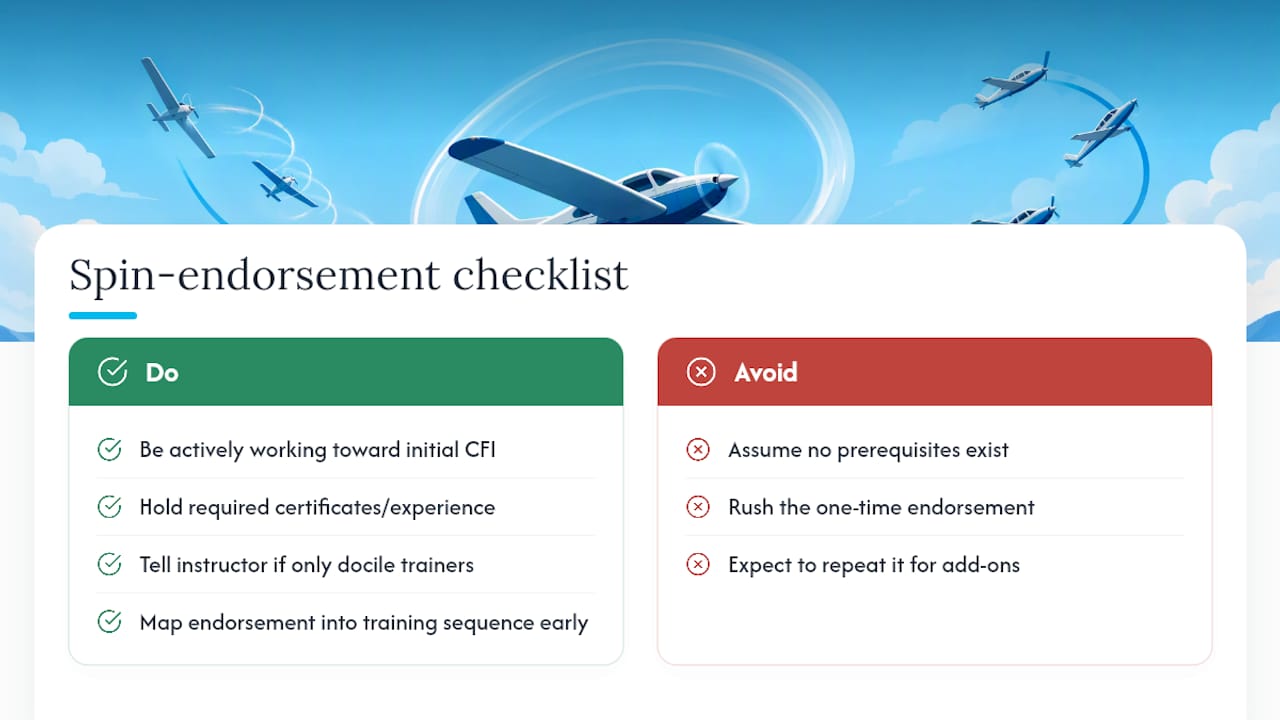
The endorsement itself has no formal certificate prerequisite written into the regulation, but the practical path there does. You need to be actively working toward an initial CFI-Airplane or CFI-Glider certificate, which means you’ve already earned your commercial pilot certificate (or private certificate with an instrument rating in some CFI-glider pathways) and built the aeronautical experience those ratings demand.
Beyond the paperwork, schools expect a baseline of stick-and-rudder comfort before they’ll put you into intentional spins. If your flying up to this point has been entirely in docile trainers with gentle stall characteristics, tell your instructor that up front. Most reputable programs will add extra unusual-attitude and slow-flight work into the ground segment rather than assuming you walked in spin-ready.
One detail worth remembering: this endorsement is a one-time requirement tied to your initial CFI certificate. It does not need to be repeated for add-on instructor ratings like a CFII or MEI later in your career. That makes it worth doing thoroughly the first time rather than rushing through it under the assumption you’ll revisit the topic down the road, because you likely won’t be required to.
If you’re still building toward the commercial certificate that makes you eligible, it’s worth mapping your persyaratan pelatihan pilot now so the spin endorsement lands at the right point in your sequence, not as a last-minute scramble the week before your checkride.
The logbook endorsement is the legal proof, but it’s not the only documentation worth keeping. A single sentence in your logbook tells a DPE that training happened; it doesn’t tell you, six months later, what you actually covered.
Keep a personal training record alongside the official endorsement that notes the date, aircraft type and tail number, the specific maneuvers practiced (entries, recoveries, cross-control demonstrations), and any deficiencies your instructor flagged. This matters for two practical reasons. First, if you ever need to explain your training history to a different examiner or a future employer’s training department, a detailed record backs up the bare endorsement language. Second, if your initial attempt at the CFI practical gets deferred for reasons connected to stalls or spins, a clear personal record helps you and your instructor pinpoint exactly what to revisit before a retest.
Many candidates also photograph or save the ground briefing materials, particularly any diagrams covering load factor, adverse yaw, or the aircraft-specific recovery sequence from the POH. Instructors sometimes hand-draw these during the brief, and they rarely survive past the lesson unless you capture them. Treating the spin endorsement like any other high-stakes training event, with its own paper trail, protects you if a question ever comes up about what “instructional proficiency” actually covered in your case.
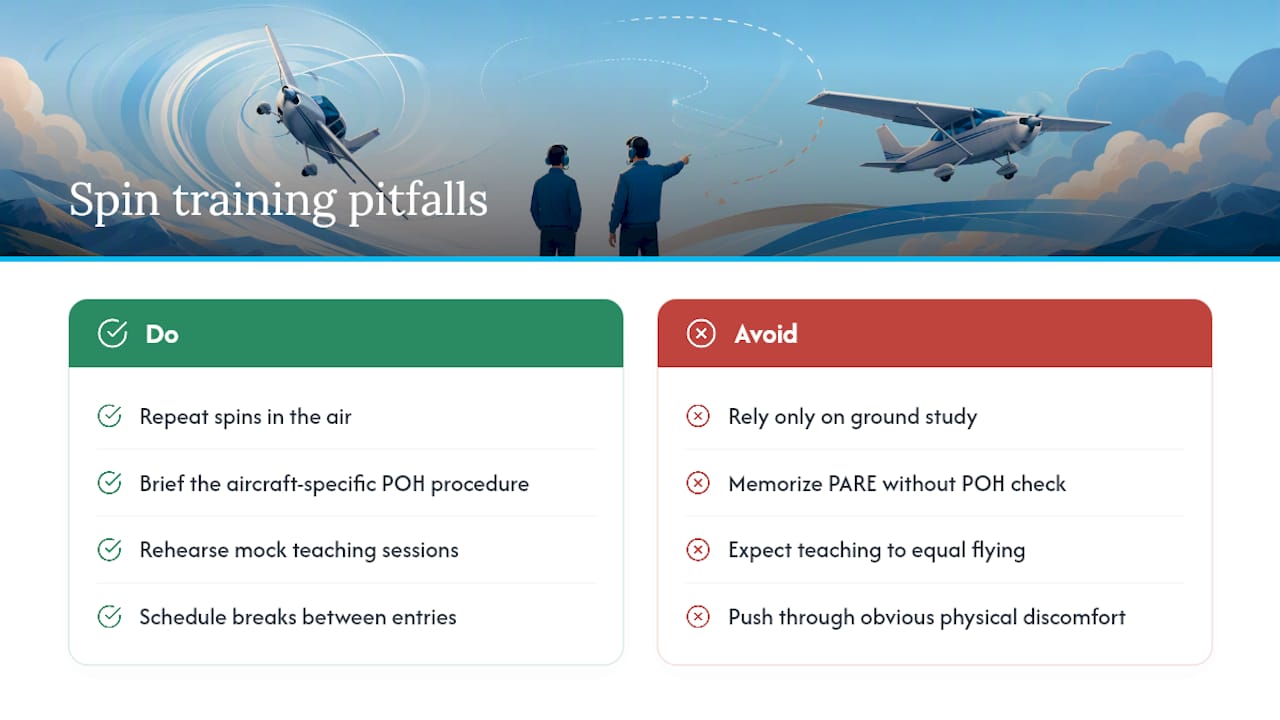
Disorientation tops the list. The visual and vestibular sensations of a spin, particularly the rapidly rotating horizon, catch first-timers off guard even when they understand the aerodynamics perfectly on paper. The fix isn’t more ground study. It’s repetition in the air, since the disorientation response fades noticeably after the second or third spin once your inner ear and eyes start agreeing with each other again.
A second common struggle is confusing the PARE mnemonic’s generic sequence with the specific aircraft’s POH procedure. Some airplanes call for a slightly different control input order, and candidates who memorized the mnemonic without cross-checking the POH sometimes hesitate at the worst possible moment. Always brief the aircraft-specific procedure explicitly, not just the general mnemonic.
Third, many candidates can perform the maneuver but freeze when asked to teach it. Flying a spin and narrating a spin recovery in real time while a “student” reacts unpredictably use different cognitive muscles entirely. The remedy is rehearsal, specifically the mock teaching sessions covered earlier, run enough times that the explanation becomes automatic rather than something you’re composing on the fly.
Finally, some students underestimate how physically demanding a compressed session can feel. Back-to-back spin entries can produce mild nausea even in experienced pilots. Reputable instructors build in breaks and won’t push through obvious discomfort just to finish the lesson plan on schedule.
Spin training carries real risk if the aircraft, instructor, or procedure isn’t right for the maneuver, which is exactly why the FAA’s guidance in AC 61-67C treats stall and spin awareness as a distinct training discipline rather than an afterthought bolted onto stall practice.
Every session should start with a weight-and-balance check specific to spin limits, since many aircraft that are otherwise spin-approved become restricted outside a narrow CG range. The instructor should verify dual controls are functioning correctly and confirm the aircraft’s maintenance status supports intentional spins, not just normal category flight. Altitude discipline matters just as much as the maneuver itself: entries typically begin well above 3,000 feet AGL to leave a wide margin for recovery, and a hard recovery altitude should be set and respected before the flight ever leaves the ground.
Instructor currency is the piece candidates least often think to ask about. An instructor who hasn’t flown aerobatic maneuvers recently, even one with an impressive logbook from years past, may have lost some of the fine motor calibration that spin instruction demands. Ask directly about recent aerobatic instructional experience before you book.
Finally, brief the abort criteria before takeoff, not during the maneuver. Know in advance what conditions (altitude loss, disorientation, mechanical concern) trigger an immediate stop, so no one is improvising that decision mid-spin.
Not every flight school offers spin endorsement training in-house, since it requires an aerobatic-capable aircraft and an instructor with specific currency most standard trainers and CFIs don’t maintain. Start by asking your current flight school directly whether they offer it or maintain a referral relationship with a school that does.
Beyond your home school, look at schools advertising dedicated upset-recovery or aerobatic instruction, since these programs almost always maintain the aircraft type and instructor currency the endorsement demands. FAA WINGS-accredited activities, like the multi-day CFI spin endorsement courses listed on FAASafety.gov, are a reliable starting point because they’ve already been reviewed against a defined curriculum.
When you contact a prospective provider, ask three direct questions: what aircraft they use, how recently the instructor has flown aerobatic maneuvers with a student, and whether they can show you a written lesson outline before you commit to a booking. A school that answers all three without hesitation is usually one worth training with.
The regulation sets a floor, not a target. Candidates who treat the spin endorsement as a same-day formality tend to be the ones who freeze during the oral or fumble the teaching demonstration when a DPE probes past the surface. Deeper training, the kind that includes real teaching rehearsal and honest debriefs, produces instructors who don’t need a retest and who can actually keep a future student safe when that student enters an unintentional spin years down the road.
Programs built around structured, exam-grade preparation tend to produce candidates who pass cleanly the first time. That’s the standard worth training to.
— Rainer
Flightschoolusa runs spin and upset-recovery training as a structured part of its CFI preparation, not a bolt-on afterthought squeezed in before your checkride. Because the academy holds Otoritas Pemeriksaan Diri, it can conduct your FAA practical in-house once your endorsement and other requirements are complete, cutting out the scheduling delays that stall so many candidates at independent testing centers elsewhere.
Before booking, you’ll need your commercial pilot certificate (or the appropriate prerequisite for a CFI-Glider path) and the aeronautical experience the certificate demands. From there, the CFI training pathway folds spin endorsement training directly into your certification timeline, alongside oral prep and mock teaching sessions that mirror what a designated pilot examiner will actually ask. Candidates who’ve completed prior training with a flight school may benefit from continuity with instructors carrying training history forward into checkride prep.
Start by reviewing the CFI career training program to see how spin endorsement training fits into your broader certification plan, then reach out to schedule your ground briefing and flight session.
No. It’s required only for the initial CFI-Airplane or CFI-Glider certificate under 14 CFR § 61.183(i), not for later add-on ratings like CFII or MEI.
The regulation sets no fixed count, but industry custom typically includes two spins left and two spins right during a 1.0 to 2.0 hour flight session.
Only in Utility Category, front-seat occupants only, and within the narrow weight-and-balance limits set in the POH, which is why most schools prefer dedicated aerobatic aircraft instead.
A retest may require an actual in-flight spin demonstration in a spin-certified aircraft, even though the original written endorsement is still on file.
Yes. Flightschoolusa builds spin and upset-recovery training into its CFI preparation and uses its Self Examining Authority to schedule the checkride in-house once training is complete.


