

U.S. airline pilots must retire by age 65 under Federal Aviation Administration rules. The pilot retirement wave’s impact is already visible in the numbers: 2,225 pilots were required to retire in 2023, and required retirements are projected to peak at 3,750 in 2029. A proposed measure would allow pilots to fly until 67, but a higher age limit and the staffing effects of retirements are separate issues.
It’s reasonable to wonder whether delaying retirement could ease pressure on airlines. The answer depends on more than the number of pilots reaching the age limit: new pilot supply, airline hiring and where qualified pilots are available all shape staffing capacity.
This article explains why the U.S. limit is 65, how retirements can affect airline staffing and flight schedules, and what a proposed increase to 67 could mean. You’ll also see how the retirement wave connects to the career outlook for aspiring pilots.
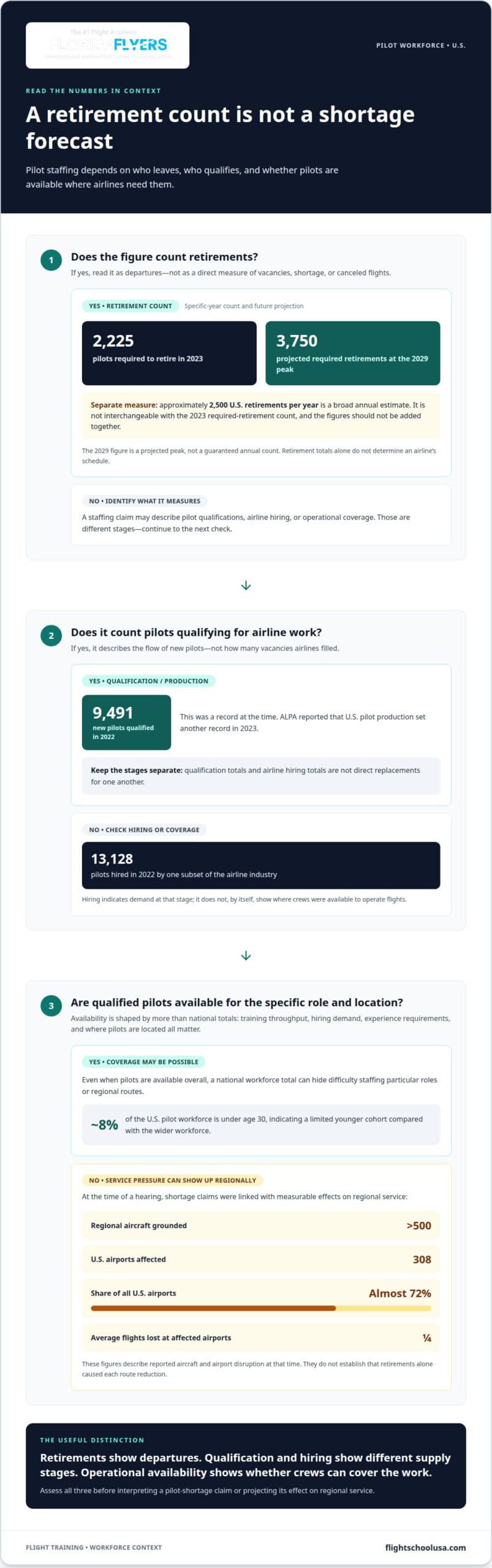
U.S. pilot retirements are a recurring staffing event, but the annual total can shift substantially. In 2023, 2,225 pilots were required to retire. Required retirements are projected to peak at 3,750 in 2029. These figures show why a single year cannot represent the full retirement trend.
A separate estimate places U.S. retirements at approximately 2,500 pilots each year. That annual estimate and the 2023 figure describe different measures: one gives a broad yearly scale, while the other counts required retirements in a specific year. They should not be treated as interchangeable totals or added together.
The 2029 projection signals a future peak, not a guaranteed count for every year around it. Retirement totals depend on how many pilots reach the mandatory age threshold during a given year. A higher projected total therefore points to a concentrated staffing challenge, rather than a uniform loss of pilots across the entire period.
For airlines, timing matters as much as the annual total. When a pilot leaves, a vacancy opens, but the impact depends on the pilot’s role and how the airline fills the position. A captain’s departure, for example, can affect staffing differently from a departure elsewhere in the pilot workforce.
Annual totals also do not show how quickly new pilots can qualify for airline jobs. Training, qualifications, and hiring shape the supply available to replace departing pilots. If retirements outpace the flow of qualified pilots into open positions, pressure can intensify in particular roles or locations. The retirement count alone does not show where that pressure will occur.
Use the figures as planning signals, not as a direct forecast of canceled flights. The 2,225 pilots required to retire in 2023 establish a specific-year baseline; the projected peak of 3,750 in 2029 identifies a later pressure point. Neither figure, by itself, determines an airline’s schedule or staffing response.
The impact of the pilot retirement wave is clearest when annual counts are read alongside workforce replacement and airline hiring. Compare the 2023 count with the 2029 projection, then consider whether qualified pilots can enter the affected positions in time. That distinction helps separate a large retirement cohort from an automatic shortage across every U.S. airline.
Retirement counts describe departures, but pilot availability measures whether qualified pilots can fill specific airline roles. The distinction matters: a national workforce total can appear adequate while regional carriers still struggle to staff routes. In the United States, pilots under age 30 make up around 8% of the pilot workforce, indicating a limited younger cohort compared with the wider workforce.
The International Civil Aviation Organization sets age 65 as the global retirement age for pilots in multicrew operations. That standard shapes how long pilots can remain in those roles, but it doesn’t show how many qualified replacements are ready. Availability also depends on training throughput, hiring demand, experience requirements, and whether pilots are located where airlines need them.
Shortage claims have included measurable effects on regional service. More than 500 regional aircraft were grounded because of the pilot shortage at the time of a hearing. The shortage affected 308 U.S. airports, almost 72% of all U.S. airports. Those figures describe disruption across airports and aircraft, not the number of pilots missing from every individual airline.
At affected airports, service was also reduced: airports had lost an average of one quarter of their flights at the time of the hearing. For communities that rely on regional connections, that can mean fewer departures to choose from. It does not establish that retirements alone caused each route reduction. Staffing pressure can reflect several linked factors, including hiring competition and the supply of qualified pilots.
Hiring and training figures show why “shortage” needs context. A total of 9,491 new pilots qualified in 2022, a record at the time. ALPA reported that U.S. pilot production set another record in 2023. Yet one subset of the airline industry hired 13,128 pilots in 2022. Qualification totals and hiring totals measure different stages, so they shouldn’t be read as direct replacements for one another.
Pay offers also signaled competition for regional airline staff. That figure describes an offer level during that period, not a universal salary or proof that every vacancy was filled.
To assess the pilot retirement wave’s impact, distinguish workforce production, airline hiring, and operational availability. Each answers a different question: how many pilots qualified, how many airlines hired, and whether crews could cover required flights. For aspiring pilots, understanding career pathways in aviation clarifies how training can connect to future workforce demand.
Raising the U.S. pilot retirement age is a policy proposal, not the same as changing the current limit. The proposed Let Experienced Pilots Fly Act would allow pilots to fly until age 67. Separately, a House-passed provision would allow airline pilots between ages 65 and 67 to continue flying. These measures describe a possible extension, not a universal change for every pilot.
The proposal includes a health-screening condition: pilots working past age 65 would undergo medical screenings every six months. That requirement matters because an age extension would not simply add two years to every pilot’s career. It would also connect continued service with recurring medical assessments. The exact effect would depend on the legislation’s provisions and how they applied to pilots and airline operations.
Support for a higher limit is contested. More than 30 labor unions oppose raising the mandatory retirement age in the United States. Their opposition shows that the debate involves workforce policy and safety concerns, not only the number of pilots available. The existence of a proposal does not mean airlines can already schedule pilots beyond the current limit.
Age alone also doesn’t describe every individual’s capability. Some senior pilots continue flying into their 80s while maintaining excellent focus and good physical capabilities. That example illustrates individual variation, but it does not establish a general qualification standard or determine airline retirement rules. A statutory age limit and an individual’s condition are separate questions.
The United States raised the pilot upper age limit to 65 in 2007. That earlier change provides context for the current debate: lawmakers have changed the threshold before, but a previous change does not guarantee another. A move to 67 would require a change in policy, and the proposals’ stated screening condition would be part of the discussion.
An increase in the retirement age could delay some departures from the workforce, but it would not directly add pilots at every carrier or location. The effect would depend on how many eligible pilots continued flying, which roles they held, and how airlines scheduled them. Training and hiring needs would remain.
Read the proposal in three parts: the age it would permit, the screening interval, and its legislative status. Here, those details are age 67, every six months for screenings after 65, and proposals that include a House-passed provision. Keeping those points distinct helps explain what could change without treating a proposed extension as current policy.
The central cause is the age profile of the U.S. pilot workforce. There are 70% more pilots aged 43 to 64 than pilots aged 21 to 42. This imbalance means more pilots are approaching retirement age than belong to the younger comparison group. As older pilots reach the applicable age limit, departures can cluster rather than occur evenly across generations.
The age distribution reflects a workforce shaped by different career-entry periods. A larger group in the 43-to-64 range creates a broader pool nearing retirement than the 21-to-42 group can immediately replace. This comparison does not predict the exact retirement date of each pilot. It explains why workforce age structure matters when assessing future departures.
The United States raised the pilot upper age limit to 65 in 2007. That change forms part of the policy history behind today’s retirement pattern. Pilots affected by the current threshold leave airline roles as they reach it, while younger pilots enter through training and hiring. The gap between those movements determines how rapidly airlines can renew their staffing.
Approximately 2,500 pilots retire each year in the United States. This yearly estimate provides a broad indication of ongoing workforce turnover. It is not a fixed count for every year or a precise forecast for a particular airline. Retirement totals vary with the number of pilots reaching the applicable threshold during each period.
Three factors help explain why retirements can affect availability:
These factors interact. A retirement creates an opening, but it does not automatically lead to a canceled flight or an unfilled position. The outcome depends on the role, the airline’s hiring needs, and the flow of qualified pilots into available jobs. The age profile points to a potential pressure point; it does not determine the operational outcome on its own.
For a prospective pilot, the age distribution offers context rather than a guaranteed hiring path. A large older cohort can create replacement demand, while training and airline recruitment shape how that demand translates into opportunities. Reading the figures together gives a clearer picture: the 2007 age-limit change, the workforce imbalance, and approximately 2,500 annual retirements each describe a different part of the retirement wave’s cause.
Under U.S. Federal Aviation Administration rules, commercial airline pilots must retire by age 65. Each retirement removes an experienced pilot from the available workforce. Airlines then need qualified replacements for the departing pilot’s role, and staffing pressure can emerge if hiring and training do not keep pace.
The scale of future turnover is substantial: approximately 50% of the U.S. airline pilot workforce is expected to be forced to retire over the next 15 years. That projection describes a workforce-wide transition, not an equal loss at every airline. The schedule effect depends on when departures occur, which roles open, and how quickly airlines fill them.
Staffing pressure can reach passengers through reduced service. At the time of a hearing, affected U.S. airports had lost an average of one quarter of their flights. This illustrates how a pilot shortage can limit schedules at affected airports. It does not mean every retirement directly cancels a flight; airline staffing and operational decisions shape the outcome.
Regional airlines can be especially exposed when experienced pilots move to larger carriers. Twelve large U.S. airlines hired more than 13,000 pilots in 2022, almost all sourced from regional airlines. That movement can create a chain of vacancies: a regional carrier loses a pilot, recruits a replacement, and must maintain enough qualified crews to operate planned service.
Hiring targets show the scale of airline demand. United Airlines and its peers aimed to hire a combined 8,000 pilots through 2023. Hiring can replace departures, but it does not automatically restore capacity at the same time or place. Recruitment, training, qualifications, and the specific positions airlines need all shape whether new hires translate into staffed flights.
To understand the operational effect, distinguish three stages:
A proposed provision allowing pilots aged 65 to 67 to continue flying could delay some departures if adopted. It would not remove the need to recruit and train new pilots. The effect would depend on how many pilots continued working and which airline positions they filled.
If you’re preparing for a professional aviation career, structured pilot career training can help you build toward future airline roles.
Before it ceased operations, Spirit Airlines operated hundreds of daily flights and employed about 17,000 people. Spirit Airlines said it had operated for 34 years before beginning an immediate wind-down; it canceled all flights and said customer service was no longer available. Jon Jackson was scheduled to fly his final flight into Baltimore-Washington International Airport on Saturday, the day Spirit Airlines ceased operations. The Trump administration floated taking a 90% stake in Spirit Airlines to prevent its collapse.
Flight School USA prepares aspiring pilots for professional aviation through flight training and career-focused programs. Retirement projections provide workforce context, but they do not guarantee a particular hiring outcome. A structured training pathway is a practical next step: build qualifications for aviation roles while keeping in mind that airline staffing depends on hiring needs and pilot availability.
The Fixed-Price Career Program and Airline Ready Program support career-focused training, while the CFI Fast Track Program provides a distinct instructor pathway. GI Bill Flight Training and M1 Visa Admission Services support eligible veterans and international students pursuing flight training in the United States.
If you’re ready to explore flight training, contact Flight School USA to discuss your aviation goals.
The impact of the pilot retirement wave is useful context, not a personal career forecast. Consider workforce projections alongside your training goals, readiness for professional aviation, and the pathway you want to pursue. Start by defining your target role, identifying the preparation it requires, and making decisions based on your circumstances rather than headline projections.
Flight School USA can help you connect your aviation goals with a flight-training pathway. If you’re ready to discuss your next step, Hubungi Sekolah Penerbangan AS. Set a clear objective, build your preparation around it, and move forward with purpose.
The facts about the age-67 proposal don’t establish that the FAA conducted a dedicated study of its effects. The FAA’s current age limit is distinct from a legislative proposal to extend flying eligibility. That proposal includes medical screenings every six months for pilots continuing past 65. A screening condition describes a proposed safeguard, not a finding about how an age increase would affect safety, staffing, or flight schedules.
No. Allowing some pilots to fly longer could delay their departure, but it would not resolve every staffing constraint. Airlines still need qualified pilots for particular roles and locations, while training and hiring shape how replacements enter the workforce. A change to the age limit could alter retirement timing, but it would not guarantee that a regional carrier, for example, could staff every planned route.
Approximately 2,500 pilots retire each year in the United States, but that broad estimate shouldn’t be treated as a fixed annual count through 2035. Required retirements are projected to peak at 3,750 in 2029. The yearly pattern can vary as different numbers of pilots reach the retirement threshold. For workforce planning, distinguish an annual estimate from a projection for a particular year.
There isn’t a one-for-one hiring figure that can be derived from retirements alone. Airlines also hire to meet staffing and operational needs, while qualified pilots may move between regional and larger carriers. As an example of hiring demand, twelve large U.S. airlines hired more than 13,000 pilots in 2022, almost all sourced from regional airlines. That historical hiring total is not a replacement forecast through 2035.
Retirements can add staffing pressure, and limited capacity can contribute to fare increases, but ticket prices have multiple drivers. U.S. airfares rose 28.5% over 2022 amid rebounding travel demand, rising fuel prices, limited capacity, and aviation staff shortages. That change cannot be attributed to pilot retirements alone. For travelers, the practical effect depends on how airline capacity and demand interact on specific routes.
Under Federal Aviation Administration rules, commercial airline pilots must retire by age 65. A proposal to permit flying until 67 is separate from the current rule and should not be treated as an active extension. The proposal also includes medical screenings every six months for pilots working past 65. For a pilot’s career planning, the operative distinction is between the current age limit and proposed changes.


