
Enfòmasyon sou karyè pilòt avyon


The lowest monthly payment may not be the right way to choose how to fund flight training. The real test is whether the funding fits your eligibility, repayment capacity, and training schedule. When comparing pilot training financing options, look beyond the headline payment: find out when funds are disbursed and what happens if your training timeline changes.
If you’re unsure how to finance a structured path from initial instruction toward a professional career, that uncertainty is understandable. Loans, education benefits, scholarships, and personal funds work differently, and none should be treated as interchangeable. Your training plan matters too. Funding that does not keep pace with instruction can disrupt progress and complicate your budget.
This guide compares the main funding routes and the trade-offs to examine, including eligibility rules, repayment terms, and disbursement timing. It also explains how GI Bill flight training may fit for eligible veterans, and why a defined pathway, such as Flight School USA’s Fixed-Price Career Program, can help organize funding decisions without being a loan itself. Use these points to build a plan around your circumstances and career goals.
Choose funding that can support your intended training pathway and a repayment plan you can sustain. Loan approval or an available benefit does not, by itself, prove that the full plan is financially workable. First distinguish the amount required to complete training from the resources you can access, when they’ll arrive, and any obligations attached to them.
Training expenses and funding are not the same thing. Expenses reflect what your chosen pathway requires; financing describes how you’ll cover them. A plan may combine personal funds with a scholarship or education benefit, while borrowing creates a separate obligation that generally must be repaid under agreed terms. Eligibility, availability, timing, and conditions vary, so no single route suits every student.
Financing broadly includes borrowed funds and other resources used to pay for flight training. A private aviation loan or personal borrowing is debt. Scholarships are awards with their own application and use conditions; savings are funds you’ve set aside; eligible education benefits are governed by program requirements. A payment arrangement, where offered, schedules payments but is not a scholarship or loan category by itself.
These sources also differ in timing. A lender may release funds according to its terms, while a scholarship decision or benefit authorization follows a separate process. Savings are available only to the extent that you’ve accumulated them. Before relying on any source, understand what it can cover, when funds may be available, and whether repayment or other conditions apply.
Training sequence and pace affect when money is needed. A student progressing through ratings in a defined order may face expenses at different stages than someone training more flexibly around work or other commitments. If funds arrive too late, training momentum may be disrupted. If borrowing is committed too early, repayment exposure may outlast or exceed what your plan can reasonably support.
A defined career pathway can make planning more orderly by helping you identify training stages and prepare for their funding needs. It does not guarantee lower costs or eliminate variables in completion time. Flight School USA operates under FAA Part 141 and Part 61 certifications, and the appropriate structure depends on your goals and circumstances. A Flight school overview on Wikipedia provides general context on flight schools and training. For more on program structure and cost context, consult the fixed-price flight-training guide.
Build your funding strategy around the pathway, not the other way around. List the expected training stages, match each to a realistic funding source, and note any conditions or timing gaps. Borrowing, benefits, scholarships, and personal resources may work in combination, but examine their separate terms first. This gives you a stronger basis for comparing options without mistaking available funding for a complete, sustainable plan.
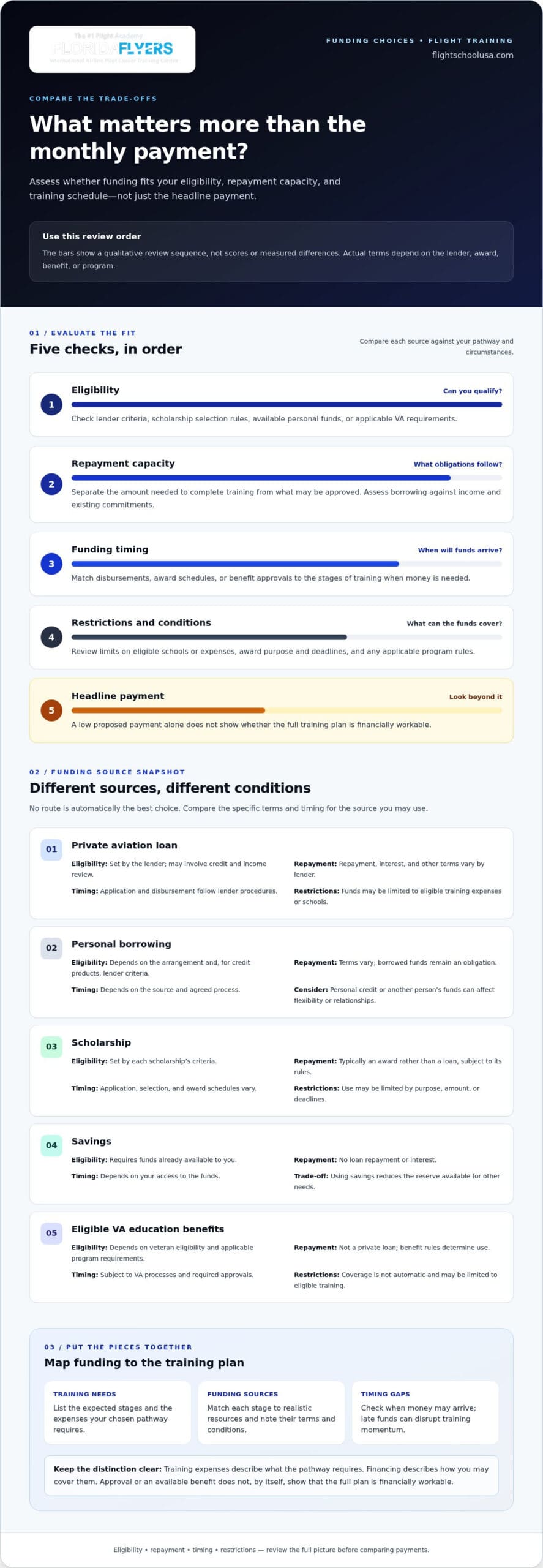
No funding source is automatically the best choice. Compare each route by who qualifies, whether repayment is required, when funds can be used, and what conditions limit their use. The table is a starting point; actual terms depend on the lender, award, benefit, or program involved.
| sous | Kalifikasyon pou | Ranbousman | Distribisyon | Restriksyon yo |
|---|---|---|---|---|
| Private aviation loan | Set by the lender; may involve credit and income review. | Repayment, interest, and other terms vary by lender. | Application and disbursement follow lender procedures. | Funds may be limited to eligible training expenses or schools. |
| Personal borrowing | Depends on the borrowing arrangement and, for credit products, the lender’s criteria. | Terms vary; borrowed funds remain an obligation. | Depends on the source and agreed process. | Using personal credit or another person’s funds can affect financial flexibility or relationships. |
| Bousdetid | Set by each scholarship’s eligibility and selection criteria. | Typically an award rather than a loan, subject to its rules. | Application, selection, and award schedules vary. | Use may be limited by the award’s purpose, amount, or deadlines. |
| Ekonomi | Requires funds already available to you. | No loan repayment or interest. | Available according to your access to the funds. | Using savings reduces the reserve available for other needs. |
| Eligible VA education benefits | Depends on the veteran’s eligibility and applicable program requirements. | Not a private loan; benefit rules determine use. | Subject to VA processes and required approvals. | Coverage is not automatic and may be limited to eligible training. |
Private aviation loans can be designed for flight training, but approval, interest, repayment start dates, and disbursement arrangements are lender-specific. Review the full agreement, including whether funds arrive in stages and what happens if your training schedule changes. A personal loan or other personal borrowing also creates a repayment obligation, even if the source is not aviation-specific.
Savings avoid loan interest and scheduled debt payments, but using them reduces your available financial cushion. Scholarships can reduce the amount you need to borrow, yet eligibility, application deadlines, selection, and permitted uses differ by award. Treat a scholarship as potential funding until you receive confirmation, not as a guaranteed part of your budget.
Eligible veterans can investigate VA education benefits for flight training, but coverage depends on individual eligibility and applicable requirements for the training program. Don’t assume a benefit covers every certificate, rating, or expense. Confirm current VA rules and approved-program details before relying on benefits in a funding plan. The FAA’s FAA Pilot Training Information offers official context on pilot training pathways; it does not determine VA benefit eligibility.
Also don’t assume ordinary federal student aid applies to standalone flight training. Federal aid eligibility depends on the institution and program, so verify current rules rather than building a plan around aid that may not apply. For veteran-focused planning alongside professional instruction, explore Flight School USA flight training pathways.
A lender’s approval amount is not a training budget. The amount you could borrow reflects a lender’s criteria; the amount you need depends on your selected pathway, expected training sequence, and personal financial circumstances. Don’t borrow simply because a larger amount is available. Estimate the funding required for your plan, then assess whether any resulting repayment obligation fits your finances.
Start with a conservative completion plan. Account for income, essential expenses, existing debt, and other commitments. Then consider whether repayments remain manageable if training takes longer than expected or your income changes. Avoid treating a projected aviation job or future earnings as guaranteed. AOPA Flight School Financing offers additional context on financing considerations, but a lender’s documents govern its own terms.
Review the loan agreement and disclosures before accepting funds. Confirm how interest accrues, when repayment begins, the repayment term, any fees, and whether early repayment carries conditions or charges. Then compare the lender’s disbursement schedule with the school’s payment schedule. If funds arrive in stages, identify how each expected payment will be covered and what you would do if timing changes.
Terms vary by lender and loan. Don’t assume a grace period, deferred payments, a particular interest structure, or direct payment to a school unless the documents state it. Keep a written record of the amount you expect to use, the conditions attached, and the repayment date or trigger described in the agreement.
Map your planned milestones before deciding how much to borrow. For example, if you plan a sequence of certificates and ratings, list each stage, its anticipated payment points, and the funding source intended for it. Treat this as a planning exercise, not a promise of a fixed completion date. Weather, scheduling, proficiency, and other factors can change the pace.
Training structure affects how you forecast cash flow. An hourly arrangement ties spending to training activity, so your total funding need may shift as hours and pace change. A fixed-price structure can make the planned program amount more defined, but it does not guarantee lower costs or remove every possible expense. Compare the scope and assumptions of each plan. Use a commercial pilot training costs guide for broader cost-planning context, then apply the figures and terms relevant to your own program.
Decision matrix, planning assumptions: These are comparison prompts, not cost estimates or lender terms.
Use this review to decide what funding commitment is supportable, not merely available. A sound plan leaves room to manage timing changes without treating a best-case schedule as certain.
A disciplined plan separates confirmed resources from assumptions before you commit to borrowing or schedule training. Use these steps to connect your career objective, funding sources, eligibility, and repayment exposure.
Create a worksheet that follows your planned training stages. For each stage, record anticipated payment timing, the funding source intended to cover it, and the source’s status. Label funds as confirmed, estimated, pending, or potential. A scholarship application or loan inquiry is not confirmed funding.
Gather your personal budget, income information, existing debt and other obligations, and training plan. Add a contingency line for schedule changes or other unplanned needs, but set its amount based on your circumstances rather than an assumed standard reserve. This makes funding gaps visible before they affect training decisions.
Benefit rules and lender agreements control. For VA education benefits, consult current official VA requirements and verify how they apply to your eligibility and intended training. For loans, review the disclosures for interest accrual, repayment start, term, fees, and the conditions governing when funds are disbursed. Keep a copy of the applicable documents with your worksheet.
Before applying, check that your records are current and that your budget accounts for existing obligations. Rework the plan if it depends on financing that has not been approved or benefits that have not been confirmed. A funding gap is a reason to reassess the sequence or timing, not to treat uncertain money as available.
Pre-application checklist:
Use this preparation to make a more informed decision about your training pathway. Explore Flight School USA’s professional flight training as you align program structure with your funding plan.
A funding plan is strongest when it follows a defined training objective. Start with the certificates or career direction you’re pursuing, then consider which training pathway aligns with that goal and how you intend to fund each stage. Flight School USA offers the Fixed-Price Career Program, CFI Fast Track Program, and Airline Ready Program. Each is a training program, not a loan, loan approval, or payment plan.
Choose a pathway based on your target certification and professional objective, not on an assumption that a particular program will meet every student’s needs. A structured program can help you map the training sequence and organize funding decisions around its stages. The Fixed-Price Career Program is a training structure; its name does not make it a financing product or determine whether a student qualifies for outside funding.
Compare your objective with the program’s training sequence, then place those stages alongside your funding worksheet. Note which resources are confirmed, which depend on an application or eligibility decision, and when you expect each source to be usable. This keeps your training choice distinct from your financing decision. The airline pilot career training guide provides additional context for understanding a professional pathway.
Bring your training objective and completed funding worksheet into your next planning conversation. Use them to describe the pathway you’re considering, identify the resources you expect to use, and flag unresolved questions about funding timing. A clear plan makes it easier to discuss training structure without treating a possible loan, scholarship, or benefit as guaranteed.
Eligible veterans may also explore GI Bill flight training through Flight School USA. Benefit use depends on the veteran’s eligibility and applicable program requirements. A training pathway does not establish VA eligibility, guarantee coverage, or secure loan approval. Review current requirements before relying on benefits as part of your plan.
Flight School USA’s training programs help you consider how a defined pathway relates to your funding plan. They do not replace lender terms, benefit rules, or an individual review of repayment capacity. Keep those decisions separate, and base each on the relevant documents and requirements.
With those points in hand, explore Flight School USA training pathways.
Turn your funding worksheet into a decision you can defend: identify what’s confirmed, what remains uncertain, and what must be resolved before you commit. Treat the training schedule and repayment plan as connected parts of the same decision. If either changes, revisit the other rather than relying on assumptions.
The right pilot training financing options are the ones that fit your eligibility, training objective, and ability to manage repayment. Flight School USA’s structured programs can help you consider how a training pathway aligns with your plans, while eligible veterans can explore GI Bill flight training subject to applicable requirements. Neither training structure nor a potential benefit replaces careful review of your funding terms.
Bring your goals and funding plan into focus, then take the next step: Explore Flight School USA training pathways. A clear plan gives you a stronger foundation for pursuing the cockpit with purpose.
Yes, some lenders offer private loans intended for aviation or training, but whether a loan can fund your program depends on that lender’s rules. Eligibility, approved programs, interest and repayment terms, and disbursement procedures vary. A private loan differs from federal student aid, which has separate institutional and program requirements. Before borrowing, read the lender’s official disclosures and consider how payments would fit your budget if training takes longer than planned.
Eligible veterans may be able to use VA education benefits for certain flight-training programs, subject to current requirements. Your eligibility and the program’s approval status both matter, so don’t treat potential coverage as guaranteed or assume it applies to every certificate or expense. Verify the applicable VA rules before including benefits in your budget. For more focused veteran planning, consult the GI Bill for CFI Training guide.
FAFSA is an application for federal student aid, not a guarantee that flight training qualifies for funding. Eligibility depends on the institution and program meeting applicable federal requirements. Before counting federal aid toward your training plan, check current Department of Education rules for the specific institution and program. Don’t assume standalone flight training qualifies, or that completing FAFSA alone means a particular training expense will be covered.
Not necessarily. Whether a cosigner is required depends on the lender’s criteria, your credit profile, income, and the loan terms. A cosigner may support an application, but their involvement does not guarantee approval. Before anyone signs, review the agreement to understand whether the cosigner shares legal responsibility for repayment and what that obligation means if payments are missed. Compare the lender’s written criteria with your financial circumstances.
Estimate your funding need by listing each planned training stage, associated payment timing, confirmed resources, and available budget. A school’s current program estimate describes expected training expenses; a lender’s approval limit describes potential borrowing, not what you should borrow. Keep those figures separate. The pilot training financing options you consider should fit a plan you can support. Consult the commercial training costs article for additional cost-planning context.
Possibly, but whether VA benefits can be used alongside other funding depends on current VA rules, program eligibility, and the terms of any private financing. Don’t assume a benefit can be applied to a specific expense or combined with a particular loan. Check the relevant official requirements and loan agreement before making commitments. In your budget, label expected benefits as unconfirmed until you’ve established that they apply to your situation and program.
No. A fixed-price program is a training-pricing structure, not a loan or source of funds. It may help you organize a training budget around a defined program, but it does not establish eligibility for borrowing, confirm VA coverage, or constitute loan approval or a payment plan. Review what the program structure covers when planning your finances. The fixed-price flight-training guide offers further detail without replacing your own funding assessment.


