

A first airline pilot job is usually about a 2½-year path from no flight experience, with reaching 1,500 flight hours a major part of the timeline. In the United States, the Federal Aviation Administration allows a person to earn a commercial pilot certificate at 18, while most airlines require applicants to be at least 21.
The gap between earning a commercial certificate and meeting airline hiring requirements can make the route feel less direct than expected. Your timeline depends on how you build flight time, which qualifications you bring, and how you perform in airline interviews. A university degree isn’t the only factor, and the path has meaningful career advantages as well as serious demands. This guide explains how flight hours, age, education, and interview preparation shape your eligibility, what career progression can look like, and what to weigh before committing to professional flight training. You’ll get a clearer picture of the steps between starting training and pursuing your first airline pilot job.
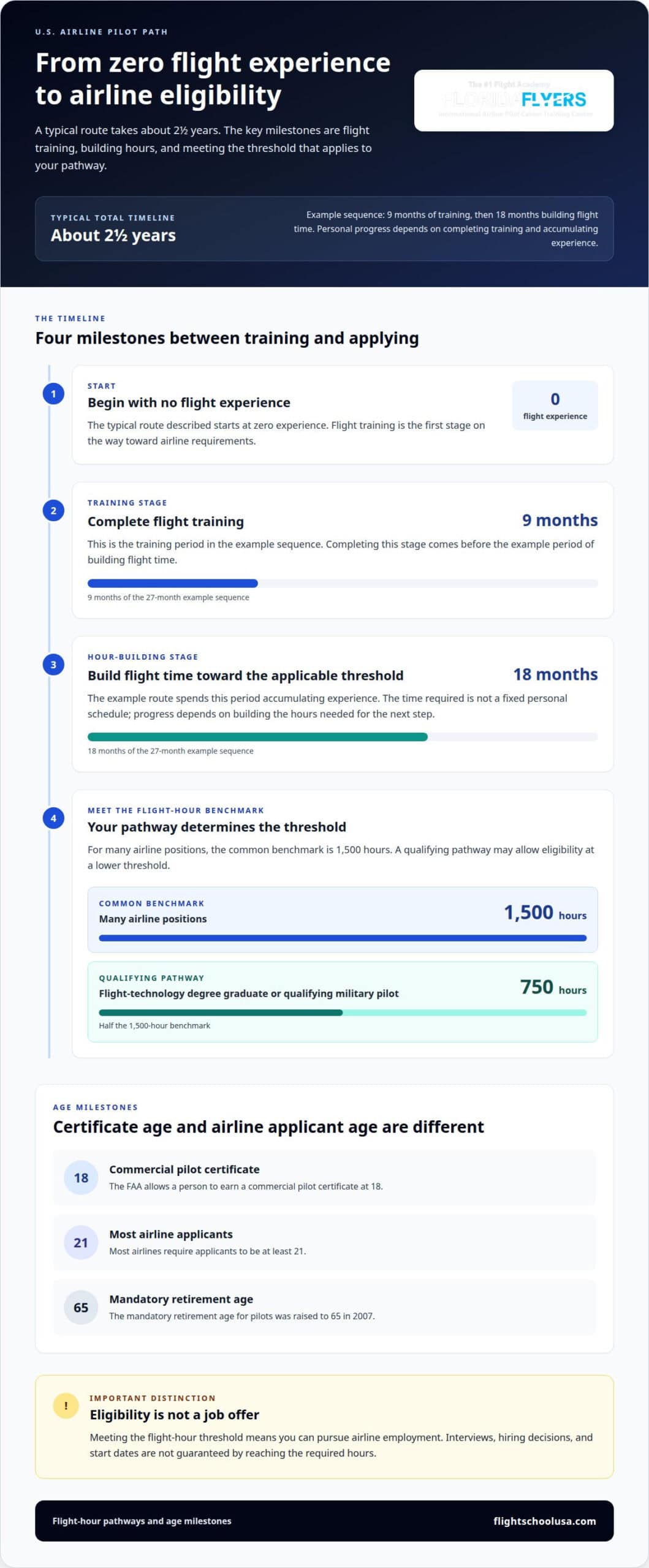
For a U.S. airline cockpit role, flight hours are a central eligibility measure, but the threshold depends on the pilot’s pathway. The common route described for new pilots takes about 2½ years from no previous experience. That timeline combines flight training with the work of accumulating hours toward airline requirements.
For many airline positions, the key benchmark is 1,500 flight hours. A typical sequence described for a new pilot includes nine months of training, followed by 18 months building flight time toward that threshold. These are stages, not a fixed personal schedule: progress depends on completing training and accumulating the experience required for the next step.
A qualifying pathway may use a lower threshold. According to the Federal Aviation Administration, a college graduate with a degree in flight technology or a qualifying military pilot may qualify for an airline at 750 hours rather than 1,500 hours. That distinction can change how much time a pilot must build before pursuing airline employment.
Which U.S. airlines hire pilots with the least experience? No specific airline can be identified as the lowest-threshold employer from these facts. Aspiring first officers may be considered for interviews after building flight experience, but an interview is not the same as an offer or a guaranteed start date.
Historical hiring conditions also matter. During an earlier period, many airlines required 5,000 hours or more before considering pilots for first officer positions. The Colgan Air accident occurred in 2009, after which Congress raised time and certificate requirements for pilots seeking airline careers. Those historical details explain why hiring expectations can shift; they should not be treated as today’s universal threshold.
Consider two pathways. A civilian entrant starts with no flight experience, completes training, then builds hours toward the common 1,500-hour benchmark. A qualifying military pilot or flight-technology graduate may instead meet the 750-hour pathway described by the Federal Aviation Administration. In each case, the situation determines the applicable threshold, the pilot builds the required experience, and the result is eligibility to pursue airline employment, not automatic hiring.
Age also shapes the length of a career. A person can earn a commercial pilot certificate at 18, while most U.S. airlines require applicants to be at least 21. According to the United States Congress, the mandatory retirement age for pilots was raised to 65 in 2007. That career limit is relevant when weighing how long training and hour-building may take.
Airline piloting can offer strong earning potential and a defined professional progression. Senior airline captains can earn around $450,000 annually, and pilots today earn five times more than counterparts did 15 years earlier. Those figures describe senior and comparative earnings, not a new pilot’s starting compensation. They show why long-term potential must be weighed against the demands of reaching and maintaining an airline position.
A new U.S. airline pilot’s starting salary and benefits depend on the employer and position. There’s no single starting figure in the available facts. Compare each written compensation package by its pay structure, benefits, schedule, and progression opportunities rather than using senior-captain earnings as a guide.
Employment stability is another consideration. During past airline hiring cycles, many U.S. pilots spent two to four years on furlough before returning to a flying job, if they returned at all. Hiring has also appeared to move in cycles of about five years during the periods described. In a downturn or period of reduced hiring, pilots may face furlough or a delayed return to work, interrupting income and career progression. This history makes flexibility and realistic financial planning important parts of career preparation.
Regional airline, cargo, and charter roles can each offer a different route into professional flying, with distinct operating demands. A regional airline candidate may prioritize scheduled passenger operations, a cargo applicant may prefer freight flying, and a charter applicant may want varied trips. In each case, compare the specific position’s schedule, base, duties, and advancement path. The goal is to choose a role that builds relevant experience and fits your priorities.
Medical qualification and background screening also affect eligibility. According to the Federal Aviation Administration, civilian professional pilots can qualify for an FAA First Class Medical Certificate with vision corrected to 20/20 using glasses or contacts. Some U.S. airlines conduct FBI background checks covering 10 years as part of pre-employment screening. A candidate’s situation is evaluated against medical and screening criteria; completing those checks supports consideration, but doesn’t replace the employer’s other hiring standards.
Consider a candidate choosing between regional, cargo, and charter opportunities. The candidate identifies preferred duties and schedule, then evaluates each opening against those priorities. The result is a more deliberate first-job choice, rather than selecting solely by employer category. Airline interview preparation can also help candidates understand selection expectations; structured airline career preparation is one way to focus that work.
Starting pay and benefits vary by employer and position. Assess the specific offer rather than using senior-captain earnings as a guide.
A college degree can affect airline eligibility, but its value depends on the degree and pathway. In the United States, the Federal Aviation Administration identifies a flight-technology degree as one qualification connected to a lower-hour route. That doesn’t make every college major equivalent. Distinguish general academic study from a degree specifically tied to flight technology and professional pilot preparation.
This distinction matters when planning training. A degree and a pilot certificate represent different parts of a career profile. A degree provides an academic credential; flight training and experience address the flying qualifications required for airline work. Treating one as a substitute for the other can lead to a poor plan. Identify the degree’s relevance, then map the required pilot qualifications and experience separately.
Consider a student choosing between a general college course and a flight-technology degree. First, identify whether the degree matches the FAA pathway described for flight-technology graduates. Then map the degree plan alongside flight training and hour-building. This creates a clearer route, treating academic study and pilot qualifications as connected but distinct requirements.
A degree can also shape how a candidate explains their preparation. A flight-technology graduate can connect academic study to aviation knowledge and the practical demands of pilot training. That explanation is more useful than relying on the degree title alone. In an airline application or interview, describe specific preparation accurately and show how it supports professional flying. The degree strengthens a profile when its relevance is clear.
Consider a candidate with substantial flight training but no college degree. Don’t assume every airline role requires the same academic background. Separate the employer’s hiring criteria from FAA qualification pathways, then identify which route applies. This avoids treating a degree as either an automatic requirement or a guaranteed advantage. A college credential may support eligibility in a defined pathway, but it doesn’t secure an airline position by itself.
Use a practical sequence: confirm the degree field, map its connection to the relevant FAA pathway, and plan flight qualifications independently. A military pilot follows a different qualification route from a college graduate, so the profiles shouldn’t be treated as interchangeable. A strong plan links education to a specific eligibility route while accounting for training and flying experience. This helps aspiring pilots make informed academic choices without confusing a degree with airline readiness.
Hiring for entry-level U.S. airline pilot jobs is competitive and can shift with hiring cycles. During the periods described, airline hiring appeared to follow cycles of about five years, so opportunity depends partly on timing and employer demand.
Aspiring U.S. first officers may interview after building between 500 and 1,500 total flight hours. That range describes when interviews may occur, not a universal hiring threshold. It also means an applicant should be ready to present qualifications before reaching the highest end of the range.
An interview lets an airline assess more than logged hours. Prepare to explain your training decisions, work through aviation scenarios clearly, and describe how you respond to feedback. Keep examples specific: identify the situation, explain the action you took, and state the result. This structure makes your judgment and communication easier to assess.
Before an interview, organize the details that support your application:
If an interviewer asks about a difficult training experience, describe the situation, explain the corrective action, and share what changed afterward. A focused answer demonstrates reflection rather than blame. Using this approach for different examples helps keep your responses relevant and organized.
A conditional offer depends on completing conditions stated by the airline. It is distinct from an unconditional final employment arrangement. Read the offer carefully, identify each listed condition, and complete the required steps in the order provided. Medical qualification and pre-employment screening are among the factors addressed in airline hiring; the written offer sets out the conditions for that specific position.
Keep each stage distinct: an interview is an assessment, a conditional offer sets requirements, and completing those requirements moves the hiring process forward. For example, a candidate with the required flight experience can interview, receive a conditional offer, and then fulfill its stated conditions. Accurate records and prompt, professional communication help keep each stage clear. Aim for consistency across your application, interview, and follow-through, rather than a rehearsed performance detached from your actual experience.
In the United States, an ATP pathway depends on your qualifications and flight experience. The standard hour benchmark discussed for airline eligibility is 1,500 hours. A qualifying restricted pathway can use a lower threshold, so identify the applicable route before planning your remaining training. Meeting an hour threshold is an important qualification milestone, not a promise of airline employment.
According to the Federal Aviation Administration, a college graduate with a degree in flight technology or a qualifying military pilot may qualify for an airline at 750 hours rather than 1,500 hours. The difference makes eligibility route a key planning decision. A flight-technology graduate and a military pilot should each identify how their background fits the applicable pathway, rather than assuming the same route applies to both.
Use this sequence to organize your ATP or restricted ATP planning:
For example, a flight-technology graduate who has built 750 hours may meet the lower threshold described by the Federal Aviation Administration. The action is to connect the degree and flight experience to that route. The result is eligibility to pursue an airline position under that pathway, not an automatic offer. A pilot without that qualifying background follows the 1,500-hour benchmark described for the standard route.
A qualifying military pilot faces a related but distinct planning decision. The pilot’s situation includes military pilot experience; the action is determining whether that experience falls within the qualifying category. The result may be access to the 750-hour route rather than the 1,500-hour benchmark. The category matters, so the threshold should match the pilot’s actual qualifications.
Keep the distinction clear: ATP and restricted ATP planning concerns the certification pathway, while airline hiring is a separate employment decision. A candidate should align flight-hour accumulation and qualifying background before pursuing the corresponding route. This is especially important when a college degree or military experience changes the applicable threshold. For focused preparation as you plan professional flight training, explore airline pilot training.
Flight School USA’s Airline Ready Program is a career-focused next step for aspiring pilots preparing for commercial aviation. Consider it when you’re ready to connect flight training and qualifications with your airline career goal. The program complements the work of meeting certification and experience requirements while keeping the next stage of career preparation in view.
Your route may differ depending on your starting point and training needs. The Fixed-Price Career Program and CFI Fast Track Program offer additional career-focused pathways, while GI Bill Flight Training supports eligible veterans pursuing flight training. Choose the option that aligns with your circumstances and professional direction.
To take a focused next step toward airline readiness, contact Flight School USA about the Airline Ready Program.
Your first airline pilot job becomes a practical objective when you turn ambition into a personal career plan. Identify your current experience, the qualifications you still need, and the training sequence that fits your circumstances. Set trackable milestones, keep your records organized, and build habits that support professional standards throughout training. A disciplined plan can help you make informed decisions as your experience develops.
Flight School USA offers career-focused options for aspiring pilots, including the Fixed-Price Career Program, CFI Fast Track Program, and GI Bill Flight Training. The right next step depends on your background and goals. Contact Flight School USA to discuss how its flight training options may fit the professional path you want to pursue.
Cuntattate a Scola di Volu di i Stati Uniti to discuss your next step. With a clear plan and consistent preparation, you can move toward your aviation career with purpose.
Starting with no previous experience, a common U.S. route takes about 2½ years. This path combines initial flight training with the later work of building experience for airline eligibility. For example, someone beginning flight training must progress through instruction before accumulating additional flying time. Treat the timeline as a planning framework: training progress and hour-building are separate stages on the way to airline applications.
A pilot’s workday generally involves preparation, flight duties, and post-flight tasks. Before departure, pilots review flight information, coordinate with the other crewmember, and complete required aircraft preparations. During a flight, they monitor aircraft systems and communicate with relevant personnel. After landing, they complete applicable records and prepare for the next assigned duty. On a multi-leg day, they repeat preparation and post-flight routines for each flight.
The common U.S. benchmark is 1,500 flight hours, while a qualifying route may allow eligibility at 750 hours. The lower threshold applies to a college graduate with a flight-technology degree or a qualifying military pilot, according to the Federal Aviation Administration. For example, a candidate should identify which pathway matches their background before planning hour-building. Meeting a threshold supports eligibility, but does not itself constitute an airline job offer.
A typical path starts with flight training, continues through the certificates and experience needed for professional flying, then moves to airline applications and interviews. Candidates may pursue instructor work while building experience, depending on their route. For example, a pilot can complete training, accumulate qualifying flight time, prepare application materials, and interview for a first officer role. Keep certification, experience records, and interview preparation aligned as distinct steps toward employment.
No specific U.S. airline is identified as having the lowest experience threshold. Aspiring first officers may interview after building between 500 and 1,500 total flight hours, but an interview is not an offer.


